


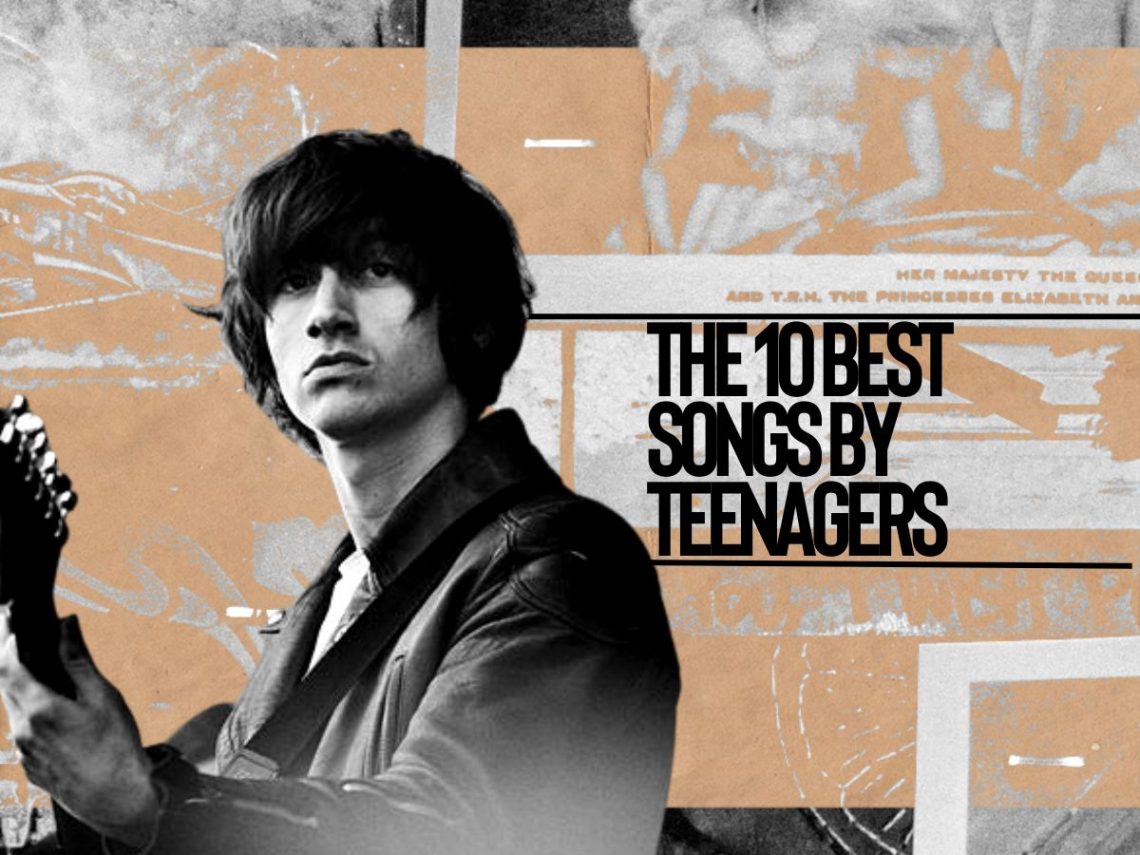
The Children of the Revolution: The 10 greatest songs ever written by teenagers

When Yukio Mishima was pondering what he opined to be the “beautiful death of James Dean,” he wrote: “Greek mythology tells of how Achilles was forced to choose between a long life void of glory and a glorious young death. Without flinching, he chose the latter. Surely all but the most prosaic of men, if given the choice at the start of life, would do the same.” While this is certainly not a notion that anyone should support, there is, indeed, a sense of seizing triumph in youth that dwindles with the wrinkles of time. Or perhaps it is the dawning reality that conquests don’t come so easily once your stockpile of green enthusiasm is chipped away at by the hammer of hard knocks and the come-hither of safe, cushioning comforts. Youth culture is borne from this proposition.
Mishima argues that “each of us secretly hopes that our life story will be immortalized in song—or, for Alexander the Great, in stone. Per his decree, all statues were to be made only in the likeness of his 21-old self.” It seems strange that as adulthood approaches, we do seem to prematurely wrestle with the presentiment of crafting a handsome legacy. Maybe this a hangover from days when our lifespans were perilous, but the upshot of this fateful oddity of adolescence is that it has prompted a slew of young stars to grab life by the horns and ride the bull towards roaring glory.
Youth movements underpin our culture. You could even argue the rule of thumb that nothing truly momentous has ever been saddled with a mortgage. When you look at the rise of pop culture, the pivotal steps have all been propagated by pockmarked teenagers or those in their early 20s. Bob Dylan was 21 when he changed the world with The Freewheelin’ Bob Dylan. The Beatles were considered elder statesmen of the scene when they cracked stereo sound with Sgt. Peppers before hitting the second half of their 20s. And the bulk of N.W.A were only 23 when they added a pointed impetus to the hip hop movement in 1988.
This air of vitality shines through on the masterpieces crafted by the younger generation in the list below. Each of the songs that we have assorted are brimming with juvenile enthusiasm in one way or another. Some of them will have you questioning your own daft teenage existence as these proteges were grappling with existentialism in waxing verse while you were busy trying to scrape together loose change to experiment with dropping Mentos into fizzy pop to laugh your cap off at the resultant foam explosion or kick about in the same corner of your favourite field that you, for some unknown reason, never ventured beyond.
The 10 greatest songs ever written by teenagers:
‘I Bet You Look Good on the Dancefloor’ – Arctic Monkeys
I have always firmly held the belief that kid’s movies should have a star rating submitted by a child—Trolls wasn’t made for the same guy who gave Andrei Tarkovsky’s Stalker five stars in an essay on obsolescence, it’s simply a different audience. Fortunately, Alex Turner and the Arctic Monkeys knew exactly what the kids needed to spark the latest saga in rock ‘n’ roll’s unending revival story—he would, he was one after all. And his frenzied pastiche of drunken youth culture is dripping with the greasy miasma of lived-in authenticity that only an 18-year-old could muster.
Like every former 18-year-old would, he has since tried to distance himself from his old schoolbook poetry and labelled the classic “a bit shit”. However, he needn’t worry, he wasn’t tarred with the same artistic teen regrets that many of us face. The track is truly accomplished. It takes a singular sort of character to pair the aura of treble vodkas with references to Shakespeare and Duran Duran in the same breath, and this epic anthem remains a paradigm of his punny individualism to this day. It is truly the zenith of dancefloor indie, fittingly foiled from the pen of a voyeur whose feet seemed to be stuck to the carpet just slightly to the leftfield of the ‘scene’.
‘These Days’ – Jackson Browne
The official story goes that Jackson Browne wrote this song when he was merely 16-years-old. However, the stirring welter of experiential wisdom and world-weariness contained within this ethereal remembrance of things past points towards one single pet theory: it was actually written by one of his parents in the manner of a guardian helping their child out with some homework. Clearly, this lovelorn carer was going through some emotional turmoil and extolled their troubles in the catharsis of a musical sigh.
This is the best that we can hope for because, ultimately, the knowledge that lines like ‘These days I seem to think a lot about the things that I forgot to do’ came from a child of 16 is a sore reality that hamstrings the sincerity of the song. Somehow, we are supposed to believe that this anthem for disenfranchised former libertines relates to some kid kicking dust up on the swings after a three-week relationship ended in some playground tiff? Nope, I’m not having it. Even Charlie Brown wasn’t wise enough for this level of wrinkled sagacity; this simply has to be the mournful exhale of a romantic-in-recovery tending to some geraniums and wheeling through the years once more.
‘Hometown Glory’ – Adele
It’s a universal truth rarely recognised that we all direct little movies in our mind when our world’s are suddenly wrapped up in headphones. This make-believe cinematic stroll of a city embroiled in New Wave drizzle is usually some very uneventful, but wonderfully poetic scene. It is this essence that Adele captured perfectly at the tender age of 16 with ‘Howetown Glory’—a masterpiece that she remarkably calls “the first song I ever wrote from start to finish.”
“It was kind of about me and my mum not agreeing on where I should go to university. Because, though at first, I’d wanted to go to Liverpool, later I changed my mind and wanted to go to university in London. But, because I love being at home and I’m really dependent on my mum, she still wanted me to go to Liverpool,” Adele explained. “So, in that way it was a kind of protest song about cherishing the memories — whether good or bad — of your hometown.”
‘My Cherie Amour’ – Stevie Wonder
There is a Ludacris theory out there that Stevie Wonder is not actually blind, and while I would never accept that troublesome assertion, I would happily get tin-foil hat with someone if they were to posit that he was actually born before 1950. I see no other way to explain away the mammoth talents he displayed as he became the youngest person to top the charts at 13. Thereafter, he would also go on to be old beyond his years in moral battles against Motown as he risked his fledgling career to throw his weight behind the Civil Rights movement and ditched Berry Gordy’s strictly apolitical label.
However, during his Motown years, the nurturing influence of some of the era’s finest songwriters certainly shines through. Alongside Sylvia Moy and Henry Cosby, he crafted a love song sealed with the kiss of honed Detroit soul perfection. The initial kernel of the song comes from a 1966 track that Wonder wrote in honour of his girlfriend in less than an hour. It was then run through the in-vogue filter of a French feel, polished up with the help of his colleagues, and now it sits as one of the catchiest pieces of head-over-heals sincerity ever jubilantly pressed onto the enlightened bulk of vinyl.
‘Wuthering Heights’ – Kate Bush
Sometimes the greenness of teenage naivety is essential in shifting the course of history. Any savvy songwriter in their 20s would’ve known that to come out wailing in a whirl of flowery mysticism at the height of the snarling uproar of punk was sure to be a juxtaposed misfire. The critics proved them right, when Kate Bush arrived with her literary anthem, ‘Wuthering Heights’, that she wrote as an 18-year-old, the Guardian called her an “odd combo of artiness and artlessness,” and the NME said “[Kate Bush] has all the unpleasant aspects of David Bowie in the Mainman era.”
However, while she might have defied the style of the zeitgeist, she remained true to herself and that shone through like an inspiring assegai of cheery sunshine. After all, wasn’t punk all about the expression of individualism anyway? Bush’s considerable talents might have separated her from the snarling side of this movement, but being expresssive is a tenet that her music upheld to the nth degree, and it still proves invigorating to this day.
‘Green Onions’ – Booker T. & the M.G.’s
‘Green Onions’ was not only produced by the 18-year-old Booker T. Jones on the fly, but he also created it almost by accident. Along with the House Band at Stax Records, Booker T. Jones sat behind the Hammond organ and while they waited for a waylaid Billy Lee Riley, they jammed out a daft practice and ended up creating a sound that helped to define the era.
The band figured they had crafted a creditable B-side for ‘Behave Yourself’ but nothing more. As it happens, they had actually tapped into the buzzy sound that defibrillated the counterculture movement. It was an adrenalising hum that proved infectious and suddenly the Hammond organ was popping up everywhere. Nevertheless, you’d be hard-pushed to say that its deployment was ever better than this accidental magic. As the Ram Dass’ of the dancefloor Deee-Lite once asserted, sometimes groove really is in the heart.
‘Gloria’ – Them
At 18-years-old, Van Morrison was the young songwriting frontman at the helm of Them. He was an introverted and retiring kid. Music proved to be an invaluable outlet for him. That sense of breaking away from the shackles of shyness roars out like a growl in the proto-punk blitzkrieg of ‘Gloria’.
He wrote the song in the summer of 1963 when rock ‘n’ roll was just getting swinging. In retrospect, it is a song that bears the hallmarks of a lot of the music that lay ahead. This is no hand-holding tale of radio-friendly pleasantry, it’s a sultry snarl of adolescent lust delivered with the bold effrontery that had conservatives calling it the devil’s music. Well, Lord knows there’s some twisted soul in this trailblazing ditty.
‘Hand in Glove’ – The Smiths
The beauty of The Smiths is tied up in the spiritual dichotomy of its constitution. The creative spearheads of the band, Morrissey and Johnny Marr come from different sides of the tracks. When they first got going, Morrissey was heading towards his mid-20s with a weary apathy already kicking in. This was eventually extolled on their anthems as sardonic prose—a dramatic halfway house somewhere between the Byronic romanticism of youth and the jaded cynicism of a lost soul at odds with the world.
Marr, however, was a buoyant 19-year-old – four and a half years younger than Morrissey – and he wanted to set the world to rights by upending the stilted synth sedation of the era with a salvo of spiritual guitar playing. So, when he cracked the riff to ‘Hand in Glove’, he raced straight over to Morrissey’s house with a little cassette and showed him his working. When they got round to recording it officially, that same collision of sonic enthusiasm and the temperance of Morrissey’s scornful wit is a force to behold.
‘Alright’ – Supergrass
When ‘Alright’ was released in 1995, Gaz Coombes had only just turned 19. Nevertheless, with the rousing record he was credited as having put his finger on the ephemerality of our younger days and how essential it is to seize them—it had 20-somethings flocking back to the local indie clubs in a heartbeat.
Ironically, young Coombes was actually looking back at his own tender days. “It wasn’t written as an anthem,” he explained. “It isn’t supposed to be a rally cry for our generation. The stuff about ‘We are young/We run green…’ isn’t about being 19, but really 13 or 14. and just discovering girls and drinking.” And that, in short, is the beauty of it. The reason it is so effective pertains to the fact that it is untouched by any air of caution. It bundles along at a roaring pace that only comes with the prelapsarian certitude of youth. The mortgaged miles of adulthood are still a few towns to the right away.
‘Hound Dog’ – Jerry Leiber & Mike Stroller
The roadmap of rock ‘n’ roll is a mystic one shrouded in fog, but ‘Hound Dog’ is undoubtedly a pivotal cats-eye on its journey that glows with more purpose than most. It is a solid dose of swagger and attitude and not much more. That’s not to say that it lacks substance, just that it walloped a new kind of charisma to the forefront of music.
Thus, it seems fitting that it was inspired by a blues star of old. Jerry Leiber and Mike Stroller were only 19-years-old when the prowess of Big Mama Thornton slapped their respective chops. “When we saw Big Mama, she knocked me cold. She looked like the worst, biggest, saltiest chick you would ever see,” Leiber said. So, he raced back to Stroller’s apartment and the pair – filled with the awestruck adrenaline of this new rocking music – rattled off ‘Hound Dog’ in 15 minutes flat.
