


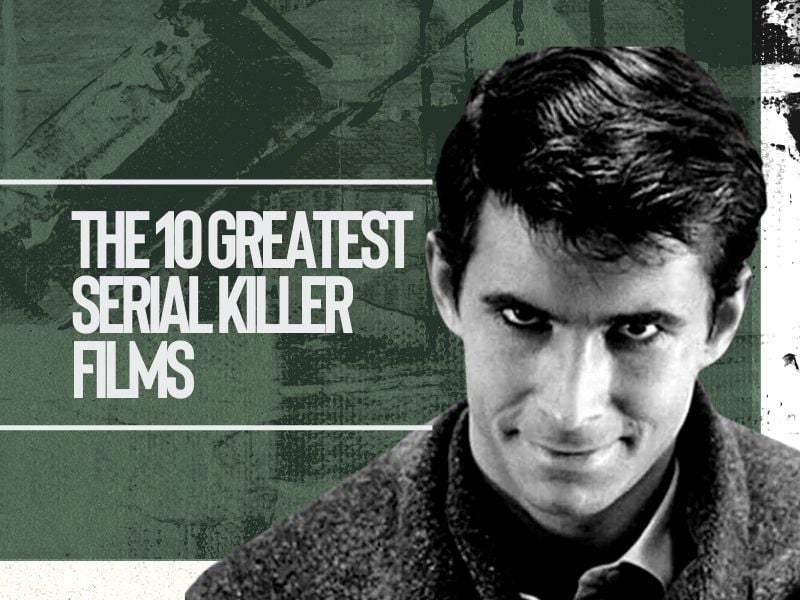
The 10 greatest serial killer films of all time

In popular culture, projects exploring the psychology and the activities of serial killers have gained a lot of prominence. From YouTube analyses to podcasts dedicated to true crime cases, a very large audience has been established for anything even remotely related to serial killers and their dangerous psychological conditionings.
While films have always focused on cinematic visions of serial killers that are larger than life, these depictions are very revealing when it comes to the repressed fantasies and inherent violence that permeates society.
For this list, we have included some of the most well-known explorations of the subject as well as other gems that contextualise the symbol of serial killers within larger frameworks of systemic issues. If you’re looking for something that extends beyond the stale discourse of true crime, this is the perfect place to start.
10 greatest serial killer films:
10. No Country for Old Men (Coen brothers, 2007)
One of the crowning achievements of the Coen brothers’ illustrious filmography, No Country for Old Men creates a violently surreal tale of crime and bloodshed set in the barren wastelands of West Texas which acts as the physical manifestation of the moral landscape.
Javier Bardem delivers the performance of his lifetime as Anton Chigurh – a strange assassin whose skills and approach to his craft are simply unnerving. In fact, Bardem’s character was even voted as the “most realistic psychopath ever”.
9. Psycho (Alfred Hitchcock, 1960)
Probably one of the most instantly recognisable serial killer films ever made, Alfred Hitchcock’s Psycho still inspires new directors to this day. A masterclass in psychological horror, the film contains the most famous psychopath in film history.
Anthony Perkins plays the role of Norman Bates, an introverted employee at a motel in the middle of nowhere whose psyche has simply split into two which enables him to transform into a serial killer without actually processing the consequences of his actions.
8. Eyes Without a Face (Georges Franju, 1960)
A seminal French horror film by Georges Franju, Eyes Without a Face is a very innovative work that does not confine itself to the stereotypical clichés of the genre and manages to engage in commentary about philosophical and social issues.
Exploring patriarchal concerns, it revolves around the obsessive experiments of a plastic surgeon who harms young women by forcibly attempting to graft their faces onto the damaged face of his own daughter who is a survivor of a brutal accident.
7. Henry: Portrait of a Serial Killer (John McNaughton, 1986)
Regarded as one of the most realistic depictions of the life of a serial killer, John McNaughton’s 1986 film is a vivid psychological portrait of the titular character who travels all over the country and engages in random murder sprees at will.
While the film received a mixed reception at the time of its release and was subjected to censorship, Henry: Portrait of a Serial Killer has only grown in stature in the years that have followed and is now considered to be one of the great cult classics of the ’80s.
6. M (Fritz Lang, 1931)
A sublime masterpiece by the legendary auteur Fritz Lang, M is not only notable for being Lang’s first sound film but it also contains several precursors that would become omnipresent in works dedicated to the subject of serial killers.
It stars Peter Lorre as the iconic Hans Beckert, a serial killer who is specifically interested in murdering children. A reflection of the prevalent socio-cultural attitudes at the time, M is now recognised as one of the finest films Lang ever made.
5. Kind Hearts and Coronets (Robert Hamer, 1949)
A truly masterful British black comedy that delivers a scathing indictment of social hegemonies and the monarchy, Kind Hearts and Coronets tells the story of a boy who struggles to climb the ranks after his aristocratic mother is disowned by her family.
In order to make sure that he does not die in poverty like his mother, he grows up and hatches a plan to regain his nobility by slowly and methodically eliminating each and every aristocrat that stands in between him and the royal title.
4. Vengeance is Mine (Shôhei Imamura, 1979)
An adaptation of the eponymous novel by Ryūzō Saki, Vengeance is Mine is actually based on a real killer named Akira Nishiguchi who tricked people by subjecting them to scams and then utilised the opportunity to brutally murder them.
Compared by Roger Ebert to Dostoevsky’s magnum opus Crime and Punishment, Shôhei Imamura’s 1979 film isn’t just a chronicle of the activities of a criminal. It is also a revelatory vision that paints a complete picture of a corrupt society.
3. Memories of Murder (Bong Joon-ho, 2003)
Bong Joon-ho might have received global attention after his 2019 Parasite but it is this 2013 crime thriller that is the greatest cinematic achievement of his illustrious career so far. Very crime films can be as engaging and profound at the same time.
Partially based on the reports of the serial murders that shocked the country during the 1980s and the ’90s, Memories of Murder is a clinical exploration of a social climate that is completely destabilised by the ominous but unidentifiable presence of a psychopath.
2. Peeping Tom (Michael Powell, 1960)
Peeping Tom – the film that ruined Michael Powell’s career – also happens to be one of the finest cinematic achievements of the 20th century. An unprecedented commentary on the dangerous voyeurism of cinephilia, it features one of the most memorable fictional serial killers.
Mark Lewis – a man who works on film sets and is brilliant with the camera has a secret obsession: he loves capturing the facial expressions of women just before he brutally murders them. Overshadowed by Psycho when it first came out, Peeping Tom is now rightfully recognised as a masterpiece.
1. Man Bites Dog (Rémy Belvaux, André Bonzel and Benoît Poelvoorde, 1992)
Man Bites Dog is the most striking and original film about serial killers ever made, structured as a mockumentary where the crew follows a serial killer who engages in one atrocity after another without any remorse while simultaneously befriending the crew.
It is a fantastic critique of society’s obsession with criminals and violent crimes, taking the widespread love for true crime to its logical conclusion and making us all complicit. If you can’t stop consuming videos and podcasts about true crime, this might be the film to help you snap out of it.
