


The 10 greatest occultist movies

Before we discuss ten of the greatest occultist movies of all time, let’s go back to the textbooks. What’s the difference between ‘cult’ and ‘occultist’, we hear you ask? Well, where ‘cult’ refers to religious or philosophical devotion towards one particular earthly object or person, the word ‘occult’ refers to something very different, generally being used to describe secretive, spiritual practices such as Satanism, witchcraft and dark magic.
Such practices are often complex and esoteric, making them the perfect subjects for horror movies in which the viewer is flung into a foreign world and tasked with making sense of the terror around them. British folk horror throughout the mid-20th century was particularly impressive at translating this fear, with the ‘Unholy Trinity’, consisting of 1968’s Witchfinder General, 1971’s The Blood on Satan’s Claw, and 1973’s The Wicker Man, providing the foundations for the modern genre.
Whilst occult movies existed long before the 1970s, with Benjamin Christensen’s 1922 horror Häxan being one of cinema’s earliest examples, such films flourished in the late 20th century when horror enjoyed a liberating boom. Films such as Richard Donner’s The Omen and William Friedkin’s The Exorcist saw great success in 1973 and 1976, respectively, whilst, in the coming decades, John Carpenter’s Prince of Darkness and the indie sensation The Blair Witch Project attracted even more attention to the horror sub-genre.
Whilst each aforementioned film holds a special place in the history of occult cinema, not all of them were significant enough to make it onto our list of the ten greatest occultist movies of all time. Spanning almost a century of cinema, take a look at our definitive list below.
The 10 greatest occultist movies:
10. We’re All Going to the World’s Fair (Jane Schoenbrun, 2021)
Even though witches, ouija boards and cloaked satanic figures may be the first thing that comes to your mind when you think of the occult, filmmaker Jane Schoenbrun asked what such spiritual wonders might look like in the age of contemporary technology. Part horror film, part psychological drama, We’re All Going to the World’s Fair is an eerie movie that speaks to the loneliness of the modern digital world and the potential ethereal dangers that exist online.
A simple film that largely revolves around Anna Cobb’s fantastic central performance as Casey, the girl who becomes engulfed by an online role-playing game, Schoenbrun’s debut is a masterful piece of occult filmmaking.
9. Hereditary (Ari Aster, 2018)
From one contemporary horror movie to another, Ari Aster’s iconic 2018 film Hereditary became a critical and cultural hit upon its release and continues to terrify audiences to this very day. Working on several different levels, at its heart, Aster’s film questions the mental illnesses that linger in one’s family history, relating this to the physical occult practices that have been performed by communities for generations.
It’s not until later in the film that you truly discover the extent of Hereditary’s occult roots, and by the time such scenes arrive, the terror has already gripped you to your seat, creating a riveting ride.
8. Twin Peaks: Fire Walk With Me (David Lynch, 1992)
David Lynch’s iconic TV series Twin Peaks, and its subsequent follow-up film, Fire Walk With Me from 1992, might not seem like obvious occult stories, but look closer, and the series bares its mystical truths. Indeed, Lynch’s series troubles itself with the metaphysical occult of peculiar realities, dreamworlds and supernatural occurrences that spill into everyday life, with Fire Walk With Me being a prequel to the series that explores the origins of the evil that killed Laura Palmer.
Lynch’s film wasn’t considered that commercially marketable, but die-hard fans still appreciate the film for its unflinching approach towards how evil can be created and fostered by ethereal forces of reality.
7. The Witch (Robert Eggers, 2015)
Some of the entries on our list so far haven’t been obviously linked to the occult, but Robert Eggers’ tremendous 2015 debut, The Witch, is a far more straightforward interpretation of the practice of dark magic. Set in the 17th century, the film follows a family in New England whose life is destroyed by the presence of witchcraft that lurks in the dark forest and threatens to lure daughter Thomasin (Anya Taylor-Joy).
A masterpiece of mood, Eggers’ movie simmers with constant tension, creating an intense horror film that refuses to abide by genre conventions. Moving away from cliché, its presentation of the occult feels terrifyingly authentic.
6. Belladonna of Sadness (Eiichi Yamamoto, 1973)
Recognised as one of the most psychedelic movies of all time, Eiichi Yamamoto’s Belladonna of Sadness is also staggeringly beautiful, being constructed mostly using still paintings. Based on the book Satanism and Witchcraft by Jules Michelet, the story follows Jeanne, a young peasant who makes a deal with the devil after being raped to gain mystical powers in order to overthrow the patriarchy.
Brought to life in stunning animation, Belladonna of Sadness is unlike any other film in the space of occult cinema, taking the audience into a dream world where the idea of witchcraft existing feels entirely plausible.
5. Suspiria (Dario Argento, 1977)
The 2018 remake of Dario Argento’s Giallo classic Suspiria, directed by Luca Guadagnino, doesn’t get the love it deserves, that’s why we’ve prefaced this entry with a tiny slice of praise. Still, nothing quite compares to the terror and colourful punch of the 1977 original, which tells the story of a newcomer to a German ballet school who comes to discover that not everything is as it seems.
An eerie and unsettling piece of horror, Suspiria is an incredible occult movie that digs beneath the skin of why such practices are so terrifying, mysterious and ethereally elegant.
4. Rosemary’s Baby (Roman Polanski, 1968)
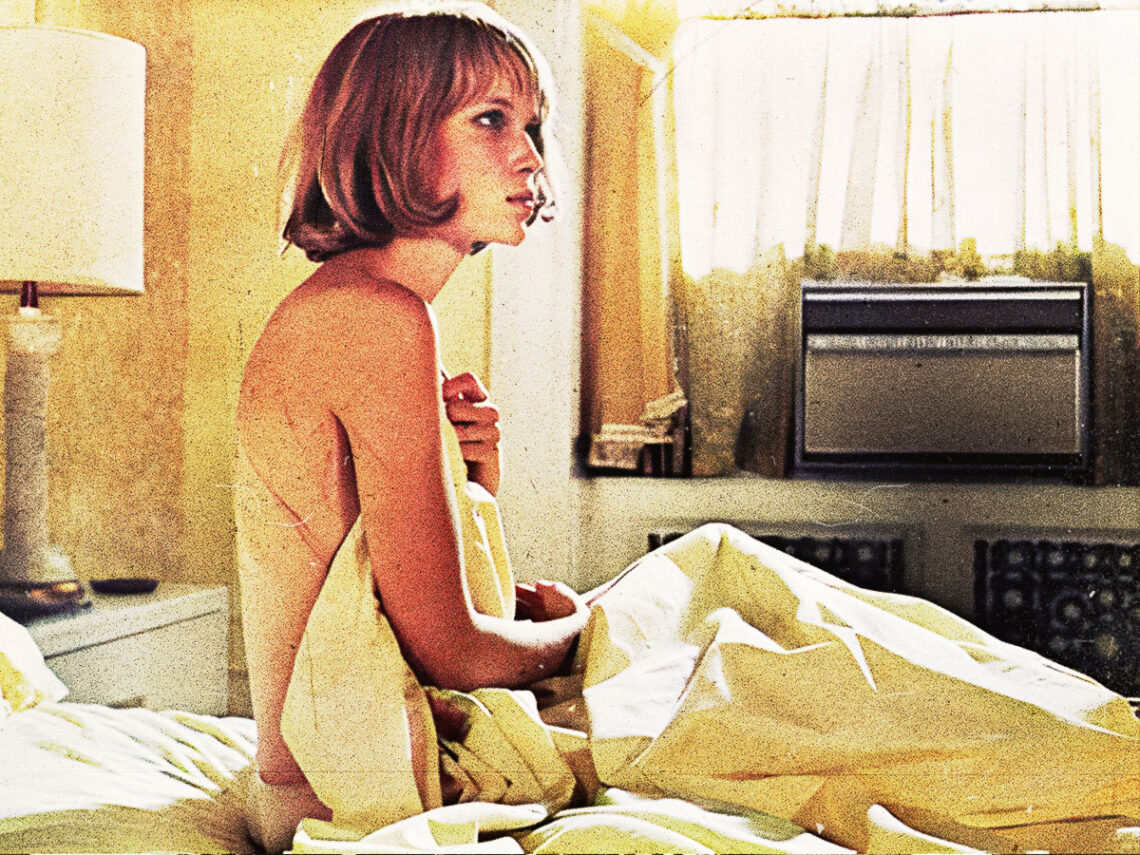
French-Polish director Roman Polanski may be something of a disgusting character, but he has made a number of movies which are inextricably linked with iconic occult cinema. His very best is the 1968 movie Rosemary’s Baby, a story which follows a man (John Cassavetes) and his pregnant wife (Mia Farrow) who move into an apartment where things seem disturbingly off-kilter.
As the film progresses, it becomes clear that something evil and mystical is residing in the building and preying on the unborn child of the protagonist, with Polanski’s screenplay helping to form a visceral and brutal cinematic experience.
3. Eyes Wide Shut (Stanley Kubrick, 1999)
Many of the entries on this list belong to the horror genre, but a film doesn’t have to be terrifying when concerning itself with the occult. The final movie from Stanley Kubrick, 1999’s Eyes Wide Shut, tells the story of a doctor from Manhattan who heads out on a surreal odyssey through the city after his wife admits sexual unfulfillment. His travels take him to a strange group of masked individuals who trade enigmatic language and bother themselves with sexual activities.
What becomes clear as the film goes on is that the doctor (played by Tom Cruise) is actually walking around a physical version of his subconscious that teems like strange fantasies and sexual wonder. It’s a complex, metaphysical exploration.
2. Vampyr (Carl Theodor Dreyer, 1932)
Many of the occultist movies we’ve discussed so far were released in the late 20th century and beyond, but for our number two pick, we’re going right back to the infancy of international cinema. Carl Theodor Dreyer’s 1932 film Vampyr remains one of the most influential movies of its kind, with the early vampire movie being based on the supernatural short stories of Sheridan Le Fanu from the collection In a Glass Darkly. It all follows a young man who is obsessed with the supernatural occult but who goes a little too far in his exploration, mistakenly falling under the spell of a dangerous entity.
Capturing an eerie feel that shares similarities to F. W. Murnau’s Nosferatu, Dreyer’s Vampyr is a terrifying monochrome masterpiece that oozes style and authenticity.
1. The Wicker Man (Robin Hardy, 1973)
We mentioned just how influential the ‘Unholy Trinity’ of British occultist movies was to the genre in the opening of this article, and none of the three films was as hard-hitting and as proficiently well-made as Robin Hardy’s The Wicker Man. Telling the story of a devoutly Christian police officer who travels to a remote Scottish island to investigate the mysterious disappearance of a young girl, Hardy’s film is a deeply haunting tale.
As he explores the island, the officer finds out that the community is a tight-knit group of peculiar pagans with some rather ancient practices. A powerless victim to the residents, Sergeant Howie (Edward Woodward) is the punchline to their games, with Hardy placing the viewer at his right hand as if they, too, were ignorant and helpless to the community. In this classic of British horror, the ever-modernising world meets the ancient rules of pagan worship to make for a terrifying concoction.
