


From Godzilla to King Kong: The 10 greatest movie monsters

“Do what you haven’t done is the key, I think.” – Ridley Scott
Cinema has the power to make viewers gasp in complete wonder as well as scream out in horror at the images it presents. Monster films have often managed to induce both, creating memorable characters who have haunted the nightmares of children and adults alike. With Godzilla vs Kong coming out soon, we revisit some of the iconic movie monsters that have defined the genre.
In an interview, horror pioneer Ridley Scott once said: “You don’t show the monster too many times because you’ll get used to him and you never want to get used to him — ever. That’s always been my thesis. The best screening room in the world is the space between your ears, which is your brain. So, it’s learning to tap into the human brain to show just so much. Let the brain do a lot of the work. That’s where you start to tap into people’s anxieties.”
He added, “I think Alien captured our most primordial fears. It’s particularly special because it’s not gilded with any characterisation other than what you see is what you get — minute by minute with these people. That’s really why a lot of people were scared to death. It’s because they are living in it, minute by minute, and eventually, second by second.”
As a celebration of the magical moments of horror that cinema has offered us, we take a look at 10 of the most iconic movie monsters ever created.
The 10 most iconic movie monsters of all time:
Godzilla
An instantly recognisable and immortal creation, Godzilla is a gargantuan sea monster that existed during the prehistoric era and was awakened from its slumber by nuclear radiation. Godzilla first appeared in the eponymous 1954 Japanese film and has become an icon of popular culture since then, featuring in several remakes, video games, TV shows as well as literature.
Godzilla was initially conceived as a metaphor for the horrors of nuclear weapons, following the Hiroshima-Nagasaki bombings and the Lucky Dragon 5 incident. In later revisions, Godzilla’s legacy has been complicated because it has been seen defending humanity from greater threats. Despite that, Godzilla remains a shocking reminder of the human condition’s helplessness when confronted with nature’s power.
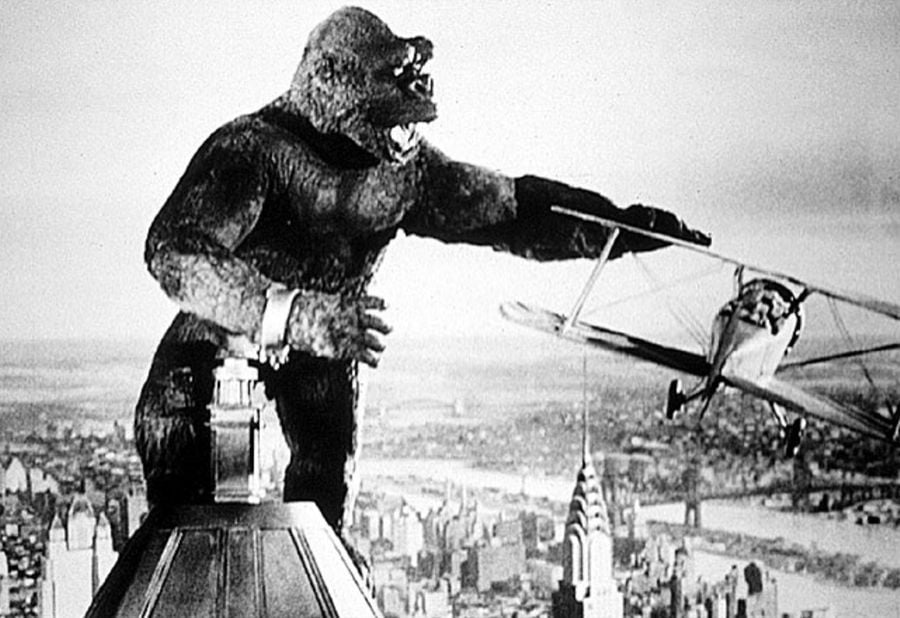
King Kong
Often called the “eighth wonder of the world”, King Kong is a giant gorilla that has remained in the mainstream consciousness since its first appearance in 1933. Over the years, sequels and remakes have examined King Kong’s identity in different ways – ranging from a relentless monster to a tragic antihero.
Created by Edgar Wallace and Merian C. Cooper, King Kong’s legacy is a problematic one. Critics have dismissed the creation as a perpetration of racist and colonialist values, insisting that the foundation of King Kong’s myth is built with prejudice. However, the legendary gorilla is still immensely popular and is soon going to feature in the upcoming film Godzilla vs. Kong.
Xenomorph
More popularly known as the Alien, Swiss surrealist H. R. Giger’s terrifying creation was first seen in Ridley Scott’s 1979 masterpiece Alien and has appeared in subsequent sequels and spin-offs. Lacking the technological modernity of other depictions of extraterrestrial life, the Aliens are primal creatures who act on their violent evolutionary instincts.
A nightmarish entity, the Alien has acid blood coursing through its body and a genuinely scary face that was first constructed by Italian special effects designer Carlo Rambaldi. Many have perceived Giger’s design for the character as an intersection of life and death that subverts our conventional understanding of the universe.
The Fly
Counted among the best body horror films of all time, David Cronenberg’s 1986 magnum opus presents the unique case of a scientist Seth Brundle (played by Jeff Goldblum) who turns into a half-insect, half-man creature due to mutation. Loosely based on the eponymous 1957 short story by George Langelaan and the 1958 film, Cronenberg translates a Kafkaesque nightmare to the cinematic medium.
Also known as the Brundlefly, Brundle becomes a vicious monster with superhuman physical attributes and powerful animalistic instincts. The Fly ended up winning the Academy Award for Best Makeup, thanks to the pioneering efforts of Chris Walas and Stephan Dupuis.
Frankenstein’s Monster
Mary Shelley’s brilliant 1818 novel Frankenstein has been seen as a seminal examination of science fiction, the human condition and Faustian ambitions. In Shelley’s immortal story, she chronicled the story of a scientist who constructs a hideous individual out of body parts of dead humans.
Since the early days of cinema, countless filmmakers have tried to tell Frankenstein’s monster’s peculiar story but James Whale’s works on the subject have emerged as the definitive depictions. Frankenstein’s monster is a deeply tragic figure, constantly trying to figure out its identity in a hostile world. In doing so, he appears less monstrous than the humans who antagonise him.
The Thing
John Carpenter’s undoubted magnum opus, The Thing is an iconic sci-fi thriller about an alien entity that has the terrifying capacity to assimilate living beings. Despite being regarded as a critical and commercial failure at the time of its release, the film has become a cult classic. In a 2001 interview, Carpenter reflected, “Had it worked, my career would have been very different. Very different.”
What makes The Thing so memorable? Well, it is a shape-shifting alien parasite that can incorporate the DNA of its victims. Rob Bottin’s masterful special effects have a massive contribution to the construction of this grotesque monstrosity, made from a mixture of chemicals, rubber, mechanical parts and food products.
Dracula
An omnipresent figure in popular culture, Bram Stoker’s fascinating creation is often seen as the archetype for vampires in later works of fiction. Inspired by the 15th-century Wallachian Prince Vlad the Impaler and Sir Henry Irving, Count Dracula is a fascinating mixture of aristocratic sophistication and primal desires.
Dracula’s scariest skill is the ability to transform humans into vampires by biting them, propagating his curse for eternity. Many skilled artists have taken on the role but none have been able to escape the monumental shadow cast by the brilliant work of Bela Lugosi.
The Predator
Created by brothers Jim and John Thomas, The Predator is a smart and sentient humanoid that indulges in trophy hunting of other species. Equipped with high-tech weapons and camouflaging abilities, The Predator was first introduced in John McTiernan’s 1987 film.
A formidable opponent, The Predator is resilient to gunshot wounds and even fatal amounts of radiation. They possess extraordinary strength and are capable of shattering concrete with their hands. However, their most dangerous skill is tracking down their victims with ruthless precision.
Gwoemul
South Korean filmmaker Bong Joon-ho has gained recognition as one of the most talented filmmakers working in the world right now and The Host is his fantastic 2006 experiment with the horror genre. It tells the story of a monster who kidnaps a man’s daughter, allegedly inspired by a newspaper report about a deformed fish.
Known as “Gwoemul”, the monster is a fish-like creature that has undergone mutation due to dumped formaldehyde and acts as the host for a contagious virus. The Host ended up being a critical and commercial success, winning several accolades including Best Film at the Asian Film Awards.
The Pale Man
Guillermo del Toro’s beautiful dark fantasy film manages to present a nightmarish vision based on the magic of fairy tales. Set in Spain in 1944, it follows a ten-year-old girl who navigates a mysterious world in order to find out what destiny has in store for her.
The Pale Man is the apotheosis of del Toro’s imagination, a child-eating monster that has eyeballs in its palms. This specific feature is inspired by the Japanese mythological monster the Tenome. With a terrifying appearance and an appetite for children, The Pale Man is definitely an essential creation for fans of the genre.
