


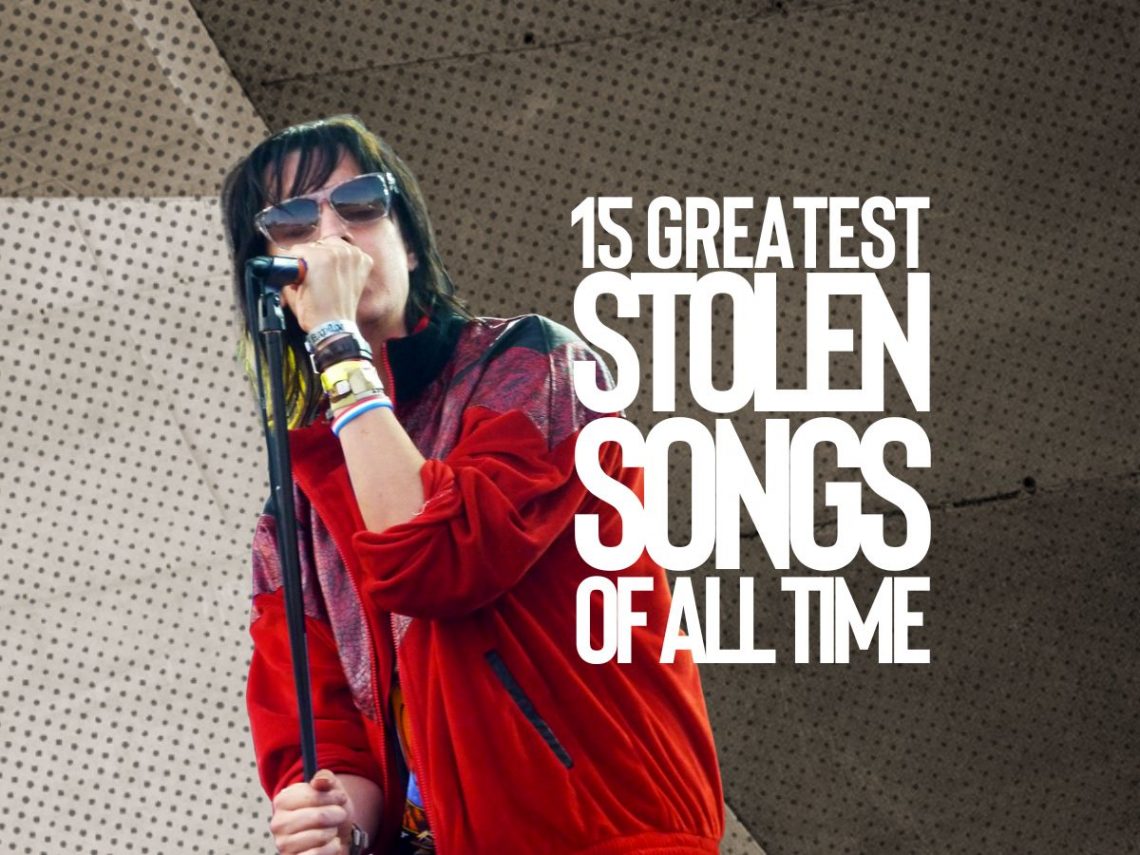
The 15 greatest ‘stolen’ songs of all time

It is no secret that some of the most iconic songs of all time have allegedly been stolen. Taken from one artist and appropriated by another, in turn making the new version of the song legendary, often at the personal and monetary expense of the composer. The unjust thing about this practice is that the ‘thieves’ also gain all the plaudits for their musical counterfeit, leaving the creator out in the cold. However, this practice has been around as long as pop music itself and shows no sign of abating.
The way in which these songs instilled themselves in popular culture led to their origins being called into question. Furthermore, how they became synonymous with the artists that popularised them also fans the flames of debate. No one questions the songs’ deserved place in the canon of popular music, but the question of who has parental rights is as just as it is intriguing, often diminishing respect for an artist that had otherwise feigned parenting.
Sometimes, the melodies and songs find their way into the brain of the canoniser subconsciously, and other times the riffs are used as a respectful homage to the creator. More often than not, though, it is just stealing, and the creators have no choice but to involve the judiciary.
“What do they say? ‘A good artist borrows, a great artist steals’ – or something like that,” Paul McCartney told Guitar Player in 1990. “That makes the Beatles great artists because we stole a lot of stuff.”
Such acceptance of truth, displayed by McCartney’s sardonic nature, is not always the case. There exist theories, often perpetuated by the accused, that, like oil, there is only a finite amount of music to go around and that there is no choice but to pinch from here and there. Although this theory has considerable weight, it doesn’t actually account for the numerous occasions where similarities between songs are so obvious that there can be no doubt a theft has occurred.
“There’s only one song in the world,” Keith Richards told the Independent in 2010, “And Adam and Eve wrote it.”
Nonetheless, we are not the judiciary nor the musicians, and we, the humble listener, have been treated to the same songs in different formats on many occasions. So strap in as we list the best ‘stolen’ pop songs of all time.
The 15 best ‘stolen’ songs:
15. Lindsey Buckingham – ‘Swan Song’
Lindsey Buckingham’s work with Fleetwood Mac is legendary, but when his time with the band finally ended in 2018, he didn’t rest on his laurels and began penning his self-titled seventh solo album. The record would continue to delight fans of the soft-rock icon, but two members of his paying audience took umbrage with the composition of his track ‘Swan Song’.
Blinker The Star’s Jordon Zadorozny and Medicine’s Brad Laner contacted Buckingham when Zadorozny noticed that the track sounded remarkably similar to the pair’s ‘Mind’s Eye’, which they had written together two decades prior. The lyrics were also incredibly similar. On ‘Mind’s Eye’, the chorus is: “It isn’t right to keep me waiting/ Do you have to hold out on me so long now?/ Is it right to keep me waiting?/ In the shadow of our mind’s eye.” ‘Swan Song’, on the other hand, goes: “But is it right to keep me waiting?/ Is it right to make me hold out so long?/ Yeah, is it right to keep me waiting/ In the shadow of our swan song.”
Buckingham had been working as the group’s producer at the time, and it was ruled that the Fleetwood Mac man had committed accidental plagiarism when he found their old demo and assumed it was his own. Zadorozny assumed that the plagiarism was a mistake and told SPIN: “He’s got years of integrity and no reason to be stealing songs from anyone, especially us. He’d taken our song, made a demo himself of it, put it away for a rainy day and, as it turns out, 16 or 17 years later found that demo and thought, ‘This is a cool thing I did back in 2000.'” Buckingham has since settled out of court for the mistake, and all is well.
14. The Strokes – ‘Last Nite’
Few songs defined the turning of the century quite like The Strokes’ hit ‘Last Nite’. the song was dripping with garage rock cool and helped to change the culture of music in seismic fashion, changing everything from hairstyles to outfit changes. However, while the song was played around newly forming indie clubs at the rate of Knotts, old-timers were quick to point out that the track was almost a complete rip-off of Tom Petty’s hit ‘American Girl’.
Julian Casablancas, the lead singer of the band, later admitted: “People would say, ‘You know that song ‘American Girl’ by Tom Petty?’ ‘Don’t you think it sounds a little like that?’ And I’d be like, ‘Yeah, we ripped it off. Where you been?’” Casablancas’ brutal honesty about taking influence from others is a breath of fresh air, although it could have severe repercussions on his bank balance if Petty wasn’t such a good sport. Furthermore, the singer wasn’t done there and went on to add: “There are some bass lines on our first album that were 100% ripped off from The Cure. We were worried about putting out the album, because we thought we’d get busted.”
Fortunately, Petty didn’t mind that they’d re-hashed ‘American Girl’, and in fact, he found their frank comments on the whole incident entertaining. “The Strokes took ‘American Girl’ [for ‘Last Nite’], there was an interview that took place with them where they actually admitted it,” Petty told Rolling Stone in 2006. “That made me laugh out loud. I was like, ‘OK, good for you.’ It doesn’t bother me.”
13. Rod Stewart – ‘Do You Think I’m Sexy’
Rod Stewart didn’t deliberately steal ‘Do You Think I’m Sexy’, but he openly admits to “subconsciously” plagiarising Brazilian artist Jorge Ben Jor. While in Brazil, Stewart heard Jor’s track, ‘Taj Mahal’, which sunk into his brain and formed the basis for ‘Do You Think I’m Sexy’. To Stewart’s credit, he held his hands up, settled the issue out of court, and all of his proceeds have been given to charity.
On Apple Music’s Deep Hidden Meaning Radio with Nile Rodgers, Stewart admitted: “Well, I nicked it from… It wasn’t a conscious nick. I was in Brazil for the festival, and I heard this song, and I just, I nicked it. Subconsciously I came back in the studio and started singing it and put words to it about six months later. But I put my hand up, and I said, ‘Fair nick, I’m guilty.’ And all the proceeds actually went to UNICEF.”
12. Billie Eilish – ‘Bury A Friend’
It’s impossible to escape from the almost identical melody in ‘Bury A Friend’ to ‘People Are Strange’ by The Doors. On Spotify, it’s the most popular track by The Doors, and it’d be surprising if Eilish or her collaborator Finneas had never heard the song before, even if they didn’t realise it.
In an interview with OK! Magazine, Eilish revealed how her battle with sleep paralysis inspired ‘Bury A Friend’. “I have these terrifying dreams,” she said. “Sleep paralysis, night terrors. It’s like the whole night is terrifying, and then I wake up. I probably wouldn’t have made that song the way it is if I hadn’t had sleep paralysis and nightmares.”
When Jim Morrison wrote ‘People Are Strange’, he was also distressed as he felt isolated because of his depression. In some ways, ‘Bury A Friend’ can be seen as a modern sequel to The Doors classic by making it Gen-Z friendly. While I don’t believe Eilish deliberately stole the melody from The Doors, the inspiration either happened subconsciously or is a bizarre coincidence.
11. Oasis – ‘Shakermaker’
Refreshingly, Noel Gallagher has always been open about plagiarising throughout his career. Although his honesty has cost him several writing credits, and on one occasion, Gallagher’s habit ended up lining the pockets of soft-drink giant Coca-Cola.
The similarities between ‘Shakermaker’ and The New Seekers’ ‘I’d Like To Teach The World To Sing’, famously featured in an advertisement for Coca-Cola, were hidden in plain sight for all to see. Originally, Oasis wanted to open ‘Shakermaker’ with the lyric “I’d like to teach the world to sing, in perfect harmony”, which is a direct nab from The New Seekers’ version. However, copyright issues thwarted their plans.
Despite changing the lyrics, Coca-Cola still sought compensation from the group, which resulted in Creation Records settling the issue for a six-figure sum. Bonehead later confessed: “We ripped it off, so they had the right to sue us. Fair enough. People will steal from other bands but change the lyrics. We just did the same thing but kept some of the same lyrics in. We drink Pepsi now”.
10. New Order – ‘Blue Monday’ (1983)
The influence New Order’s ‘Blue Monday’ has had on music is massive. From electronic and dance to indie, its influence is everywhere. It famously became the most-bought 12-inch single of all time after its release in 1983. Typically, however, the Mancunians could not agree on where the song originated. Peter Hook alleged that they “stole it off a Donna Summer B-side”, but it transpired that it was actually the A-side ‘Our Love’ and the similarities are certainly there to be heard.
Bernard Sumner, on the other hand, maintained that parts of the song had been plucked from Klein + MBO’s ‘Dirty Talk’, Sylvester’s disco classic ‘You Make Me Feel (Mighty Real)’ and that the long, iconic intro had been sampled from Kraftwerk’s Uranium. Keyboardist Gillian Gilbert didn’t agree either: “Peter Hook’s bass line was nicked from an Ennio Morricone film soundtrack.” Interestingly, these very disparate influences all have substance when listening.
Allegedly, ‘Blue Monday’’s actual starting point actually lies with fellow Mancunians, Gerry and the Holograms’s eponymous, obscure slice of electronica, released on Absurd Records in 1979. The group consisted of satirist CP Lee and John Scott.
Suitably, New Order knew Lee and decided the joke was on him. This is possibly the reason they’ve never been sued, as this joke has had an unfettered cultural impact, in addition to the numerous progenitors the band’s members claim the song has.
9. Guns N’ Roses – ‘Sweet Child O’ Mine’ (1987)
The crossover success of this 1987 hit is huge; plastered with Slash’s legendary guitar licks and Axl Rose’s powerful voice, the song still receives regular airplay over thirty years later. However, many have doubted the song’s originality, with the band members themselves conveying different feelings towards the song’s provenance. Threatened with a lawsuit in 2015, the discussion came to the fore.
In Q, Rose claimed that the writing of ‘Sweet Child O’ Mine’ happened quickly. Slash was killing time playing “this stupid little riff”. The other members liked it and fashioned the rest of the song around it. Allegedly, the riff, soon to become synonymous with Slash, wasn’t entirely original.
Rose claimed that its main influence comes from somewhere close to home: “I’m from Indiana, where Lynyrd Skynyrd are considered God to the point that you ended up saying, I hate this fucking band!” he said. “And yet for ‘Sweet Child’ … I went out and got some old Skynyrd tapes to make sure that we’d got that heartfelt feeling.”
Contrastingly, in the Daily Mail, Australian Crawl singer James Reyne, touched on the parallels between GNR’s’ only chart-topper and his band’s song ‘Unpublished Critics’. Adding that GNR was enthused about listening to a lot of Aussie bands back then. However, GNR bassist Duff McKagan swears he’s never heard the very similar Australian track. Ironically, Reyne has declined to sue, saying he wasn’t about to “take on the might of the Guns N’ Roses lawyers”, a might that has no doubt been funded by that song.
8. The Bee Gees – ‘How Deep Is Your Love’ (1977)
The pop ballad hit number one in the US and reached number three in the UK and Australia whilst being included in the soundtrack for the classic Travolta flick Saturday Night Fever. It also held the record for being in the top ten for the longest continuous run before being broken by Boys II Men’s 1992 smash ‘End of the Road’.
The Bee Gees’ relationship with the song came into question in 1983, when Chicago-based, part-time musician Ronald Selle, filed a lawsuit six years after the song had first topped the charts. Selle told the jury that the Gibb brothers had stolen the idea from his 1975 demo entitled ‘Let it End’.
Unfortunately, the judge ended the case as Selle could not prove the group’s point of contact with the song, along with any actual songwriting similarities. Selle tried to appeal the verdict but lost again, as it was proved that his demos had similarities with other Bee Gees songs that predated his demos.
7. Robin Thicke and Pharrell Williams – ‘Blurred Lines’ (2013)
It is right we label this song a megahit, as for months, it was everywhere, with the video making waves for reasons other than the music. However, the weight of this huge commercial success was questioned two years after its release when an LA court ruled the song was, in fact, plagiarised from Marvin Gaye’s ‘Got to Give it Up’, from 1974. This was a landmark case, as nobody had ever claimed ownership over a “groove” before. Not until Gaye’s daughter brought forward the suit.
In The New Statesman, Rhodri Marsden claimed: “The view that it plagiarises is based on a fundamental misunderstanding of what songwriting is. Let’s be clear: these two songs are fundamentally different. They have different structures, different melodies, different chords. Were it not for the similarity of the sparse arrangement (an offbeat electric piano figure and a cowbell clanking away at 120bpm), the court case wouldn’t even have taken place.”
Regardless of Marsden’s statement, the case was closed in 2018. Thicke and Williams were ordered to pay $5 million in damages to the Gaye family.
6. Led Zeppelin – ‘Stairway to Heaven’ (1971)
The song that is synonymous with Led Zeppelin has also taken them to court on numerous occasions. It transpires that “the most popular rock song of all time”, the one that every novice guitarist tries and fails to learn, may not actually be Zeppelin’s at all. Regardless of the amazing musicianship, and crazy claims of “satanic backmasking”, contemporaries to Zeppelin, Spirit, claim the song is theirs.
Zeppelin were taken to court over the similarities between ‘Stairway’ and Spirit’s 1968’s instrumental ‘Taurus’. Spirit were a band that had toured with Zeppelin early on in their career.
However, Zeppelin ultimately prevailed in court, with the ruling stating that ‘Stairway’ does not constitute a copyright infringement because both songs were recorded before 1978 and that they were not under copyright protection, to begin with.
Furthermore, due to the deaths of the Spirit members who brought forward the case, the plaintiff’s argument lost its original impetus and fell apart. Pretty inconclusive, eh?
5. George Harrison – ‘My Sweet Lord’ (1970)
Delaney Bramlett claims George Harrison was backstage at one of his duo, Delaney & Bonnie’s shows, in 1969. According to Bramlett, “I grabbed my guitar and started playing the Chiffons’ melody from ‘He’s So Fine’ and then sang, ‘My sweet lord, oh my lord, oh my lord.’”
Two years later, he heard Harrison’s ‘My Sweet Lord’ on the radio. Bramlett immediately called Harrison up to say he hadn’t meant for him to use his exact melody and complained about receiving no credit – “I never saw any money from it.” Neither did George.
In 1971, Bright Tunes Music – the publisher of ‘He’s So Fine’ – filed suit. Then Beatles manager Allen Klein met with its president in a bid to purchase the near-bankrupt company’s entire catalogue; on Harrison’s behalf. He was refused.
Subsequently, Harrison later offered the company $148,000, allegedly representing 40% of the US royalties from ‘My Sweet Lord’. Bright Tunes declined and demanded 75% of worldwide royalties along with the surrender of the song’s copyright.
Harrison, who had since split with Klein, should have smelt a rat. Klein knew the future value of this copyright, and secretly bought Bright Tunes Music for himself. This was a clear breach of the financial duty he owed to his former client, and the judge in the case agreed. Rather than the $2m Klein confidently expected, the judge awarded him $587,000 in damages, repatriating the exact sum he had paid for the company.
John Lennon had little sympathy for his old friend Harrison, commenting: “He walked right into it. He knew what he was doing.” Nevertheless, this tale, with mist reminiscent of a Raymond Chandler pulp, still leaves us with questions regarding the origin of the former Beatle’s classic song.
4. The Beach Boys – ‘Surfin’ USA’ (1963)
There is no song more synonymous with The Beach Boys’ earlier work. Brian Wilson says that this very obvious pinch of 1958’s ‘Sweet Little Sixteen’ was definitely intended as a tribute to Chuck Berry.
However, this homage to one of his heroes was not reciprocated, and Berry’s legal team saw it another way. What ensued became one of the first major plagiarism cases, a landmark in the history of rock’s relationship with copyright issues and the courts of law.
The Beach Boys had to settle on giving away the rights, and Berry’s name began appearing on the single a few years later. Wilson commented: “I was going with a girl called Judy Bowles, and her brother Jimmy was a surfer. He knew all the surfing spots. I started humming the melody to ‘Sweet Little Sixteen’ and I got fascinated with the fact of doing it, and I thought to myself, ‘God! What about trying to put surf lyrics to ‘Sweet Little Sixteen’s melody? The concept was about, ‘They are doing this in this city, and they’re doing that in that city’ So I said to Jimmy, ‘Hey Jimmy, I want to do a song mentioning all the surf spots.’ So he gave me a list.”
Regardless of Brian Wilson’s intentions and the subsequent giving away of the rights, I think we all know who we really associate this hit with.
3. Elvis Presley – ‘Hound Dog’ (1956)
This song we closely associate with Elvis Presley, and his is one of the best-selling singles of all time. This is high praise for a version of a song that has been recorded over 250 times and one whose creators barely saw any profits.
The song was first written by Jerry Leiber and Mike Stoller in 1952. In a story that is so stereotypical of the music industry, they were subject to a ruthless display of power from the world of music publishing. Almost immediately after writing, their song was copyrighted to Don Robey, owner of Peacock Records, and Big Mama Thornton, whose recording initially popularised the song. The miscarriage of justice meted out to the duo was down to producer Johnny Otis, to who Leiber and Stoller had contracted their songs, hoping to break into the industry.
Later, Stoller would say: “The reality of the cold-blooded music business was something else. Later, we learned that Johnny Otis [had] put his name on the song as a composer and indicated to Don Robey, the label owner, that he, Johnny, had power of attorney to sign for us as well.”
Up to his death in 2012, Otis maintained that he completely rewrote the lyrics, which originally “had lyrics about knives and scars, all negative stereotypes”. He even took the pair to court when Elvis released his cover, having previously signed a release renouncing all claims to the song in exchange for a measly $750.
His claim was popularly dismissed, and the New York federal judge branded him “unworthy of belief”. This story only serves as another warning not to deal with the Devil, or somebody else will take your work and make millions from it.
2. The Beatles – ‘Come Together’ (1969)
The huge scale of the impact Chuck Berry had on rock’s development is unrivalled. His music influenced the majority of the rock ‘n’ roll stars of the 1960’s, who, in turn, would influence the next crop of rockstars, Kurt Cobain included. Considering Berry was one man, and the severity of the way his disciples changed music’s trajectory, this really cements his godfather-like status in the world of popular music.
It is no wonder then that some of his music was directly appropriated by his adherents. Again, Chuck Berry’s army of lawyers jumped into action. This time turning their attention to the Beatles and ‘Come Together’. The song opens with the phrase – “Here comes ol’ flattop,” a line lifted directly from Berry’s 1956 hit, ‘You Can’t Catch Me’.
‘Come Together’ shot to the top of the charts on release, and Berry’s influence was plain for all to see. Lennon settled, with the stipulation he recorded other songs owned by Berry’s publisher Morris Levy, – including ‘Ya Ya’ and ‘You Can’t Catch Me’.
It’s nice to see that this particular story ended somewhat amicably for both parties.
1. John Barry -The James Bond Theme Tune (1962)
This is possibly the most iconic film theme tune of all time, accompanying a character just as iconic. The theme has been featured in every Bond blockbuster since the first, Dr. No, in 1962. The origins of the character of James Bond are well known, originating in author Ian Fleming’s famed exploits as a spy. However, the uber-stylish theme tune is not as original.
This came out in 2001 when John Barry, the credited writer, was forced to defend a libel suit brought against him by Monty Norman. Norman had for years suggested it was he who had written the theme and not Barry, as listed on every bond film credit. In 1998, The Sunday Times asked Barry if Norman was, in fact, the real author, and he replied: “Absolutely not.”
Unfortunately for Barry, he was required under oath to explain just how exactly he managed to compose a theme Norman had written five years earlier, under the name ‘Bad Sign, Good Sign’. Barry begrudgingly admitted he had actually used ‘Bad Sign, Good Sign’s riff.
Regardless, he maintained the rest of the tune was his – until an expert witness explained how almost all the theme stemmed from Norman’s original. Barry claimed ignorance and that he had never intended to claim royalties on the song. Continuing, the prosecution swiftly produced letters from Barry’s solicitors threatening Norman; unless he withdrew his libel action.
Barry lost the case, and the Times also faced a substantial bill for costs. Justly, Norman was awarded £30,000, although the fee seems minuscule in comparison to the revenue the theme tune has accrued over the years.

Never Miss A Tale
The Far Out Classic Rock Newsletter
All the latest Classic Rock content from the independent voice of culture.
Straight to your inbox.