


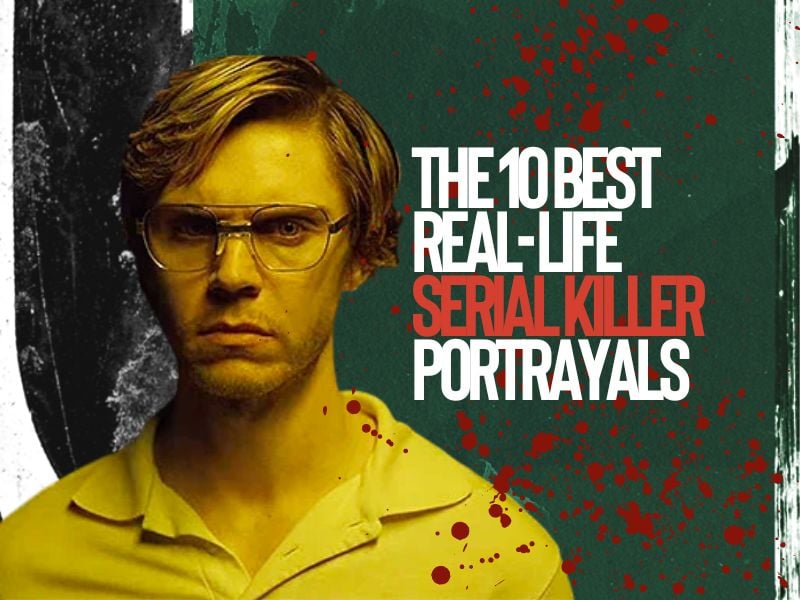
The 10 best real-life serial killer portrayals of all time ranked

Serial killers are responsible for less than 1% of murders in the US each year, and Scott Bonn, a sociologist at Drew University, estimates there are less than two dozen active at any given time. Yet, our fascination with this tiny, grisly asterisk to society endures, often dwarfing far larger problems, which he puts down to a “kind of cultural hysteria”.
This morbid fascination is a global phenomenon, for better or for worse, and most likely for worse, we can’t escape the psychological draw of the demimonde’s darkest characters. This trend continues to grow. The most recent craze is Netflix’s Monster: The Jeffery Dahmer Story. It’s a tale we’ve all heard before, but with an appetite for true crime at an all-time high, people are hungry for more.
Part of the reason we lust for such dark entertainment is the mystery these stories entail. Even when they are solved, the mystery remains regarding just how such a horror came to pass. We are hardwired to be titillated by this. It is evolutionarily advantageous to understand and solve things beyond our grasp. The draw of the serial killer resides in the fact that they are largely an unsolvable puzzle.
This is an element that enters the debate of whether we should be enjoying them at all. This rehashing of trauma for entertainment is definitely condemnable, however, some have argued that the saving grace is that these explorations further our understanding of the societal elements and contributing factors which can be mitigated. It’s up to the creators to ensure that this is at the forefront and far more paramount than merely turning tragedy into entertainment.
Thus, below we have curated a list of the finest acting portrayals of serial killers to date. These performances epitomise the essential psychological and societal elements that make the movies worthwhile.
The 10 best real-life serial killer portrayals in cinema:
10. Daniel Hanshall in Snowtown
Geography has a hand in everything. Where we grow up is a shaping factor on our eventual character. The impoverished suburb of Salisbury in Adelaide, Australia is a gruelling environment, but the crimes of murderous ringleader John Bunting far outsized anything that the urban decay had induced before.
His twisted tenet as a serial killer was to rid the world of those he deemed deserved death. In a homophobic rampage begins a dark pursuit and soon acts as a Svengali bringing in impressionable youngsters into his ‘gang’. The darkness thereafter proves sickening beyond belief as the town is beset by killings. Eventually, the police would discover eight bodies stored in barrels in an old bank vault.
Hanshall’s performance unspools with brilliant control. He displays how violent eruptions can be the product of years of bubbling dormancy. Somehow, he also depicts both the vulnerability of Bunting, and how he was able to dominantly force others under his spell.
9. Evan Peters in Monster: The Jeffery Dahmer Story
Jeffrey Dahmer has been one of the most widely documented serial killers in history. His callous disregard has been stewed over in many portrayals. However, Peters captures the truly gruesome nature of his crimes with nauseating horror making his casual nature all the more perplexing.
What’s more, given that this insight displays how such tragedies went unsolved due to prejudice, Peters is able to place the character in wider society. Thus, it might be gore and violence that is turning stomachs, but the true terror lingers in the scenes where he simply strolls among us as a neighbour. Peters serves up this duality with informative ease—his frequent underplaying fits the angle of this exposition perfectly.
8. Michael Shannon in The Iceman
Michael Shannon is a terrific actor full stop. The film itself might not have lived up to the billing of the Philip Carlo book written on Richard Kuklinski, but Shannon masterfully navigates the role. And it can’t be understated just how much of a difficult role that proves. After all, Kuklinski is a true embodiment of duality—a family man who committed over 100 murders for the mob.
What’s more, Kuklinski was psychologically perturbed by his own indifference to his crimes. He would film a man being torn apart by rats and then watch it when his family had gone to bed, wondering why he was able to sit through it without stirring when he knew it was objectively immoral and grotesque. Along with his utterly explosive violence, that is a difficult character to portray. Shannon does it with an unerring sense of villainy. To put it simply, every time he is on the screen you are scared of him.
7. Michael Rooker in Henry: Portrait of a Serial Killer
Henry Lee Lucas killed his mother in 1960 after years of abuse. In 1983, with his demented sidekick Otis Toole, he committed two further confirmed murders. However, when he was incarcerated, he confessed to roughly 600, making him the most prolific serial killer in history, only for such numbers to be proved impossible. Three have been confirmed and eight remain disputed, with Lucas retracting nearly all of his confessions.
The film, however, commendably avoids being dragged into the absurdity of the disputes and focuses on how such a felon came to be. This makes for a truly dark film. The gritty display is heightened further by the low-budget feel (it was made for only $100,000) and the filthy aesthetic. All of this is centred around Rooker’s disgusting performance that leaves you wanting to shower for a week and watch nothing but Pixar while you’re at it. The hardest filth to scrub of all is the mundanity of everyday evil.
6. Hans Beckert in M
In a very early display of proto-postmodernism, the 1931 film M takes a look at things from the viewpoint of the killer. Peter Lorre depicts Hans Beckert who was based on the notorious Vampire of Dusseldorf. This deranged killer terrorised the city committing nine murders and countless sadistic sexual assaults over an alleged 31-year period (1899-1930).
“Who knows what it is like to be me?” he asks in the pivotal scene. This is not a moment that induces empathy given the horrors he has inflicted, however, that question just about underpins our current fascination with killers. Complete with a touch of the unreliable narrator, Lorre’s performance implores you to wade into the darkness of his mind.
5. Robert Mitchum in The Night of the Hunter
There are some that might have thought Robert Mitchum was far too suave and handsome to induce terror before The Night of the Hunter was released. However, his matinee idol good looks only add to the unsettling portrayal of Reverend Harry Powell, a killer based on Harry Powers. Powers lured his victims through Lonely Hearts adverts that claimed he was looking for love.
This motif was ironically blazoned across Mitchum’s knuckles, creating a picture of the perfect pop culture charismatic killer. This renders the film a mere perspective trip away from reality. If we all live our lives like a film, then some of them are going to be directed by terrible folks—Mitchum is one of them, and he veils it with just enough charm to prove spookily alluring.
4. Martin Sheen in Badlands
Badlands is a masterpiece. Rarely, however, have the depths of depravity produced anything as beautiful as Terrence Malick’s Badlands. Malick’s masterful 1973 movie takes on the story of Charles Starkweather. The murderous 19-year-old who embarked on a deranged killing spree in 1958, taking his 14-year-old girlfriend along with him, as though it was merely a road trip.
However, Malick takes a unique approach to handling the aesthetics of the film in so many ways. On the surface, it is a movie about a raging homicidal rampage, and considering the James Dean wannabe portrayed by Martin Sheen is ten years older than Sissy Spacek’s 15-year-old Holly, it’s about paedophilia too. However, it never comes close to materialising as that on-screen, without trivialising either of those atrocious elements, the movie simply unspools in a dangerously drifting tranquillity, like the long midwestern roads ahead of the disillusioned duo.
The film and Sheen’s performance alike, are a fantastic deployment of post-modernism as we witness murder and terror through the rose-tinted eyes of man with no subjectivity. The murders are merely as important as the music, the elemental glowing golden-hour landscapes, and sanguine beat-prose of young love, lust or ambivalence, all swirling on a canvas of youth to form an entrancing disassociation of action and aesthetic that unfurls like French Expressionism on screen.
3. Anthony Hopkins in The Silence of the Lambs
The Silence of The Lambs is 118 minutes long, Anthony Hopkins’s Hannibal Lecter is in just 16 of those. In that short time on screen, he not only secured himself an Oscar for Best Actor in a ‘Leading Role’ but also imbued the viewing public with such an indelible impression that Martha Stewart had to stop dating him because she couldn’t stop associating him with a brain-eating lunatic.
The fact that over 30 years on people still regurgitate lines that the mind-walloped-psychopath snarled out, is a testament to an unforgettable performance in an unforgettable film. It leaned into gratuitous fiction but merely as a device to capture the dark psychologies at play.
The character was inspired by Alfredo Ballí Treviño, a Mexican doctor who killed his boyfriend in 1959 after an argument. Training as a surgeon at the time, he dismembered his lover to allow him to fit his whole corpse into a small box before burying him. He was imprisoned for 20 years during which time he tried to retain a sartorial elegance and understand the human mind. Albeit he was linked to cannibalistic killings, these were never proven, and upon release, he went on to practice medicine – often for free – hoping to repent for his crime.
2. Charlize Theron in Monster
You could be mistaken for not realising that Charlize Theron was ever in Monster such is the extent of her exacting transformation. While props must go to hair and makeup for the realism behind her portrayal of Aileen Wuornos. With shuddering naturalism, you get to see the way that Wuornos relished her crimes with an almost voyeurism angle.
As a prostitute, Wuornos shot dead and robbed several male clients. She was convicted of six counts of murder and after 12 years on death row, she was executed by lethal injection. With brutal rage, she vowed, “I would just like to say, I’m sailing with the rock, and I’ll be back, like Independence Day with Jesus.” With sickening repulsion for the viewer, Theron somehow portrays this bubbling anger without ever overacting or reverting to fictional tropes.
1. Anthony Perkins in Psycho
Without Psycho, then there is an argument that this list wouldn’t exist. Alfred Hitchcock and Anthony Perkins helped to create art out of atrocity in such a way that has permeated culture ever since. What is it that makes it so brilliant? Perkins and Norman Bates are one and the same.
The slasher-feel might have imbued it with a sense of fiction, but it is a fiction that we can assimilate spookily into the everyday. You can’t shower peacefully for at least a week after watching Psycho thanks to these day-bedevilling bastards. In part, that is the key to the brilliance of Perkins’ portrayal of Ed Gein, might be far more clean-cut than the real mother-loving killer, but that only heightens the horror of what a straight-laced kid can be capable of.
