


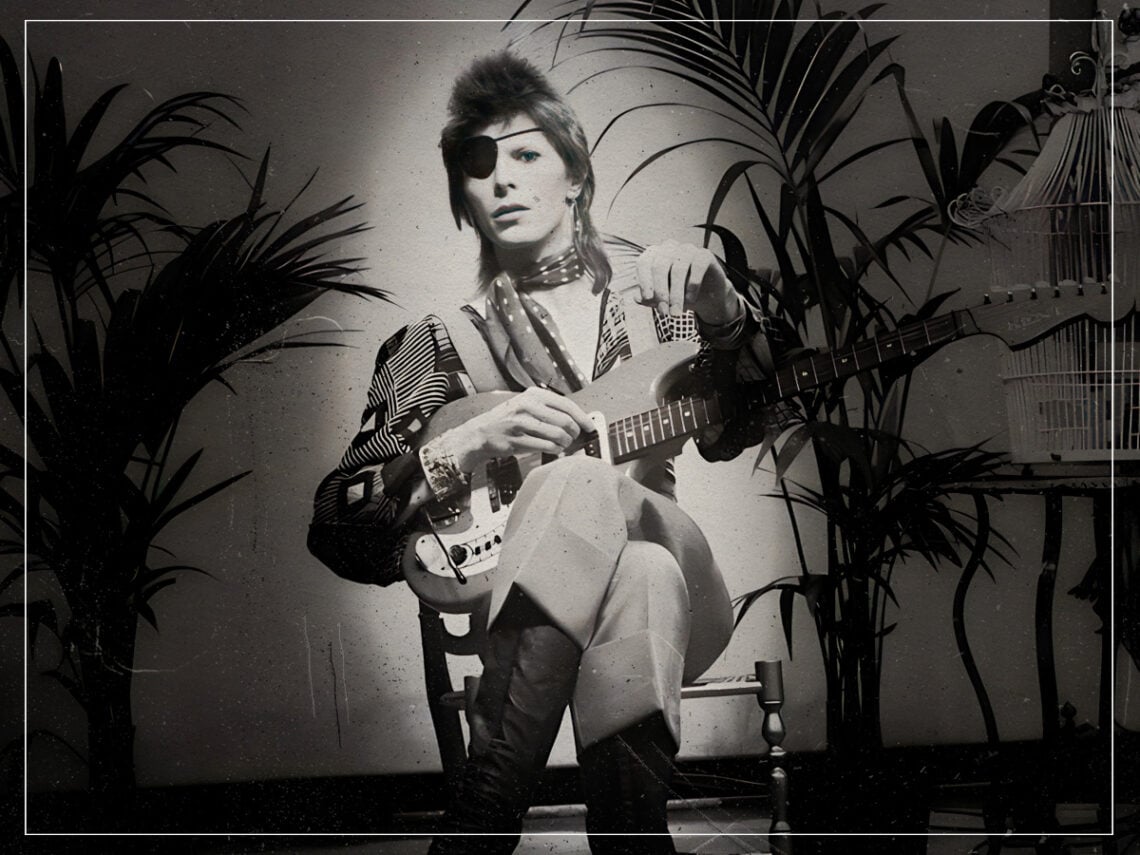
The 10 best guitar riffs from David Bowie songs

David Bowie is perhaps one of the last music heroes ever to exist. He embellished art in every sense of the word, reinstating its power as a delicate, meticulous craft with elements that worked together to create, express, and even challenge. To the outsider, Bowie was divinity, while to the laymen, he was a mystical intruder, a Goblin King whose promise of freedom and open-mindedness would open doors to other worlds of discovery.
Many musicians are lauded for their ability to create instantly gripping numbers, luring you in with thunderous riffs that keep your attention for a handful of minutes. Others are praised for their meticulous slow burn, which adds complex layering to songs and enhances experiences with every repeated listen. The beauty of Bowie is that he was able to see the best of both worlds by becoming the ultimate musical magpie.
Calling Bowie “just terrific”, Jimmy Page would highlight his appreciation for Bowie’s ear and ability to work with other musicians in a seamless yet directive way. “In the early days, he was prolific, and he put out some really important work,” he claimed. “He was taking from various sources and putting it together, but that’s an art form in itself.”
While Bowie’s sound would meander through the musical landscape, he kept the guitar close to his heart. Many of the riffs were extraordinary, showcasing the singer’s ability to work with artists who create catchy and inventive sounds and add texture and depth in organic ways. Often, it also demonstrated his penchant for blending different genres and styles, as explained in Moonage Daydream, when he likened a particular song to a “smorgasbord” of various, sometimes seemingly contrasting, elements.
As we delve into some of the best guitar lines found within his repertoire of tracks, it’s interesting to pinpoint the ways in which he traversed the intersection between commercialism and experimentalism, creating sounds that appear completely unforced, timeless, and, most importantly – purely Bowie. Whether with other musicians or in collaboration with his long-time musical partner Mick Ronson, these are some of Bowie’s most gritty, seductive, and memorable hooks.
The 10 best David Bowie riffs:
‘Ziggy Stardust’
Starting with the obvious, this song is one of Bowie’s most famous for a reason. It would probably be difficult to find someone who doesn’t immediately recognise the opening notes of ‘Ziggy Stardust’ as its rhythmic riff promises great energy before you’ve even had a chance to delve into the lyrics. Although Ziggy Stardust, the character, was introduced in ‘Moonage Daydream’, the dangerous riff acts as the distillation of Bowie’s persona, leading the way into a song that dives head first into his rise and fall as a bisexual alien rock star.
Many songs on The Rise and Fall of Ziggy Stardust and the Spiders from Mars showcase Bowie’s natural affinity for straight-up rock tracks. The titular number is equally as straightforward in many ways, but with Ronson on guitar, the riff is deceptively full. Layered with acoustic fragrance and electric grit, there are few numbers that define an entire album as easily.
‘Rebel Rebel’
When you help to initiate an entire movement, it’s only fitting that your departure is explosive. ‘Rebel Rebel’ saw Bowie delivering a swan song for his involvement in the glam rock scene, crafted almost entirely by the singer alone. Unlike most of the musician’s most powerful six-string moments, the riff in ‘Rebel Rebel’ was created by Bowie, who came up with the D, E, and A progression and enhanced by Alan Parker, who added the downward notes at the end.
Wanting to create a riff that sounded exactly like The Rolling Stones, ‘Rebel Rebel’ epitomises Bowie’s inclination towards direct communication through the medium of music, with a riff that both points a tantalising finger while beckoning you to dance along to its mischievous endeavours. Once again, he utilises the one-two punch of simplicity and complexity, lighting fires with neatly placed chords that accompany you far longer than ‘Satisfaction’ ever could.
‘Cat People (Putting Out Fire)’
The original version of ‘Cat People (Putting Out The Fire)’ centred around only two chord changes, creating an eery atmosphere that may test the patience of some of the most dedicated Starman fans. However, it was initially created for the 1982 film of the same name, which incorporates numerous dark themes like sexual repression and societal prejudice. Therefore, Bowie’s original song is dark and gothic in execution, perfectly fitting with the film’s tone. The re-recording, however, appears more rock-heavy and aggressive due to its faster tempo and glam rock riff.
Of course, much of that extra power comes from the highly acclaimed session musician Bowie brought in to help him. Blues guitarist Stevie Ray Vaughan played the lead guitar on the track, bringing his blues-rock groove to a song which sounded much too laid back in its original format. The brooding original has its admirers, but the riffs centred in the middle of Vaughan’s performance are hard to ignore.
‘The Jean Genie’
Some of the greatest musicians of all time possess the remarkable ability to make music sound like shapes and movements, and the riff to ‘The Jean Genie’ has that exact appeal. Instead of going directly into its brilliant riff, it’s prefaced by a guitar distortion and fast-paced downward notes that immediately articulate rock ‘n’ roll.
Described by Bowie as a melting pot of Americana, an Iggy Pop-inspired protagonist, and a play on the name “Jean Ganet”, ‘The Jean Genie’ demonstrated Bowie’s natural ability to extract various elements and reframe musical masterpieces. The riff, played perfectly by Ronson, started off as something lightweight before all of the other aspects came into play. This organic piecing together resulted in something groovy but also heavy, welcoming, yet immersive.
‘Heroes’
Some of the most emotional songs of all time don’t need to rely on lyrics to evoke depth and feeling, and ‘Heroes’ began and ended with a feeling of grandeur – the type that stuck in Bowie’s mind and influenced its persistent rhythmic pulse. ‘Heroes’ was driven by feeling, according to Bowie, who explained that the song almost wrote itself once they established its riff: “With such great musicians, the notes were never in doubt,” he said.
With synthesiser overdubs added by Bowie and Brian Eno and guitar contributions from Robert Fripp, ‘Heroes’ demonstrated two incredible aspects of Bowie’s artistry: the power of his music to invite, evoke, and enlighten, alongside his talent for alluding to heroic existentialism with lyrical simplicity. “We can be heroes just for one day” is perhaps one of the most poignant lyrics in music history, thanks to its rawness and authenticity, alongside the undeniable undertones of tragedy and longing.
‘Let’s Dance’
There are few riffs in the world of David Bowie that pack as much power as ‘Let’s Dance’. Though Bowie would look back on the album with some degree of scorn in his later years, thinking of it as a push for mainstream success above artistic purity, the song is undoubtedly one of his most beloved tunes. And we have Nile Rodgers to thank for it.
Bowie had a rough demo of the tune ready for Rodgers when they first met, but Rodgers thought it landed somewhere between Anthony Newley and Donovan, “and I didn’t mean that as a compliment.” The Chic man took the track and turned it into a mega-hit, “Gone were the strummy chords, gone was the moving voice. I’d replaced them with staccato stabs and a strict harmonic interpretation. I used silence and big open spaces to create the groove and kept rearranging it on the spot, like I always did with Chic. David quickly got down with the reshaping of his song.” While Stevie Ray Vaughan has the credit of lead guitar on the song, the bones of everything came from Rodgers.
‘Suffragette City’
Owing in part to the obvious connection to rock, Ziggy Stardust is rife with classic riffs. It’s the most heavily featured LP on our list, and it’s positively packed with headbanging moments. Mick Ronson can take most of the credit there. While Bowie certainly had a hand in the arrangement of the guitar, Ronson shaped the band’s rock sound with his purposeful playing. ‘Suffragette City’ is Bowie’s most urgent use of guitar.
“‘Suffragette City’ was just balls to the wall and go for it,” said drummer Woody Wodmansey of the track. That push of the accelerator comes from Ronson’s impatient guitar, kicking into gear with the first notes of the song. The choppy exchange is neatly filtered into the groove until the song evolves into an elated free-for-all of rock and roll hedonism.
‘Sound and Vision’
Stevie Ray Vaughan, Mick Ronson, Nile Rodgers and Robert Fripp are probably the first names one thinks of when summoning the guitarists who helped Bowie define generations with his music. But fewer plaudits are afforded the wonderfully talented Carlos Alomar. The Puerto Rican six-string maestro became the go-to axman for Bowie in the mid-1970s and helped to deliver some of his best songs.
One such track is ‘Sound and Vision’, which, despite being one of Bowie’s sadder numbers, is enhanced by an unstoppably groovy lead line, executed by Alomar with aplomb. “After we were finished with the drums, bass and piano, we retained Carlos and Ricky to overdub more guitars,” explained producer Tony Visconti of the record Low. “This was fun because they all had their own lush guitar pedals and great ideas. We didn’t hold them back.”
‘Golden Years’
Carlos Alomar’s swinging groove was once again utilised in Sound and Vision, and the hip-shakingly brilliant riff in ‘Golden Year’s is the distillation of that sound. The first song to be written for the record, it is drenched in a sunshine groove that feels inescapable. It’s arguably Bowie at the top of his game.
“‘Golden Years’ was kind of David’s version of ‘On Broadway’, but I told him he had to be careful, so I came up with a new riff for it,” explained Alomar of the tune. While he can be considered the “inspiration line,” it was Earl Slick who cemented the riff in all its glory. Alomar continued: “His was the real line. His sound was very close to Mick Ronson, which David loved, and he was able to create a link.” What was recorded is one of Bowie’s most infectious grooves.
‘Moonage Daydream’
“Ronno played exactly what was needed,” noted Ken Scott of Bowie’s arresting ‘Moonage Daydream’. A potent addition to Ziggy Stardust and Mick Ronson’s repertoire, the riff is the very essence of Bowie at this time. Unafraid and unabashed, it delivers a striking blow capable of bloodying a nose and leaving a glittered bruise around the eye.
Across the entire record, Ronson’s sound is formidable, but one moment typified Ronson’s work — the solo on ‘Moonage Daydream’. It lands around the 3:12 mark, and after Bowie utters “Freak out. Far Out.” (following a ream of extraordinary lyrics), Ronson lets snarling an alien life form escape from his guitar. However, the solo wouldn’t land as effectively without the explosive opening riff.
