


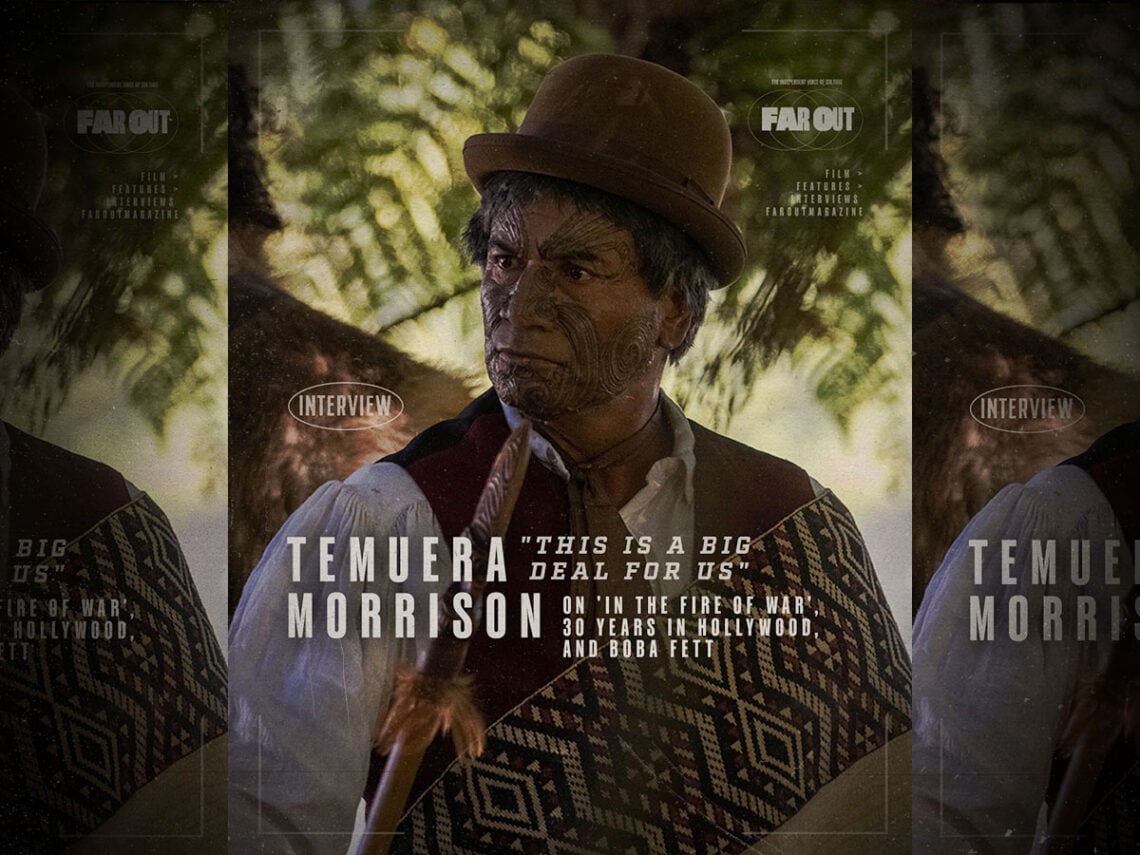
“This is a big deal for us”: Temuera Morrison on ‘In the Fire of War’, 30 years in Hollywood, and Boba Fett

Temuera Morrison is one of New Zealand’s most successful exports to Hollywood, with the actor appearing in blockbusters, box office smash hits, and billion-dollar movies like Aquaman and Moana 2, not to mention his two-decade association with Star Wars, most notably as Boba Fett.
However, his latest role brought him close to home after he played the legendary chief Rewi Maniapoto in director Michael Jonathan’s feature-length debut In the Fire of War, also known as Ka Whawhai Tonu. The historical epic was released last year in New Zealand, but with the film now available to a global audience, Morrison is thrilled that new viewers will be able to discover the story.
“This is a big deal for us to get a release in the US,” he said. “I’m very, very proud of the production. We’re very proud to be screening in Hollywood. I’ve had a few friends looking forward to seeing something like this. It’s been a year or so now, so the dust has settled down a bit.” Still, he hasn’t forgotten the fond memories of shooting it.
“It was like coming together, a lot of friends coming together, a lot of favours,” Morrison continued. “And we’re all from a small town called Rotorua, New Zealand, and we’re all doing our own thing here in terms of making programmes for our own people; Māori stories made by Māori young people today. So this one’s a big one for us, a really big deal. So we’re very, very proud that it’s going to be showing.”
A combination of fact and fiction, In the Fire of War unfolds during the siege of Ōrākau in 1864 amid the New Zealand Wars, combining real people, events, and battles with the invented story of two teenagers, Paku Fernandez’s Haki and Hinerangi Harawira-Nicholas’s Kopu, struggling to find their place in the world and make sense of the conflict raging around them.

“It’s quite a spectacular movie on one side,” he ruminated, “There’s a lot going on, yet it’s quite intimate as well. It’s a story that was fictional, put into a real-life situation. On one level, it’s looking at a historic event, but they’ve woven in the story around the children, which is kind of fictional, but it’s a very powerful film.”
Morrison has been friends with Jonathan for a long time, and even borrowed his computer to conduct this interview because he was at his house. It meant a lot to him to see someone he knows so well stepping up to helm an expansive war drama that tells an important story that not many people outside of New Zealand may even be aware of.
“I’m very proud of my friend who got it off the ground,” he agreed. “Obviously, he’d been working on the script for a number of years, trying to refine the story. The funny thing was that myself and the director both have genealogy towards some of the chiefs that are in the movie. So it was kind of a natural thing to play this character, in a way, because I am a descendant.”
Morrison can trace his lineage back to Rewi Maniapoto, and Jonathan “ties into that tribe as well”, making the role even more personal, and not only because he and the filmmaker have “worked on a number of other projects and we’ve always been close anyway”. The actor said the project and others of a similar nature “make us feel obliged to play these roles because we are direct descendants of our ancestors”.
Despite his extensive history with Jonathan, Morrison wasn’t signed on from the beginning. “To be quite honest, when it actually came time to start filming, just like everything in this business, everything happens in the same month.” He was working on another period piece and managed to find some time in his schedule to head back home to shoot his scenes.
“I was actually a bit nervous that I wasn’t going to make it,” he confessed. “I was working on Chief of War, a Jason Momoa project, and I was right in the middle of that production. So I had to pull some favours and tell a few lies and run away from the set for ten days. I got in touch with my buddy. I said, ‘Bro, I think I can. I think I’ve got ten days. I think I can give you ten days to squeeze my little bit in’.”
After pulling the requisite strings to open up the necessary gap in his schedule, Morrison was able to “come back home, come back with the brothers, and work on something a little bit more epic, but intimate as well”, an agreement he was relieved was reached.
“I was very proud at the end of the day to come back, and what a wonderful experience it was, too, for me,” Morrison reflected. “I’ve worked on a number of films now, but this one really had a camaraderie. This one, we had a lot of the descendants from the actual ancestors that were filling in all the extra roles and being the Māori warriors, and a lot of humour as well.”
“But the way we all came together for this, what we say, kaupapa, for this project, was amazing. We had a lot of love, and also we had a lot of emotion,” he continued. “I noticed from all the performers right through to the extras, because they were the direct descendants of these ancestors, these people hadn’t been trained theatrically. They hadn’t been trained in drama school, but they were conjuring up emotions that were real.”
“Even on the crew side, you really felt a sense of pride for this project, a sense of pride that we were representing our ancestors in recreating all of this. Against the odds, too. With a whole lot of love, it’s amazing what you can do when everyone works together. You’re all in the same canoe, and you’re all paddling in the same direction to get this project made.”
It was a collaborative effort between the cast, crew, and production companies to bring everyone and everything together for In the Fire of War, but Morrison reserved more special praise for Jonathan, who played an unsung but instrumental role in helping him first crack Hollywood almost 30 years ago.
“He’s been very supportive of me in the past, and I remember quite vividly a lot of times actually auditioning for small roles in small movies in America. And many a time I’ve had to come to his house and say, ‘Bro, bro. I need to film my audition. I need to send it off quickly. I could get a part, I could make it in Hollywood.’ And you know what? He was always there.”
It’s probably worth noting that Morrison’s first major American releases were Pamela Anderson’s Barb Wire and the infamous Island of Dr Moreau with Marlon Brando and Val Kilmer, but everyone has to start somewhere. These days, he’s a regular fixture on the silver screen in some major titles.
Last year, for instance, summed up the two sides of Morrison’s career. He reprised his voice role as Chief Tui in Moana 2 and played his part in In the Fire of War. One is an animated Disney juggernaut, and the other is a local film that spent years in development, and he’s always hoping to give something back to the New Zealand industry.
“Well, we’re blessed down here in New Zealand,” he offered. “We have a little family down here in New Zealand, a small film industry as well. And we’re still growing. We’re still in infancy, really. We’re still young down here in New Zealand, our film industry, but it’s the projects at home that get you noticed.” Morrison knows this better than most, with Lee Tamahori’s acclaimed and incendiary 1994 drama Once Were Warriors serving as his international breakthrough.

“That budget was very, very small,” he recalled, “and again, people were working for the passion of the project. And sometimes it’s the little films that get noticed, in a way, that’s what I’ve noticed, and it’s the one with a bit of heart. It’s those films with a bit of heart and a bit of soul in there that get noticed. So we’re very proud of that.”
Not that he could have predicted at the time that Once Were Warriors would be a defining moment, with Morrison initially thinking the film’s graphic nature would dissuade people from checking it out: “I was worried about who was going to watch this movie because of the content, and especially some of the stuff I had to perform.”
“It was just one of those things,” he reminisced, “one never knows when you’re actually making a film, where it’s going to end up. But I actually thought, ‘Well, no one was going to watch this movie because of the content.’ You know, the family abuse and the domestic violence and the alcohol, that is part of it, but that’s the movie that still resonates today and transcends a lot of cultures.”
“I travel the world these days, signing autographs for Boba Fett and Star Wars,” Morrison explained, “but people always bring up Once Were Warriors, and a lot of the Star Wars fans are movie people. So they know your history, and they know some of the films you’ve been in. It was one of those films that stood up, considering I was the big problem going in, because at the time, I was playing a doctor on a soap!”
Best known for the long-running medical soap opera Shortland Street in the early 1990s, not everyone was convinced Morrison had the chops to play the terrifying Jake ‘The Muss’ Heke: “It was quite a change for me to go from the doctor, from a soap, into that character. But I got through it”.
Director Lee Tamahori was another Once Were Warriors alum who cracked Hollywood, directing Anthony Hopkins in The Edge, Morgan Freeman in Along Came a Spider, and taking the reins on the 20th James Bond movie, Die Another Day, leaving Morrison tickled by how much things have changed.
“It’s kind of weird that back in the day, everyone was trying to get into LA, but things have changed a little bit,” he said. “I think we’re getting more work down here in New Zealand and Australia than Los Angeles. LA used to be the place, it used to be the dream: ‘Gotta go to Hollywood’.”
“We can do it, but I think things are shifting now. We can stay home and make our own Hollywood here. Now we can make our own movies here, and get noticed that way. And again, this film is proving that.” Of course, no discussion about Morrison’s Hollywood sojourn would be complete without addressing the elephant in the room: Star Wars.
It’s been 25 years since he was first cast as Jango Fett in George Lucas’ Episode II – Attack of the Clones, and he’s gone on to appear in over a dozen Star Wars projects as multiple characters across film, television, and video games. When asked if he had any inkling it would be the gift that kept on giving, Morrison was nothing if not honest.

“No,” he declared point-blank, adding, “When I got in this business, I was always just grateful for that job, grateful for that movie that the director put me in. And that’s about it, really. That’s how you think of it. ‘OK, let’s do this film. Put it in the can. Work hard’. I always try to work hard for the director as well. Once you know, once they’ve made the decision to cast you, I always feel a sense of, ‘OK, I’m going to do the best I can for this director, since he’s cast me, he obviously wants me in his movie, so I’m going to do the best thing I can do for him’.”
He elaborated on making peace with the creative process and what the reality is surrounding it, especially once the filming is over: “You don’t think about later on or what’s going to happen to the film. You just deal with the process of making that film, making that television programme, and then wait and see. Normally, you’ve been unemployed for that whole time, and now you’ve got to go out and promote the movie and pretend you’ve been busy doing other films!”
“Even with the Star Wars stuff, I played a character, Jango Fett, in the year 2000,” he ruminated, “and then, blow me down 20 or so years later, I’m asked to play the clone son of Jango, Boba Fett. I still can’t believe it sometimes. Wow. And that’s been a big one for me, too, The Book of Boba Fett, in terms of keeping me out there profile-wise, but things have died down there. So, onwards and upwards!”
