


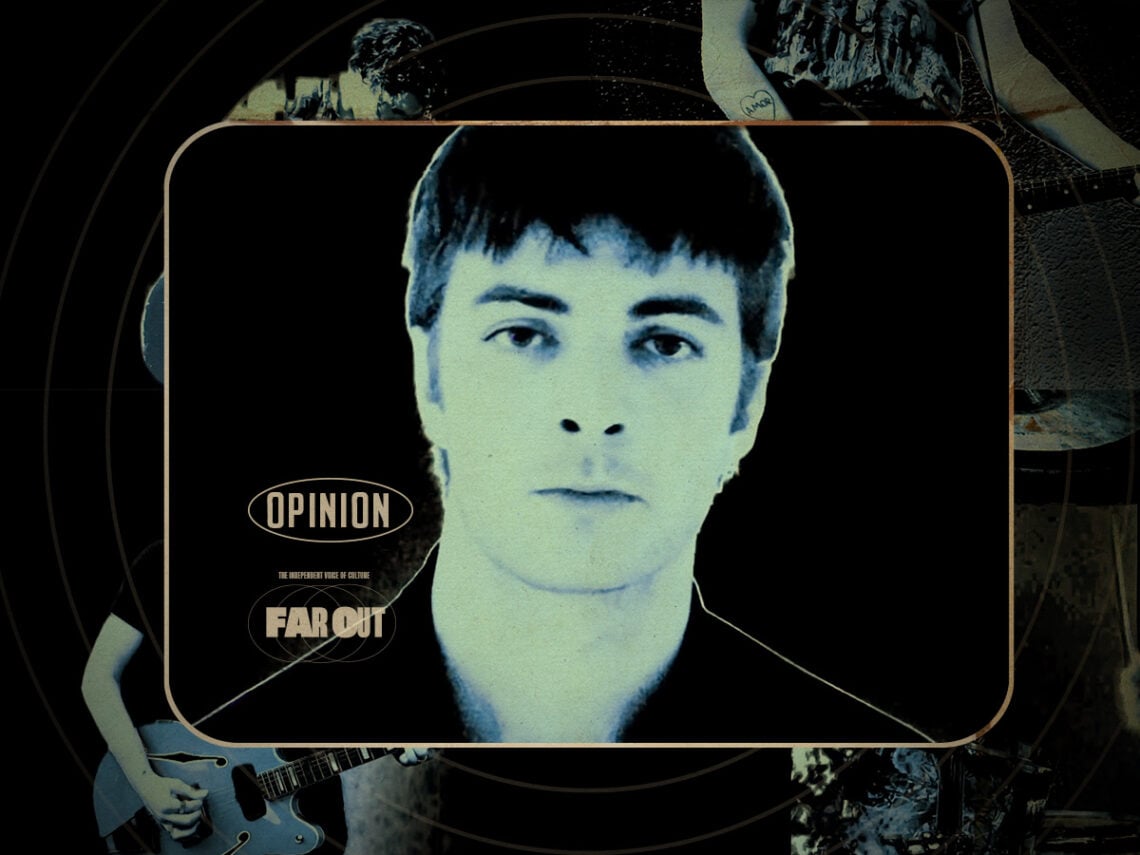
Hear Me Out: ‘Televised Mind’ remains Fontaines DC’s best song

Lauded as the Irish saviours of post-punk by critics and subsequently worshipped by fans, Fontaines DC have wormed their way into the hearts of even the most resistant old-timers.
Since their formation in 2014, Fontaines’ rapturous debut single ‘Liberty Belle’ placed them on a seemingly endless upward trajectory, and rightfully so. They have a knack for crafting infectious songs that breathe new life into post-punk’s relatable, but sometimes exhaustive, cynicism. Even in their most tortured lyrics, Fontaines DC incorporate the slightest hint of optimism that brings their energy to a peak. They have achieved the perfect blend of this paradox on their latest offering, 2024’s Romance, with its collection of unashamed love songs, existential ballads and meditations on mortality resonating with mainstream audiences at an unprecedented pace.
The first time I saw Fontaines DC live was just over two years ago, when they opened for the Arctic Monkeys at Forest Hills Stadium in Queens, New York. Back then, seeing Fontaines felt like the ultimate gift: they were just on the cusp of “breaking” America, beloved but only by a cult following that paled in comparison to Ireland and the UK’s fixation with them. While the sheer adrenaline of witnessing them perform for the first time surely played a factor, their set has stuck like a magnet in my brain as one of the most exhilarating I’ve seen in my nearly two decades of concert-going. The highlight of their set was ‘Televised Mind’, the irresistible energy exerted from the song instantly hypnotising and proving to be one of the best in their catalogue.
First heard on June 30th, 2020, ahead of the release of their second studio album, A Hero’s Death, ‘Televised Mind’ is a relatively simple song, at least on the surface. Vocalist Grian Chatten relies heavily on the repetition of “that’s a televised mind,” his hastily-shouted vocals hammer a depressing reality: we are all slowly being overtaken by the media. Lurking underneath is an impending doom, heard in the anxiety-inducing bassline from Conor ‘Deego’ Deegan III that festers with every note. Carlos O’Connell and Conor Curley’s guitars drone in and out of consciousness, while Tom Coll’s drums tumble into an unknown realm, where freedom and authenticity are at stake.
At the time of its release, Chatten likened the song’s meaning to an echo chamber, noting how people tear away the best parts of themselves to gain approval from others. He said: “People’s opinions are constantly reinforced by agreement, robbing us of the ability to recognise our own fallibility. We’re rarely taught to acknowledge when we’re wrong. Instead, people often adopt trendy beliefs to fit in, rather than forming their own independent thoughts.”
In Chatten’s interpretation, society is filled with people who have become shells of their former selves. He sings: “All your laughter pissed away / All your sadness pissed away / Now you don’t care what they say / Nor do I.” Left unable to feel anything, joy or sorrow, where else are we supposed to land except in a pit of despair? Chatten almost can’t help but find himself trapped in the same cycle. All the while, the instrumentals pick up speed, as though to mimic running away from the same fate. With humanity left to barely fend for itself, Chatten sings of the gulls that remain circling in the sky.
“They all mimic love’s cry,” he sings, “And I wish I could die / Me or them.” His melodrama doesn’t seem too unrealistic, though. In an increasingly robotic world, can there be room for love to still exist?
Chatten cited The Prodigy and The Brian Jonestown Massacre as frequent listening for the band, while ‘Televised Mind’ came to fruition. Their influence is heard in Fontaines DC’s aforementioned ability to make even the most depressive songs sound captivating, or, at the very least, danceable. In a similar vein to The Brian Jonestown Massacre, Fontaines DC capture a near-psychedelic twist in their guitars, tuned in a way that rings in your ears for days on end. Its power steadily grows, amplified best in the latter half of the song when Chatten’s repeated “What ya call it?” morphs from a chant to a mantra. Intended to mimic the feeling of being distracted and left with nothing to say but the flippant expression of, “What ya call it,” it eradicates all meaning. The listener even forgets where they are, stuck in Fontaines’ endless loop.
Remaining a staple in Fontaines DC’ live setlist, thankfully so, ‘Televised Mind’ is a brilliant rendering of an all-consuming anxiety and dread. Still, the unfavourable subject is exorcised by the song’s liveliness, exerted by the band into a cathartic release that continues to wield its power.
