


‘Tango’: Zbigniew Rybczynski’s monumental experiment

Polish animation has had a significant impact on the frameworks of global filmmaking, and Zbigniew Rybczynski will always be counted among its foremost pioneers. In addition to his work as a cinematographer and documentarian, Rybczynski’s experimental approach to the art of animation has played an important role in shaping not just the artistic sensibilities of the Polish avant-garde but also the wider trends of experimental animation.
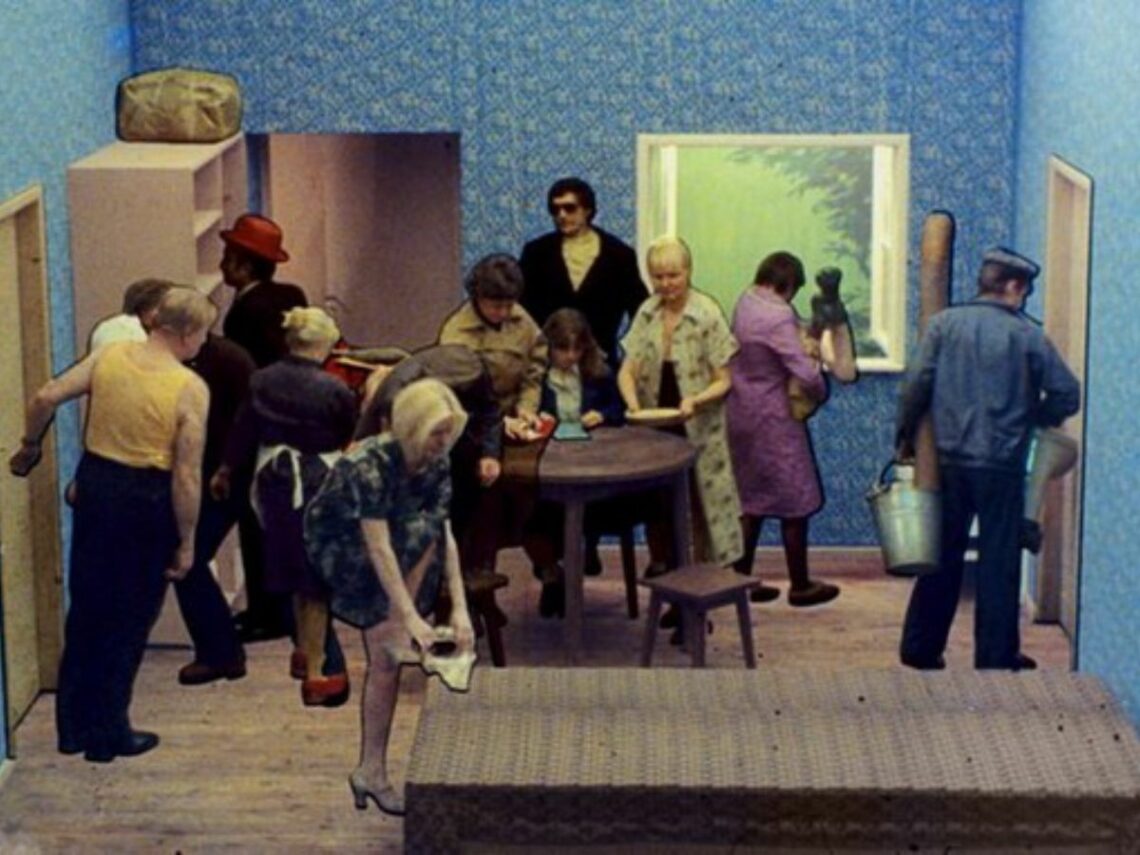
Over the years, Rybczynski has developed an extensive body of work, but one film always stands out whenever his oeuvre is discussed: Tango. The 1981 animated project is considered by many to be the apotheosis of the Polish filmmaker’s artistic vision, featuring a complex experiment with the poetics of space. Built from around 16000 cell mattes and countless exposures, it presents a static shot of a space where characters move in repetitive arcs.
During a conversation with Revolver, Rybczynski said: “In Tango and my other films, there is always a problem with an experimental arrangement. In the realisation I have to find out: is it possible, will it work, and how will it work? I then consider the final effect as a visualisation of my idea. So I didn’t make films because I wanted to say something with them, but to arrive at a result that also depends on whether I can build on it in the next films.”
It’s a fascinating experiment not just because of its technical achievements but also because of its sociopolitical commentary, portraying a limited space that represents the working-class reality of many and also contains seemingly working-class characters. Ranging from a dog getting its butt spanked to a couple going at it in a crowded room, it’s an unparalleled depiction of the chaos that is embedded within a specific economic reality.
The director added: “Tango has a construction that I drew in the form of a graphic representation on graph paper. My storyboards or screenplays are graphic shop windows. Constructing is part of my frequency, so to speak. I am not an impressionist but a constructivist. A perfect construction can grab me, and in Tango, there is a fairly complex construction of space and time. This includes numerous narrative loops with different timing that had to be coordinated. The characters meet at different time levels without there being a plot conflict. This results in a complicated space-time structure.”
Tango managed to gain wider recognition because it won the ‘Best Animated Short Film’ Award at the Oscars, but that’s the least interesting thing about it. It’s a towering work of art that can be compared to the New Complexity movement in music, utilising unsettling multiplicities to disrupt and subvert the narrative structures that we are familiar with.
Watch the film below.
