


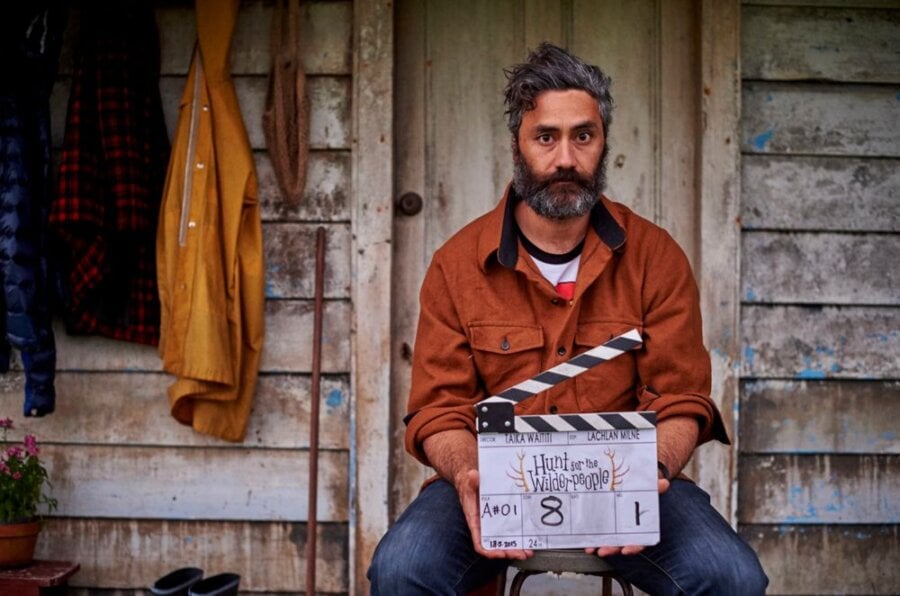
Taika Waititi discusses his love of Andrei Tarkovsky

Taika Waititi has become one of the most well-respected popular filmmakers in recent years. Known for his films Boy, Hunt for the Wilderpeople, What We Do in the Shadows, Thor and Jojo Rabbit, Waititi is the recipient of an Academy Award, a BAFTA, and a Grammy.
Discussing his five favourite films with Rotten Tomatoes, Waititi admitted going through a “big Tarkovsky phase” when he was in his mid-20s and noted that the cinema icon’s 1979 film Stalker was the film that “always stuck with” him.
“For me, I think visually there’s something about that film that manages to get inside your head and touch you on your emotional synapses or something; it somehow just gets in there,” he said. “Visually: for instance, just the shot of this dog, this black dog that’s always wandering around by itself. I mean, Tarkovsky was a master of symbolism and just knowing, for example, that a candle in a certain place would trigger in most audiences’ minds something to do with memory.”
Indeed, often, as with many of the best directors, the imagery tells as much about the film’s narrative as do more conventionally narrative-telling techniques. “It doesn’t always matter what people are saying,” Waititi noted, “because the film’s full of dialogue, full of poetry and stuff, but that’s what I love about that film.”
Waititi went on to explain that he learned an awful lot about filmmaking from watching Tarkovsky’s works. “It’s the same as in painting,” he said. “You know: people have to go back and study the old masters to see how they did shit. They’re called masters because they’re still the best that ever were”.
He then referenced some of the great Japanese film directors alongside Tarkovsky: “It’s the same with Kurosawa and Ozu and Tarkovsky: if you look at their films and what they were doing, you kind of feel safe watching those films.”
The greatest impact that Tarkovsky had on Waititi’s life, though, was to provide a counterpoint to the onslaught of the standard format of American films. “With Tarkovsky’s stuff, I have to keep going back to it to remind myself that there’s an alternative to the 90-minute American film,” he said.
Waititi added, “You know where it’s all fucking three acts and information, boom-boom-boom, and just to go, ‘Hey, you know what — there’s a way of communicating that’s different, and there’s nothing wrong with that. Don’t be scared to appreciate that stuff.’”
