


Survival Research Laboratories’ essential industrial reading list

For nearly 50 years, performance art collective Survival Research Laboratories has delighted in large-scale carnivals of robotic mayhem and industrial destruction.
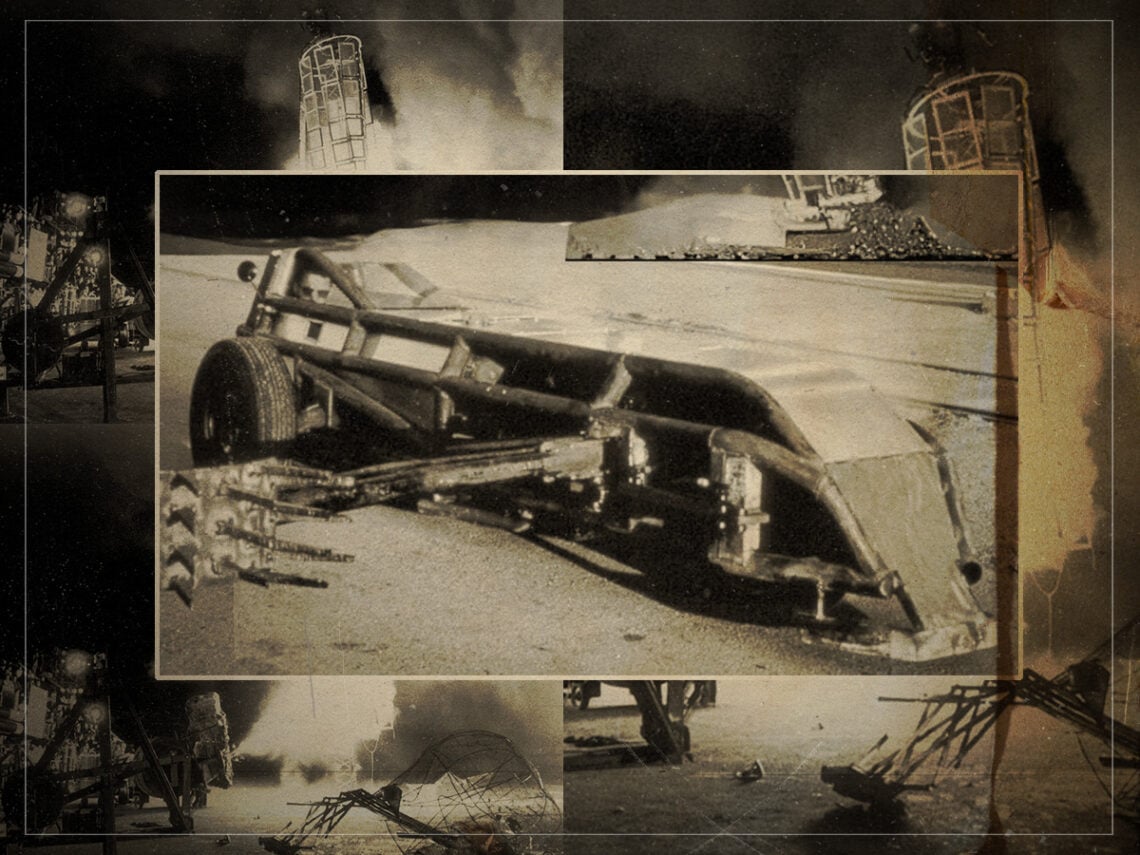
Founded in San Francisco’s arts and punk underground in 1978, SRL boasts a perennial revolving door of mechanised mutants and terror techs artfully dreamed up by the team to unleash all novel manner of obliteration. From the Wunderwaffen’s shockwave blasts that can shatter glass remotely, Sparkshooter’s molten metal spit that propels 500 years with 20,000 volts behind it, or the insectoid walker controlled by a pet guinea pig called Stu, the scrapyard creatures that crawl, scurry, and stomp around their cordoned arenas are the automated and radio-controlled stars of the show.
Founded and headed by ironworks welder turned art student Mark Pauline, SRL’s mission agenda to produce “the most dangerous shows on Earth” ensures the orgies of carnage are always fused to a political edge layering the mechanised maelstrom. Collated from the junk left behind by the military complex and corporate industry, Pauline and the SLR team repurpose the former tools and implements of American foreign policy and capitalist expansion, birthing new alien machines that carry over their hostility from their previous lives but reoriented as relatively harmless entertainment.
Rising up in the arts world alongside the explosion of industrial music that scored the alternative world concurrent to post-punk, Pauline found himself featured in 1983’s Industrial Culture Handbook alongside the likes of Throbbing Gristle and Cabaret Voltaire, offering an in-depth insight into his background, ethos, and creative practice. As well as reeling off several record and film recommendations, listing Steve Allen’s foray into bossa nova jazz alongside Wes Craven’s exploitation shocker Last House on the Left, Pauline outlines his personally curated reading list that offers a clue to his hazardous visions.
Naturally, academia and journals in the armed forces, aviation, and space technology have a general fingerprint on the list, highlighting the defence periodical Armada International for particular note. Alongside the world of industry sits a reach into 19th-century psychology with the seminal Extraordinary Popular Delusions and the Madness of Crowds study from Scottish journalist Charles Mackay, a three-volume work that explores behavioural psychology in the age of fads and financial manias that struck the 1800s but presciently applied to the market forces of today.
Pauline generously slaps “all books” on a host of celebrated alternative authors that prop up plenty in industrial heritage and leftfield pop, JG Ballard, Thomas Pynchon, Walter Abish, and Marguerite Duras all open season in which of their works to dive in first.
Pauline states clearly that he “prefers” Beat writer William Burroughs’ cut-up novels, but elsewhere he plumbs for the select fictions from Gerry Davis and Kit Pedler’s sci-fi thriller Mutant 59: The Plastic Eaters, Raymond Roussel’s surrealist Impressions d’Afrique from 1910, and The Iron Dream. Norman Spinrad’s 1972 alternate history posits Adolf Hitler’s emigration to America after WWI and finding fame as a pulp sci-fi writer, pouring all his latent fascism into the Lord of the Swastika metafiction that the story explores.
“I use literature to maintain a certain sort of order in my mind,” Pauline told Industrial Culture Handbook. “If I don’t read literature that has something to do with my interests, the kind of cynical ideas I have, the structure of my mind starts to fall apart, and I can’t think effectively anymore…”
He added for context how his reading patterns shape his work, “That’s what I do—I read and pretty much strip the structure out of books—I use it to shore up my own faulty system. For some reason I need that; I have to have literature to be able to function correctly. That’s how I trained my mind to work in the first place; through reading, and analysing what I read.”
Survival Research Laboratories’ essential reads:
- Armada International: Home of Defence Publication [journal]
- Extraordinary Popular Delusions and the Madness of Crowds by Charles Mackay
- “All books” by JG Ballard, Thomas Pynchon, Walter Abish, and Marguerite Duras
- Cut-up Trilogy by William Burroughs
- Mutant 59: The Plastic Eaters by Gerry Davis and Kit Pedler
- Impressions d’Afrique by Raymond Roussel
- The Iron Dream by Norman Spinrad
