


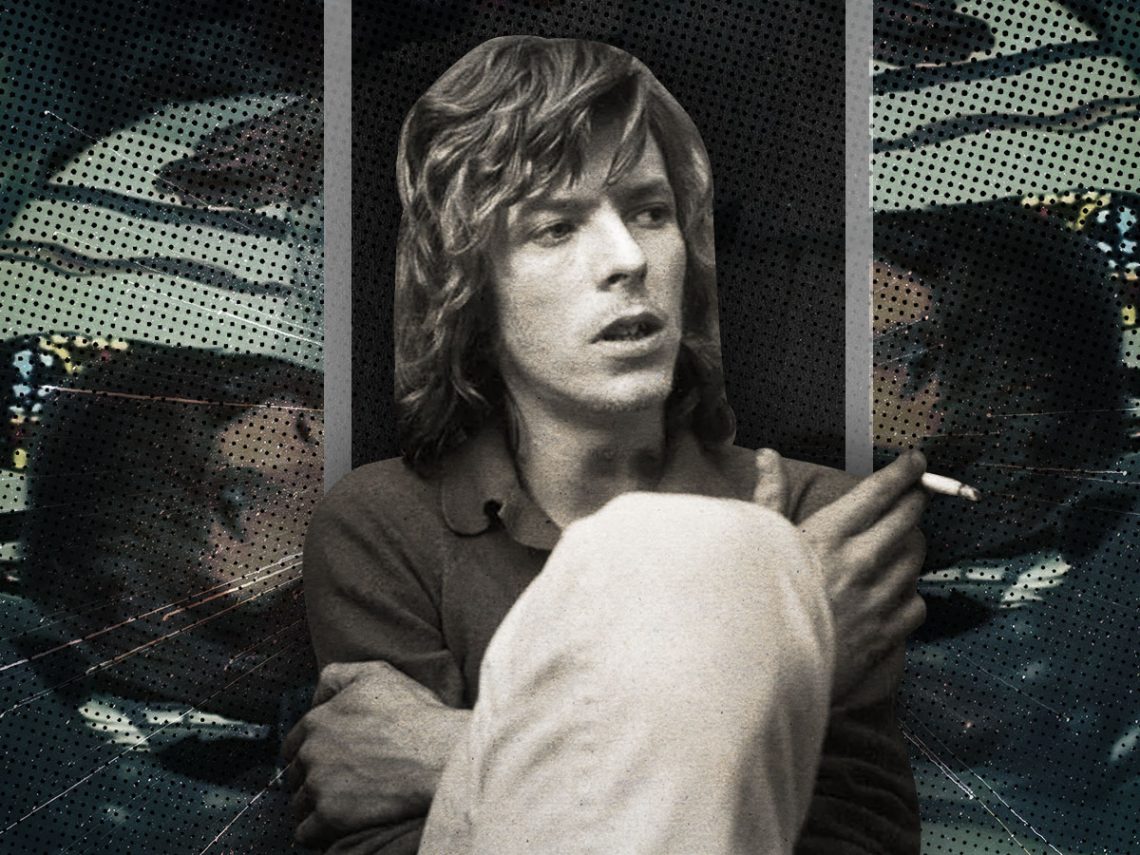
Subsumed by Dystopia: How David Bowie invented punk and saved the world

If punk was a riotous response to helplessness, then what better place to start than the University of Pennsylvania? In 1967, a pair of psychologists created The Learned Helplessness Experiment. In brief, professors Martin Seligman and Steven Maier took some poor little beagles, harnessed them in a contraption that allowed them to stand but not to move, and subjected them to random electric shocks. One group had a button in front of them that they could press with their nose to stop the shock while the other group sadly had no button and simply had to endure the sporadic zaps.
After this phase of the experiment ceased, the individual dogs were placed into a box split in half by a small hurdle. Only one half of the floor was electrified, meaning that all the dogs had to do to escape the shocks was to leap over the small partition. The dogs that had previously been able to stop the shocks by pressing a button duly obliged and leapt away from the electrified half of the floor. However, the beagles that had previously been forced to endure the shocks without recourse, simply endured them once more, too entombed by helplessness to simply leap a few inches away from the torture.
In an alternate universe, this could have almost been a paradigm for the way that the 1970s were going. Despite their best efforts, the children of the revolution in the ‘60s had been subjected to continual shocks without making too much headway with their peace and love movement. The cultural zeitgeist was blighted by assassinations, war and a continual stream of tragedies amid the flower power of pop culture’s renaissance period. When Woodstock failed to turn the tide, all seemed hopeless.
As Joni Mitchell explains in Michelle Mercer’s novel Will You Take Me As I Am. “There were so many sinking, but I had to keep thinking I could make it through the waves. You watched that high of the hippie thing descend into drug depression. Right after Woodstock, then we went through a decade of basic apathy where my generation sucked its thumb and then just decided to be greedy and pornographic.”
Bob Dylan had said that the times were a-changing and by the glorious ‘60s came to a close, they were changing faster than the racetrack rabbit and seemingly for the worse. In New York City, between 1969 to 1974 the boho capital lost 500,000 manufacturing jobs. Subsequently, a million homes depended on welfare, rapes and burglaries tripled, drugs ran rampant, and murders hit a high of 1690 a year. However, a lot of art comes from chaos and defiance—David Bowie keenly purveyed this more than most.
As his hero William S. Burroughs once said: “Artists to my mind are the real architects of change, and not the political legislators who implement change after the fact.” Thus, when Bowie’s music career really took off with ‘Space Oddity’ – a song pointing at the isolation of the modern capitalised world – he became determined for it to make an impact. As producer Tony Visconti recalls: “David said [‘Space Oddity’] was actually a song about isolation and he used the astronaut in space as the metaphor. The song was written in that spirit, being isolated in this little capsule, but seeing the Universe from your window.”
This was a drift not just affecting spacemen like ‘Major Tom’ and Bowie was doggedly hoping to bring drifters back down to earth and revitalise the youth movement. Ziggy Stardust became his masterstroke. The opening track to Stardust’s titular record begins with a bleak news report. The broadcast fizzles out and universal despair descends like thick rain—the sort that lodges itself under loose paving stones and causes a tidal wave of errant urban slosh to splash up on your leg when you idly step on it. Then the resultant wet sock is the sort that makes you give up on the boon of rock ‘n’ roll entirely. However, through this crushing downpour, a meek sun can be seen. Rumours of a hopeful salvation echo in the underground… a rock ‘n’ roll alien called Ziggy who is “simply outrageous” is the saviour among us coaxing him down.
On behalf of the floating eternal “starmen”, Ziggy sets about grabbing the lapels of the youth and rattling them into action like a second hand Skoda travelling over a cattle-grid. He lassos the wild side of life and assumes the role of a divine messenger. Therein his wayward ways impart one sure-fire message: We are here for a good time.
That is the message that the mystic Ziggy might have imparted in a fictional dystopia, but Patti Smith and the likes were sagacious enough to know what Bowie was getting at. “I was young, but I felt our cultural voice was in jeopardy and needed an infusion of new people and ideas. I didn’t feel like I was the one. I didn’t consider myself a musician in any way, but I was a poet and performer, and I did feel that I understood where we were at, what we’d been given and where we should go, and if I could voice it, perhaps it could inspire the next generation.”
“The only people that were interesting at all,” she told Spin, “were people like David Bowie.” So, it seems fitting, that in 1974 Bowie even said, “People look to me to see what the spirit of the ‘70s is.” Seemingly he thought it was a spirit that was trying to ward off the shackles that had slowly descended on art and society. In order to do so, he administered an electric shock to the scene that harked back to the energy of the old days and illuminated the new—no wonder he used a lightning bolt as his motif.
This concept of saving the world from stilted dull drudgery with rock also came to the fore with Aladdin Sane. On the album’s third track, ‘Drive-In Satruday’, he throws all-things ’50s into the sonic mix for a swinging recreation of the slicked-back era. Therein he celebrates the liberating effect of music.
Thus, the eponymous hip-thrusting frontman Mick Jagger enters the mix alongside Twiggy. These two stars of the ‘60s help to save the world from an apocalypse of the youth simply forgetting how to have sex. The synopsis of the song, in an unfurling sense, places youths in the desert, driving out to outdoor movie theatres to pick up tricks from the likes of Jagger about how to break the spell of celibacy that Bowie almost ironically extolls befell those who came after the ‘60s.
The rampant lust at the heart of punk proves that Bowie was, I suppose, successful in ensuring this drive-in dystopia never came to pass. Bowie stood out amid the music scene as a freak going his own way, and he encouraged others to do the same, to harness the energy of rock ‘n’ roll and make an outrageous change. His wild outfits were soon mimicked by the likes of the New York Dolls and suddenly kids had a new movement to cling to—a means to elope from the dystopia around them. From his love for Metropolis and [The Cabinet of Dr] Caligari to the championing the riotous nature of Iggy Pop, this love for disrupting potential doom with an assegai of rebellious creativity is something that he stood by throughout his career, and it is, in essence, the same central tenet of punk.
As he said of the genre that borrowed so much from him: “It was a vital necessity at the time. Everything again was becoming complacent. Everybody was saying such and such. ‘This is how it goes’, and we’ve all got our future’s planned’. It was getting too technical again. Everybody wanted to be great guitarists, or at that time, synthesiser players.”
“Then these ragged arse little street muffins came along,” Bowie said in a way only he could. “With instruments, they’d either stolen, or got on hire purchase and saying, ‘We want to be superstars, and we want to sing about the conditions we know about. We can’t afford to go to rock concerts to see bands or things. So we’ll just sing about the neighbours, girls, the things we do or we don’t want to do, and the places we don’t want to go.” As Johnny Thunders would ratify: “Rock ‘n’ roll is simply an attitude. You don’t have to play the greatest guitar.” Without Bowie first illuminating that in his own outsider away amid the onslaught of prog, the revelation of punk might have been subsumed in the mire.
Was this his intent with Ziggy Stardust all along? Well, Bowie was a man with a keen eye for psychology. In fact, he once even ventured into a remote Austrian psychiatric hospital with Brian Eno for the weekend as research for Outside. Whether or not his psychological curiosity stretched to a knowledge of The Learned Helplessness Experiment is hard to know, but one metaphor is easy to draw: he was certainly the heroic beagle who urged the despairing to leap over the hurdle and get out there.

Never Miss A Beat
The Far Out Punk Newsletter
All the latest Punk content from the independent voice of culture.
Straight to your inbox.