


Cinecittà Studios: The story behind Italy’s greatest film studio

Beyond Los Angeles, few cities hum with the memory of cinema’s golden age as loudly as Rome. In the 1950s and ’60s, the Italian capital had more cool per capita than anywhere on the planet. Both responsible for and synonymous with the fashion, music, nightlife – and, of course – cinema of the day, Rome was at the centre of it all, with the biggest names in the film world helping to re-establish the ‘Eternal City’ as an icon in its own right. Burton and Taylor, Sophia Loren, Marcello Mastroianni, Marlon Brando, Kirk Douglas, Audrey Hepburn: all of them lived and worked here for a time. It was the ‘Hollywood on the Tiber’, and at the centre of it all was Cinecittà Studios.
I say ‘centre’. Cinecittà is actually located 5.6 miles to the southwest of Rome, where it lies just a lemon’s toss from the Appian Way, one of the first roads of the ancient republic. While Rome’s empire may have faded long ago, its scale and grandeur are echoed in the pale walls of Cinecittà, which remains the largest film and movie studio in continental Europe, covering an area of 99 acres. With a population of 5,000 production personnel, it’s no wonder this incubator of Italian neorealism was named ‘Cinema City’.
Founded by Benito Mussolini, Cinecittà Studios opened its doors in 1937. At this time, it was used to make government propaganda films, many of which still exist. It is said that the studio’s vault contains more than 100,000 pre-war newsreels, including the dictator’s declaration of war against the allies. In 1945, by which time Italy had decided to ditch the Nazis, Roberto Rossellini began work on his neorealist masterpiece Rome: Open City. The film was formative in the development of Italy’s post-war national identity, offering an alternative to the Hollywood studio system, putting amateur actors centre stage and using real-world locations wherever possible. Rome: Open City went on to win the Grand Prize at the 1946 Cannes Film Festival and the New York Critics Choice Award for Best Foreign Film the same year. Its success not only marked the zenith of Italian cinema’s golden age but established Cinecittà as a worthy alternative to the Hollywood dream factory.
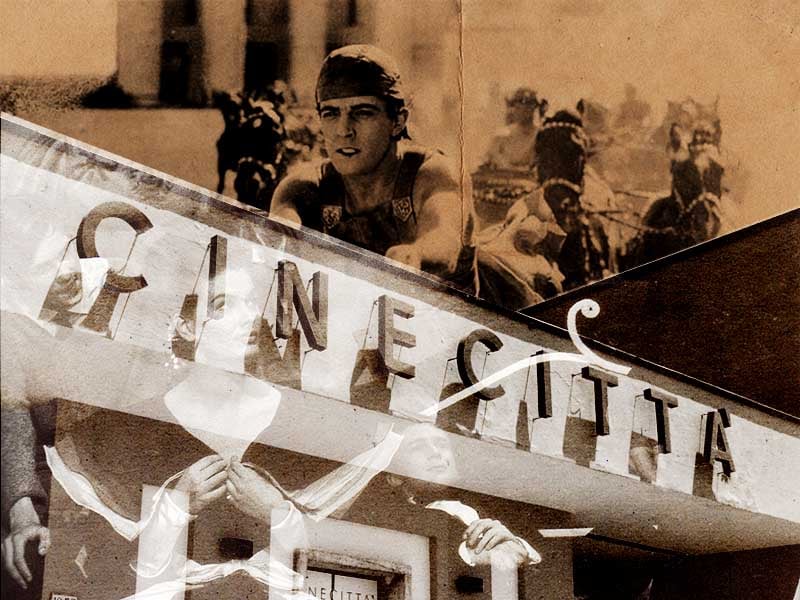
By the end of the 1950s, Cinecittà was producing some of the biggest film production on the planet, including classic historical epics such as Helen of Troy and MGM’s Ben-Hur, the latter of which used more than 33 sets, 10,000 extras and over 100,000 different costumes. Its budget was in excess of $15 million and its director, William Wyler, even made an artificial lake constructed in one of Cinecittà’s back lots, which was utilised for the various naval scenes. Perhaps the most famous set built for the movie was the amphitheatre which serves as the setting for the chariot race between Ben-Hur and Messala. At 18 acres, it was the largest set ever built for a film and cost around $1 million to construct. Following the success of Ben-Hur, Cinecittà became the studio for sword and sandal movies, playing host to the crew of Helen of Troy and Cleopatra, starring Richard Burton and Elizabeth Taylor.
In 1960, another era-defining filmmaker set up shop in Cinecittà Studios. Federico Fellini used the studio for the production of his controversial romantic drama La Dolce Vita, sparking a love affair that would last a lifetime. He once called the studio “my ideal world, the cosmic space before the big bang”.
On release, La Dolce Vita was condemned by the Vatican for its frequent depiction of sex and drug use – basically all of the things that made it such a hit. The film raked in more than $19 million at the box office and is widely regarded as the bridge between neorealism and was celebrated for breathing new life into modern Italian cinema. Indeed, if there’s one thing that can be said of Cinecittà Studios with absolute certainty, it is that it has life coming out of the metaphorical wazoo. Responsible for creating some of the most enduring filmic narratives of our age, the echoes of the film studio’s heyday are still ringing in our ears. If you want to find out more about the history of Cinecittà and happen to be in Rome, you can find it on Via Tuscolana.
