


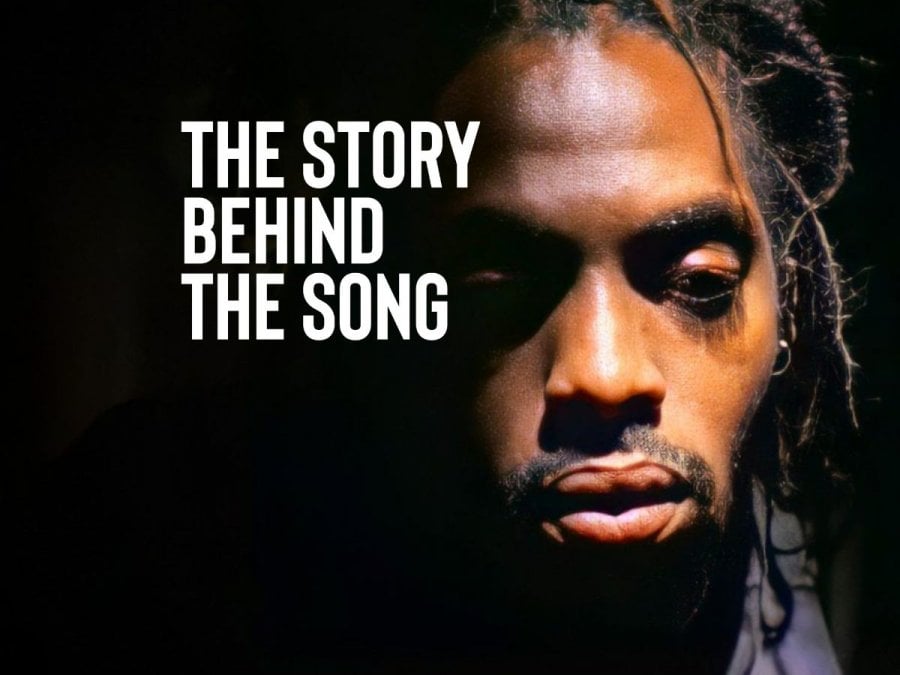
The Story Behind The Song: Coolio’s cinematic masterpiece ‘Gangsta’s Paradise’

Few songs are as intrinsically linked to a decade and all its foibles as Coolio‘s 1995 anthem ‘Gangsta’s Paradise’. The song shot to fame across the globe after it was given an ample cultural partner in Michelle Pfeiffer’s film Dangerous Minds. For a while, in the mid-90s, it was entirely impossible to walk down any street without hearing this song blasting out of a stereo, no matter if you were in Los Angeles or Lyme Regis, this song was blaring out of your nearest speakers. It became an anthem and is rightly considered perhaps the greatest hip hop track ever made for a film.
The cinematic qualities of Coolio’s visceral lyrics and the soulful refrain of L.V. (the vocalist on the project) was not lost on anybody who heard it. Originally, the song was eyed up by Will Smith and Martin Lawrence for the title track of their upcoming action thriller Bad Boys but, clearly, with his mind on his money, Coolio went for the highest bidder.
While the decision may seem like a money-motivated one, the truth is there was another reason Coolio wanted to collaborate with Pfeiffer and co. It would provide a star-studded MTV video, which made perfect sense for the Compton rapper. By giving the song to Dangerous Minds, he got himself a music video with the now-iconic Antoine Fuqua and the mega-star Michelle Pfeiffer. Coolio had now put himself centre stage.
As well as being a classic hip hop anthem, the film the song was attached to was also a huge hit. The school-based drama focused on Pfeiffer’s efforts to get through to her classroom full of troublemakers as their teacher. Through Bob Dyan and alternative teaching methods, she tries to help them fall in love with learning and achieve their high school graduation certificates.
Like so many classic records, the track is a reworking of Stevie Wonder’s classic ‘Pastime Paradise’ and sees Coolio drop some street knowledge on a sensational beat. “I wasn’t really familiar with ‘Pastime Paradise,’ as much of a Stevie Wonder fan as I was,” Coolio explained to Rolling Stone.
“My very first album I ever bought was the one with ‘Superwoman’ on it. [1972’s Music of My Mind.] I got that for my 12th birthday, that one and Fight the Power by the Isley Brothers. Songs in the Key of Life, my mother had that album at the house, so it was kind of weird that I didn’t know the song.
Though Coolio had never been particularly interested in recording the cover, Larry Sanders sent the demo his way, and everything clicked. Coolio would later perform the song alongside Stevie Wonder at the 1995 Billboard awards. Speaking about the song’s creation with Howard Stern in 1995, Coolio noted the track’s central imagery: “It’s really all about life, because you living in a gangster’s paradise also. See, you’re business is not really controlled, and a ‘gangster’s paradise’ is when you’re being controlled. When I was writing it, L.V. singing the track, and I walked in and was like, ‘damn, I would really like this song’.”
The song would also give CooIio his first Grammy, taking home the prize for Best Rap Solo Performance. It flew to number one on both sides of the Atlantic and confirmed that Coolio’s career was about to skyrocket. It provided the perfect zenith of art imitating life as the Compton native penned a song about trying to break out of the hood through knowledge.
Coolio said of the writing process: “I sat down and I started writing. Hearing the bass line, the chorus line and the hook, it just opened up my mind. ‘As I walk through the valley of the shadow of death/I take a look at my life, and I see there’s nothing left’ — I freestyled that; that came off the top of the dome, and I wrote that down.
“I thought about it for a minute,” he continued, “and then I wrote the whole rest of the song without stopping, from the first verse to the third verse. You know, I like to believe that it was divine intervention. ‘Gangsta’s Paradise’ wanted to be born; it wanted to come to life, and it chose me as the vessel.”
The track has become a mainstay of decade parties, a cultural touchstone among hip hop fans and one of the few songs of the era that broke into the mainstream beyond any kind of voyeuristic notion. The song reached number one in the United States, Ireland, United Kingdom, France, Italy, Germany, Sweden, Austria, Denmark and across Australasia, setting a record in Australia with 14 weeks at the top. The single was the first explicitly rap song to sell over a million copies.
For those reasons and several more, the legacy of Coolio, the late rapper, can be heard in every bar of ‘Gangsta’s Paradise’.
