


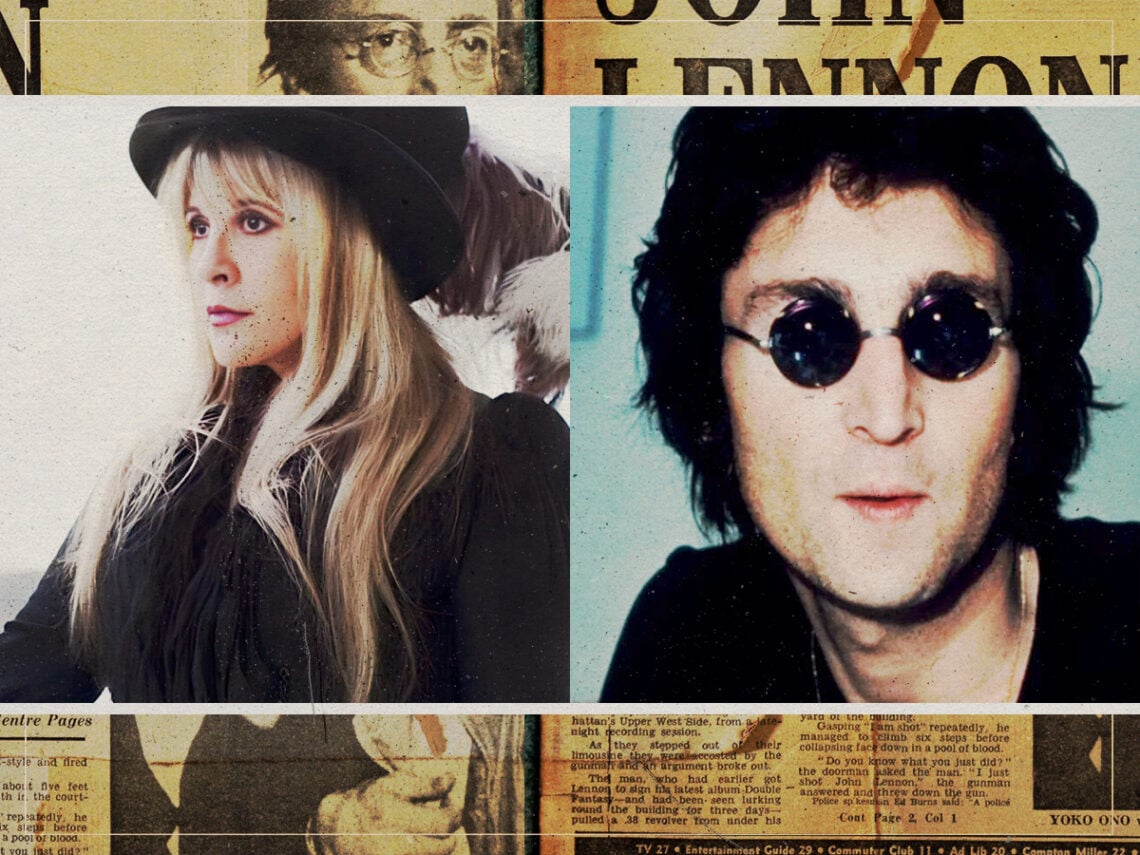
Stevie Nicks explains how the death of John Lennon terrified musicians

It’s not an exaggeration to say that the death of John Lennon changed music forever. It remains the biggest ‘what if’ question there is. What if he’d survived? What music would the world have heard that the tragedy took for us? What might have happened to the Beatles later down the line? Would they have gotten back together? The answers are an infinite spiral of possibilities. Now, the answer will never come. But for Stevie Nicks and her fellow musicians, the assassination was not only devastating but was utterly terrifying.
It was the December 8th, 1980. That day, Lennon and Yoko Ono did a photoshoot with Annie Leibovitz. Lennon held an interview with Dave Sholin, not knowing it would be his last. The pair stepped out to head to the studio to finish the mix of their track, ‘Walking on Thin Ice’, a song he was sure would be a hit as Lennon said, “I think you just cut your first number one, Yoko.”
But lingering around their apartment at the Dakota was Mark Chapman, a crazed and deranged crazed man masquerading as a fan. Earlier that day, Lennon had met his killer, signed his record, and chatted a while with his murderer, later remarking, “He was very kind to me. Ironically, very kind and was very patient with me.”
The kindness couldn’t save the singer, though, as at 10:48pm, Chapman opened fire on Lennon as he was making his way back into their apartment. At 11:01pm, John Lennon is pronounced dead, and the course of music history is changed forever.
It’s a harrowing tale for anyone to hear, especially considering the chilling fact that Lennon has chatted cordially with the man who would kill him just mere hours before the deed. But for Nicks, the death of an artist sent shock waves through the music community, bursting a bubble of safety that they’d once thought surrounded them.
“That was a very scary and sad moment for all of us in the rock and roll business, it scared us all to death that some idiot could be so deranged that he would wait outside your apartment building, never having known you, and shoot you dead,” Nicks said.
To her, this wasn’t something that happened to musicians. The prospect of assassination felt far removed, like a fate reserved for political figures. “If you were the president of the United States, maybe, but to just be a music person, albeit a Beatle? And to be shot and killed in front of your apartment, when you had a wife and two kids? That was so unacceptable to all of us in our community,” she said, still shaken by the fact that something so horrible could happen in her world.
For Nicks, the only way to process the loss and the fear it had left her with was through song. Her track ‘Edge Of Seventeen’ became a kind of battle cry, attempting to turn this confusion and upset into a song of power and defiance. While the lyrics metaphorically meander through the idea of life’s unexpected twists and turns, the chugging guitars and big rock sound feel bolstering, as if the instrumentation is emboldening the track’s concepts.
“Everything stopped / Nothin’ else mattered,” she sings as if capturing the moment of Lennon’s death or the ways that the world can switch in a second. It’s a reminder of what’s important by confronting the fleeting nature of life. But the track is also a resting place for the Beatle as Nicks wrote him into the imagery of the track.
Written right after his assassination, Nicks said, “The white dove was John Lennon and peace”.
