


The Ballad of Steve Wiebe: Good and evil in the world of competitive ‘Donkey Kong’

There’s a real power to the medium of the documentary film. Documentaries can take a subject with which we have no prior knowledge and not only inform us of its inner secrets but also present a narrative which we have a more substantial, previously built, conceptual relationship with.
One such instance of this magnificent quality of the documentary came in 2007 with Seth Gordon’s film The King of Kong: A Fistful of Quarters. Gordon would eventually become known for his comedy movies Four Christmases and Horrible Bosses, but it is The King of Kong that still serves as his arguable greatest cinematic achievement.
The film tells the banal yet utterly fascinating tale of the challenge to record the highest score for the 1981 arcade video game Donkey Kong, developed and published by Nintendo. We’re introduced to the entrepreneur Billy Mitchell, who just so happens to hold the record for several arcade games, including, you guessed it, Donkey Kong.
Straight away, though, we know something’s up with Mitchell, whose beard, shock of long brown hair, and shirt and tie combo almost cuts him as a Jesus Christ figure, something we learn that he genuinely believes himself to be. Mitchell swans about with his joyless wife and adoring entourage. “Games can be fun,” Mitchell claims, but their real beauty is in the competition.
Cut to Steve Wiebe, polo-shirted and cropped-haired, pretty much diametrically opposed to everything Billy Mitchell represents. He finds comfort in video games and a sense of control that the stresses and pains of real life seem to hold no consideration for. We will come to love everything about Steve Wiebe.
Wiebe, a former engineer, is out of work in 2003 and buys himself a Donkey Kong machine to pass some time with a loose hope of maybe setting its world record. His experience in mathematical engineering gives him an advantage in understanding the patterns of the game, and he eventually sets a record of 947,200 points, followed by the first-ever score over one million – 1,006,600 points.
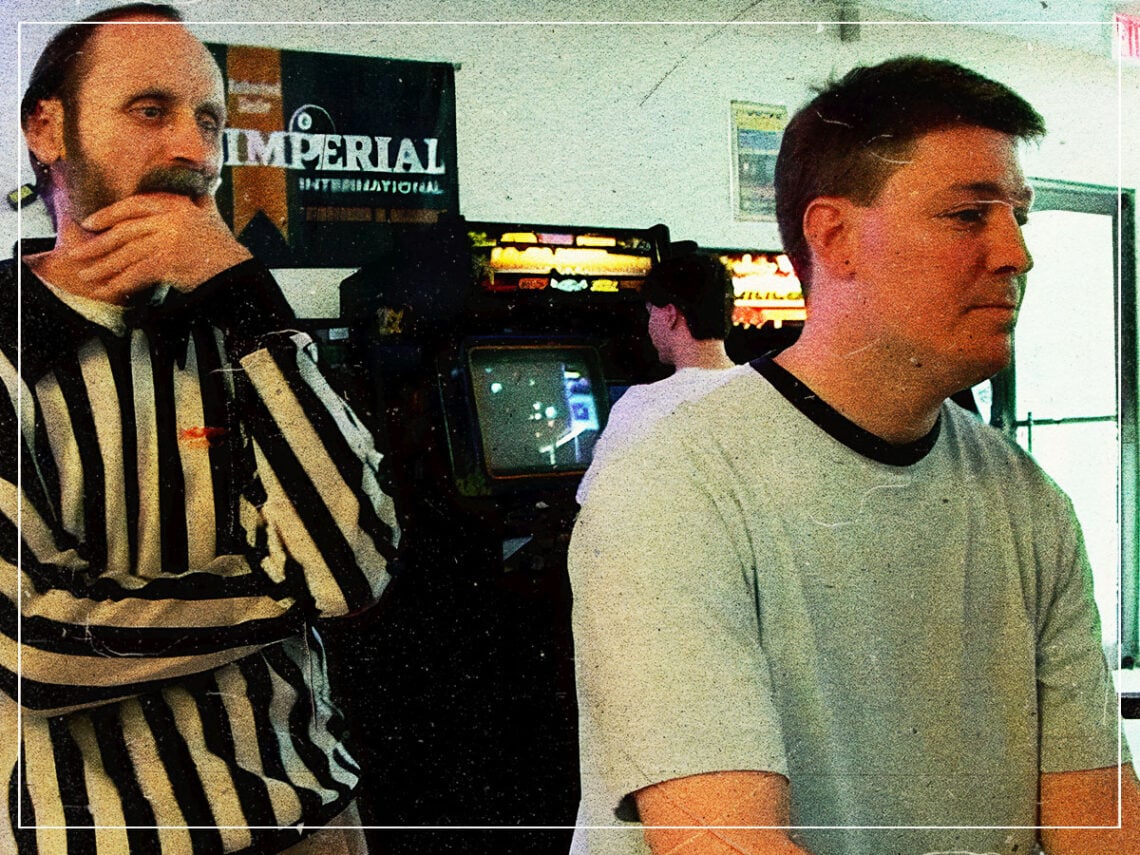
Billy Mitchell, famed as he is, has more than a few fingers in the pies of Twin Galaxies, the organisation responsible for tracking video game high scores. For Mitchell, all he wants is to be famous, to be the best in a true display of self-aggrandisement and arrogance. Mitchell and Twin Galaxies quickly send a referee to look into Wiebe’s score and then claim it should be invalidated over concerns about Wiebe’s game board, which was provided by Roy Shildt, who has a longstanding feud with Mitchell over a Missile Command high score.
Wiebe is naturally upset; as far as he was aware, his score is authentic. He follows up by agreeing to record a live score at a tournament in New Hampshire, accompanied by his wife and sons and also invites Mitchell to a one-on-one challenge. However, clearly scared of getting his ass kicked, Mitchell declines.
When Wiebe approaches a live-set high score in New Hampshire, Mitchell has his crony Brian Kuh drum up a crowd to try and put Wiebe under pressure, but Wiebe somehow still manages to record a new high score of 985,000 points. Mitchell’s not done just there, though, and sends in a videotaped score of 1,047,200 points, which is immediately accepted by Twin Galaxies despite the tape seemingly showing the score jumping around unusually. Wiebe’s request to see the tape is denied.
So, we’re left in a terribly unjust situation of our hero Steve Wiebe, good and honest and downtrodden, by the seemingly evil Billy Mitchell. Seth Gordon does a masterful job of pitting these two age-old archetypes against one another, despite the seemingly weird and banal subject matter. We root outrightly for Wiebe; he’s the everyman, he’s all of us, the oppressed, the downtrodden, while Mitchell is certainly portrayed as the man with too much power, the ugly narcissist with little care for justice and the right thing to do. Even Twin Galaxies founder Walter Day comes to side with Wiebe, much to Mitchell’s chagrin.
Robert Louis Stevenson once wrote, “In each of us, two natures are at war – the good and the evil. All our lives, the fight goes on between them, and one of them must conquer. But in our own hands lies the power to choose – what we want most to be we are.”
In light of those words, it’s clear that Steve Wiebe can’t help but be good; he’s a family man and has already suffered the slings and arrows of misfortune throughout his life, having recently lost his job. But he never gives up. In fact, it is perhaps because of Billy Mitchell’s heinous ways that Wiebe is driven to overcome his adversity.
The opposite can be said for Mitchell himself. He’s cocksure, blinded by his fame, forever turned from doing good, even though the opportunity is often there for the taking right in front of him. Mitchell’s pride is what forces his hand in becoming what he truly is – an outright prick. He can’t entirely concede the idea that someone is better than him, even though he (Wiebe) clearly is.
And that’s the beauty of The King of Kong. Good and evil are everywhere we look, even in the most unlikely of places, say a Donkey Kong arcade game competition. And what’s most interesting about the film is that we are immediately drawn towards that beacon of good and of light, Steve Wiebe, perhaps more so because we know he’s indeed a real person with an actual quest beyond his own self-advancement.
If you want to see whether the plight of good in Steve Wiebe conquers the evil forces of Billy Mitchell, then check out The King of Kong: A Fistful of Quarters below.
