


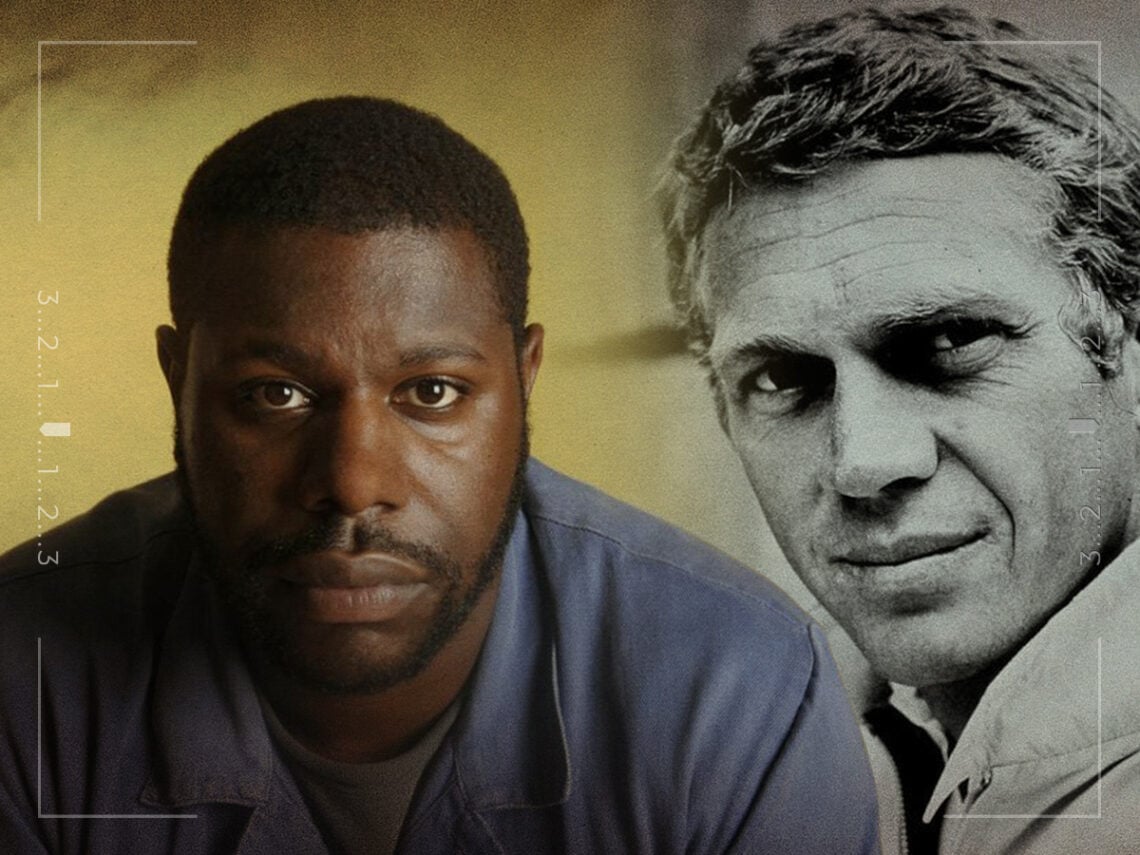
Steve McQueen, the director, names his favourite movie by Steve McQueen, the actor

On October 9th, 1969, a baby was born in a London hospital to a Trinidadian mother and a Grenadian father with the surname ‘McQueen‘.
In those days, while the exhausted mother recovered, newborns were kept in a basket on the end of the bed with the family name written on the side. For the next few hours, every time a nurse passed, she would ask, “How’s Steve doing?” At first, the mother had no idea why they were referring to her as-yet-unnamed baby as Steve, until she found out it was an affectionate reference to one of the biggest movie stars of the day: Steve McQueen.
At that time, Bullitt was still busting blocks at UK cinemas, and the nurses got a kick out of the newborn with the same surname as the iconic actor who played crusading detective Frank Bullitt. Initially, the mother wasn’t keen on her baby being named after the star, but the more she heard the name ‘Steve’ mentioned, the more it “started to have a nice ring to it.” This, as revealed to The Daily Mirror in 2014, is how the acclaimed director Steve McQueen received his famous name, which bestowed the movie business with not one, but two iconic Steve McQueens.
As the future filmmaker grew up in Ealing, West London, he showed an early aptitude for football, which made him one of the more popular kids in his class. “It was fun,” he told The Guardian with a smile. “We laughed all day. I didn’t do any homework ever. We just laughed.” However, when he turned 13, his class was split in two, with one focusing on academically gifted children, and the other on kids whose futures more likely lay in manual labour or a trade. By this point, McQueen had developed an interest in art, and had no idea why he wound up in the second class.
Then, when he returned to his high school to present an achievement award 15 years later, the new headmaster admitted the school had been institutionally racist back then, and that’s likely why he, and other Black boys like him, didn’t have their potentially fully explored. “The system, it was absolutely disgusting,” he raged. “It’s divisive and it was hurtful.” He couldn’t help wondering about the other kids who failed to achieve their dreams because “no one believed in them, or gave them a chance, or invested any time in them.”
This period of McQueen’s life was extremely difficult, but thankfully, he continued to develop his drawing skills, and eventually made it to the University of London’s Goldsmiths College to study fine art. This was where he first developed an interest in film, a medium through which he could express his artistic ambitions, his contempt of authority, and his experiences of racism. Eventually, with harrowing, well-observed dramas like Hunger, Shame, and 12 Years a Slave, he became one of the most vital voices in British cinema.
By the time he became famous in his own right, McQueen, the director, had forged such a unique path that he had little call to talk about McQueen the actor. While they shared the same name and both worked in movies, their lives and crafts had little else in common. However, that didn’t stop curious journalists from remarking on his iconic name, or asking him what he thought about his namesake’s films.
Finally, while being interviewed by the short-lived news service The Messenger in 2023, the Small Axe director did (somewhat reluctantly) admit that the Great Escape star was a vital part of one of his earliest cinema experiences. In fact, he still counts the McQueen film he saw that day as his favourite movie from the taciturn star’s entire career. “This was actually one of the first movies I saw at the cinema,” he nodded as he took a stroll down memory lane. “I went with my father to the Hammersmith Odeon.”
What film did they see on that fateful day? None other than The Magnificent Seven, the seminal western adventure that saw McQueen join an ensemble cast including Yul Brynner, Eli Wallach, and Charles Bronson. The young boy was blown away by Elmer Bernstein’s instantly memorable score, and loved watching the action-packed tale of seven gunslingers defending a village from bandits unfold in all its technicolour glory. However, his primary memory of the occasion was actually the experience of going to that particular cinema, which imprinted on him forever. “I remember running my hands on the side of the walls, and it was carpeted,” he said wistfully. “This is one of my first movie experiences, if not even my first. And I loved that.”
