


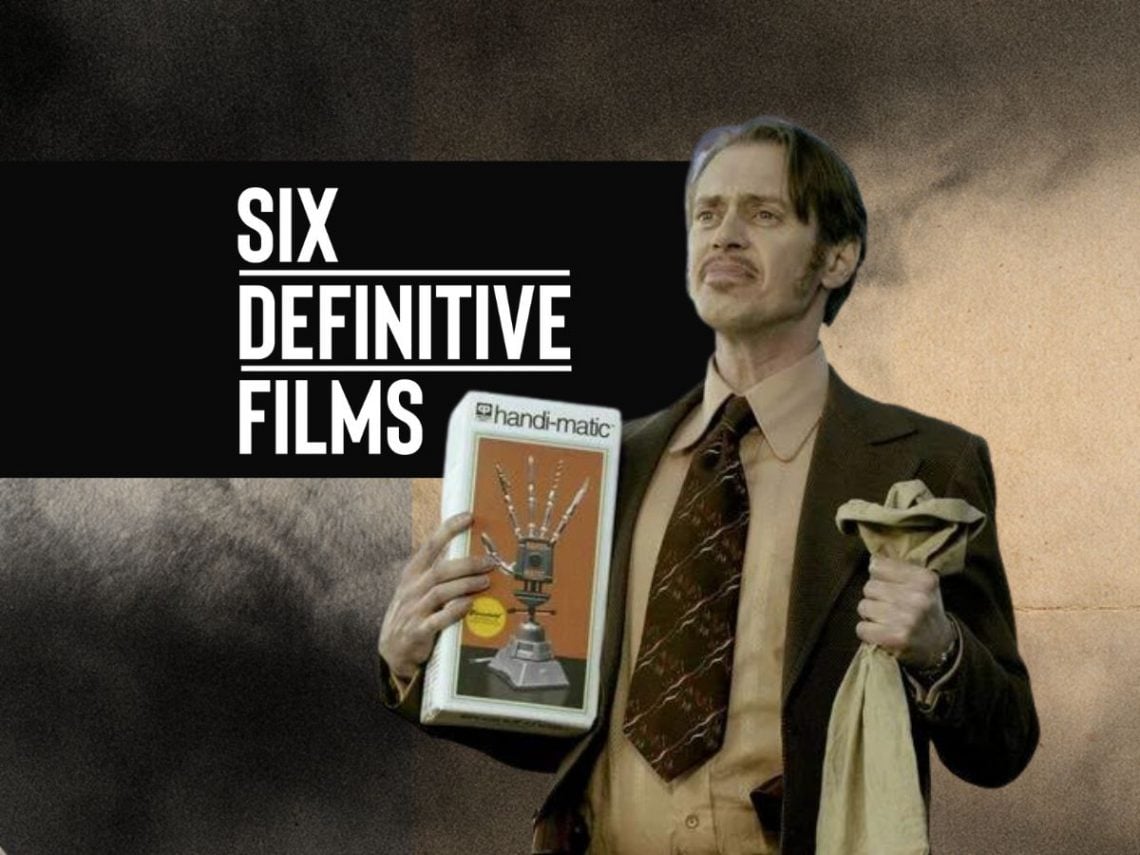
Six Definitive Films: The ultimate beginner’s guide to Steve Buscemi

Despite rarely appearing in lead roles, Steve Buscemi has developed a reputation as one of the most revered character actors of his generation, bringing a gloriously oddball energy to each of his characters.
Born in Brooklyn to a sanitation worker and a hostess at Howard Johnson’s, Buscemi’s family left New York when he was ten, settling in Valley Stream, Nassau Country. It was here that Buscemi would attend high school and experience his first taste of acting. He would later return to Valley Stream for his 1998 film Trees Lounge, set and mostly shot in the town where he grew up.
After graduating from high school and attending Nassau Community College for a short spell, Buscemi moved to Manhattan to take up a place at the Lee Strasberg Institute. It was around this time that he began writing and performing in original plays with writing partner Mark Boone Junior.
In 1985, after years of graft, Buscemi made his screen debut in The Way It Is, a black and white number directed by Eric Mitchell and starring Kai Eric, Brosi Major, Vincent Gallo and Buscemi as a group of actors rehearsing a play in New York’s East Village. That brings us to our first film. These are the six definitive films of Steve Buscemi.
Steve Buscemi’s six definitive films:
Mystery Train (Jim Jarmusch, 1989)
Buscemi’s performance in The Way It Is earned him further roles in 1986’s Parting Glances and a bit-part in Miami Vice. Then, in 1989, he appeared in a string of movies that cemented his reputation: Slaves of New York, Bloodhounds of Broadway, Martin Scorsese’s New York Stories and Jim Jarmusch’s indie feature Mystery Train, which earned him the Independent Spirit award for Best Supporting Male.
Buscemi stars as Charlie The Barber, one of three amateur robbers who end up going on a drunken binge and shooting up a racist shop owner. His co-star, The Clash’s Joe Strummer, is far from convincing, but Buscemi gives a wry edge to his character – it’s completely magnetic.
Reservoir Dogs (Quentin Tarantino, 1992)
The 1990s were a good decade for Buscemi. Following his breakthrough, he starred in Miller’s Crossing, his first Coen brothers collaboration. Then, in 1991 he starred in the duo’s black comedy Barton Fink, which was released the same year he landed his first lead role in Alexandre Rockwell’s In the Soup.
However, it was for a smaller role that Buscemi gained the most recognition. In 1992, he starred as Mr Pink in Quentin Tarantino’s Reservoir Dogs, a role that was originally intended for the director himself. One of the best heist movies of all time, Reservoir Dogs follows six criminals, unknown to one another, who come together to carry out a robbery only to be ambushed by police and shoot their way out, leading the survivors to conclude that somebody int he gang has been loose-lipped. Buscemi is wonderfully sleazy.
Fargo (Ethan Coen, 1996)
After appearing in Tarantino’s next film, Pulp Fiction, and endearing himself to comedy fans in Airhead, Buscemi landed a role in the Coen brothers’ dark comedy Fargo, which competed for the Palme d’Or at the 1996 Cannes Film Festival and earned the actor a reputation as a talented character actor
Buscemi plays Carol Showalter, a thug hired by destitute car salesman Jerry Lundegaard to kidnap his own wife. Looking for quick cash fast, Jerry hopes that the victim’s wealthy father will pay the ransom, which he will then collect, paying the criminals a small fee for the trouble. Sadly, the scheme falls through when Showalter’s partner, Gaear, shoots a state trooper and two witnesses.
The Big Lebowski (Coen brothers, 1998)
In 1998, Buscemi rose to new heights after starting in Garland Greene’s 1997 picture Con Air and Michael Bay’s action blockbuster Armageddon, which saw him star opposite Bruce Willis. That same year, he was cast as Donny in the Coen brothers picture, The Big Lebowski. It remains one of his most iconic roles.
Though The Big Lewboski’s main focus is its titular character, it is The Dude’s companions who make this particular film the perennial stoner classic that it is. Take Donny, for example, an unflinchingly dim bowling enthusiast who is continually told to “shut the fuck up” by Lewboswki as they engage in a wild goose chase around LA in pursuit of Lebowski’s namesake and, following this escapade, his kidnapped wife.
Ghost World (Terry Zwigoff, 2001)
The 2000s marked a shift in Buscemi’s career, with the actor co-starring in a number of children’s films, including Spy Kids 2: The Island of Lost Dreams, Monsters Inc and Charlottes Web. However, in 2001, he played Seymour, the middle-aged loner of Ghost World.
Starring Thora Birch as Enid and Scarlett Johansson as Rebecca, Ghost World tells the story of two high-school graduates trying to work out what they really want from life. While Enid becomes friends with a local oddball called Seymour, Rebecca becomes increasingly fixated on their previous join crush, Josh. As the girl’s friendship starts to change, a new one, that between Seymour and Enid, begins to bloom.
The Death of Stalin (Armando Iannucci, 2017)
After bagging awards-a-plenty for his portrayal of Enoch Thompson in the HBO drama series Boardwalk Empire, Buscemi signed on to Armando Ianucci’s satirical dark comedy The Death of Stalin, in which he plays Nikita Khrushchev, a role that earned him a British Independent Film Award nomination for Best Supporting Actor.
The Death of Stalin, as the name implies, traces the aftermath of Russian dictator Joseph Stalin’s death in 1953. A frantic power struggle ensues while the Soviet Union awaits its next leader. Khrushchev is one of the contenders, joining Georgy Malenkov and Lavrenti Beria in a battle of political cunning. That might sound a little austere, but remember that Iannucci wrote The Thick of It, undoubtedly the most scathing, hilarious and, regrettably, accurate satirical comedies of the 2000s. Buscemi is the wildest politician of the bunch but, sadly, not wily enough.

Never Miss A Take
The Far Out Quentin Tarantino Newsletter
All the latest Quentin Tarantino content from the independent voice of culture.
Straight to your inbox.