


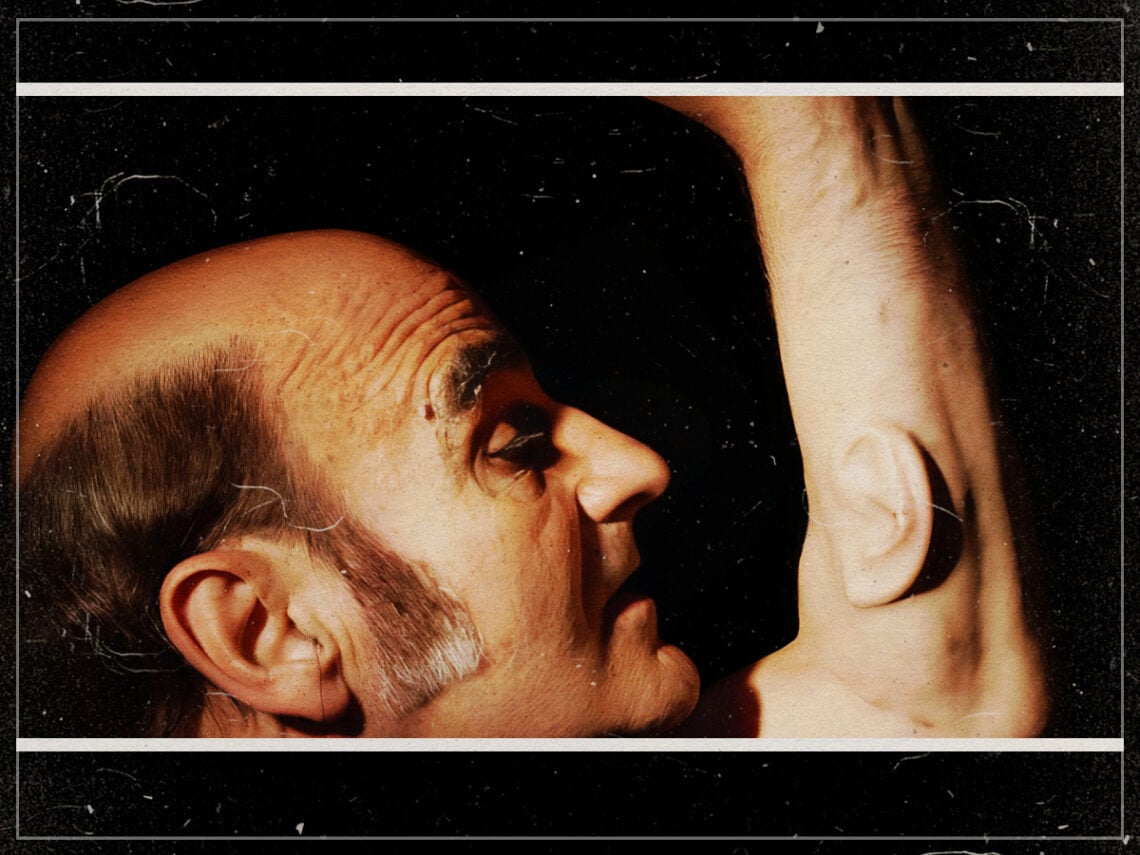
Stelarc: the artist who grew a third ear

People argued it was offensive, and surgeons pointed out there was no clinical necessity for the operation. But Australian artist Stelarc spent ten years weighing up those two points. Over the course of a decade, he’d been slowly raising funds, scouring the country for surgeons willing to implant an extra ear in his forearm.
Years earlier, he’d been struck by the scientific developments happening in MIT labs. Harvard surgeons Joseph and Charles Vacanti had worked alongside MIT engineer Bob Lander to produce the ‘Vacanti Mouse’. They implanted an artificial ear on the back of a mouse. This was no small feat either, given that ears are one of the hardest parts of the human body to reconstruct because they’re made up of cartilage.
The cartilage on its own is easy to manufacture, but making it out of human tissue is incredibly complex. It left people who’d either been born without one or had lost them in accidents without the ability to surgically correct it. That’s what makes Stelarc’s elective surgery so divisive. With access to surgeons not afforded to most, a scaffold was inserted under the skin of his arm, and within months, tissues started to develop around it. It had its own blood supply.
Stelarc was thrilled. His work often took on a scientific bent, tending to question the limits of the human body by introducing technology to it. “People’s reactions range from bemusement to bewilderment to curiosity, but you don’t really expect people to understand the art component of all of this,” he told ABC. “I guess I’ve always got something up my sleeve, but often my sleeve is rolled down.”
His use of technology didn’t end once the ear was implanted. He also looked to have a wireless microphone inserted into it, the idea being that anybody around the world could tune in to listen to what he heard. “If I’m not in a wi-fi hotspot or I switch off my home modem, then perhaps I’ll be offline, but the idea actually is to try to keep the ear online all the time,” Stelarc once explained. There was a brief and fairly successful trial of a mic, but an infection scuppered it.
It’s no surprise that bemused onlookers often ask why exactly he is putting his body through these changes – in previous performances, he has been suspended from flesh hooks and controlled by electronic muscle stimulators connected to the internet, seemingly all in the name of merging the human with the robotic.
“I am particularly interested in that idea of the post-human, that idea of the cyborg,” he told CNN. “What it means to be human will not be determined any longer merely by your biological structure but perhaps also determined largely by all of the technology that’s plugged or inserted into you.” What’s interesting is that in his bid to become a cyborg, he is forced to utilise the most innately human thing possible – his flesh and blood.
