


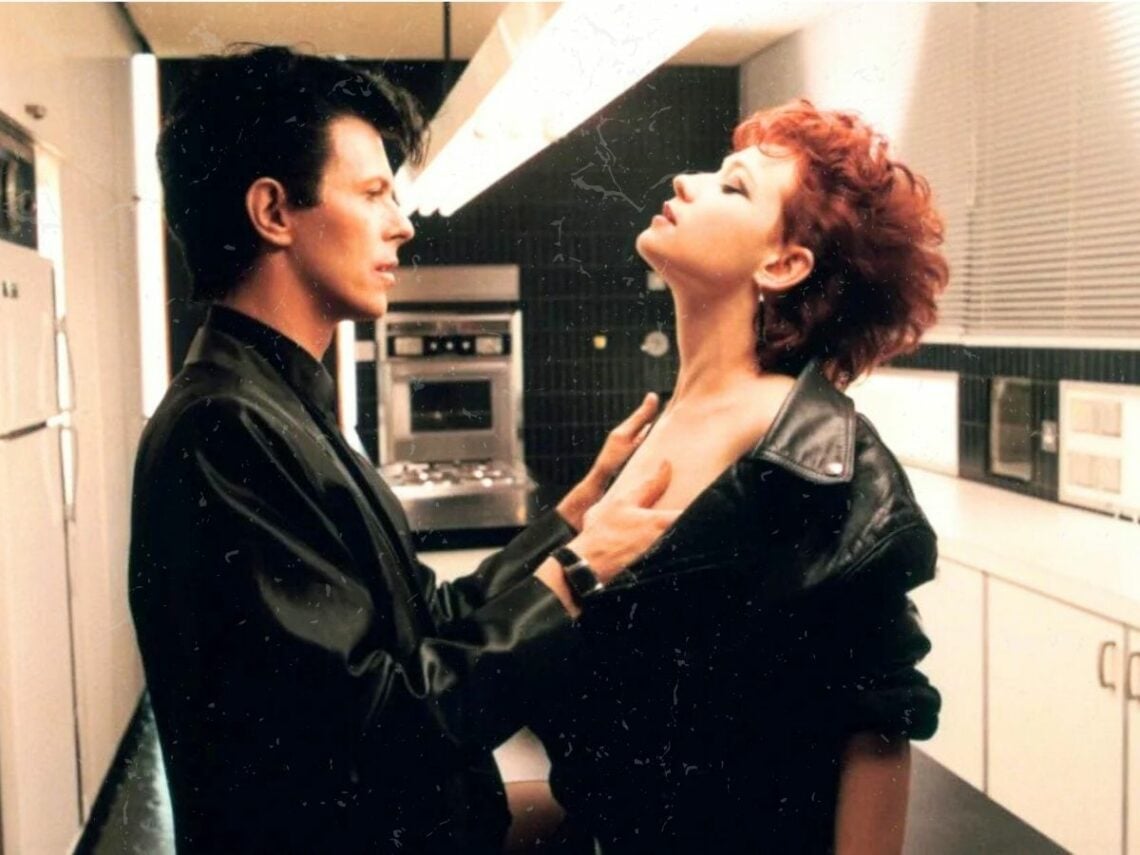
The “agonisingly bad” steamy movie David Bowie made with ex-lover Susan Sarandon

“We found love in a hopeless place,” booty-dropping Barbadian singer Rihanna once exuberantly extolled; whether or not she was talking about the sultry romance that blossomed between David Bowie and Susan Sarandon amid the dog dirt production of The Hunger is anyone’s guess, but it would certainly ring true to life. The forgotten sexy vampire flick that critic Roger Ebert described as “agonisingly bad” is about as hopeful a place for love to bloom as the Stadium of Light on a torrid Tuesday in January.
The project’s failure is an oddity when it comes to the pedigree involved. You’d imagine that Tony Scott directing Bowie, Sarandon and Catherine Deneuve in a raunchy fanged love triangle in 1983 was a sure-fire bet as a searing romp. However, when you get into the nitty-gritty of the fine details, you are left with a gaudy and confounding affair that makes Ebert’s esteemed disdain pretty much fair game.
The film is a loose adaptation of Whitley Strieber’s novel of the same name, which was released two years before the picture. The novel’s description gives you a loose idea of what we’re dealing with here. It reads: “Eternal youth is a wonderful thing for the few who have it, but for Miriam Blaylock, it is a curse—an existence marred by death and sorrow. Because for the everlasting Miriam, everyone she loves withers and dies. Now, haunted by signs of her adoring husband’s imminent demise, Miriam sets out in search of a new partner, one who can quench her thirst for love and withstand the test of time.”
If that’s got your slacks dripping with excitement, then there’s more hammy thrills in this unfurling fight for love and flesh to come. It continues: “She finds it in the beautiful Sarah Roberts, a brilliant young scientist who may hold the secret to immortality. But one thing stands between the intoxicating Miriam Blaylock and the object of her desire: Dr. Tom Haver…and he’s about to realise that love and death go hand in hand.”
If that still sounds like it might be a treat, then essentially that’s because in an abridged sense it is. Even Ebert, who daubed it with a dirty 1.5 stars, admitted that it was “sort of dreamily erotic” and circled around “an exquisitely effective sex scene” but it’s the thrills and spills in-between that rely on story more so than celluloid chemistry that soar like a squib that has been dampened by the steamy residue left over from saucy shower scenes that fail to fully ventilate.
Bowie and Sarandon’s on-set romance
And if the erotic chemistry is palpable between the love-triangle trio throughout the movie, that’s because Bowie and Sarandon were enjoying a beautifully attractive courtship. It came at a time when Bowie wanted to settle down, and he snuggled right into Sarandon’s open arms. As he said at the time when the pair were interviewed together: “When you’re young and you’re determined to crack the big dream of ‘I have a big statement and the world needs to hear my statement,’ there’s something a bit irresponsible about your attitude to the future. A nonrecognition that the future exists. I think it’s important for youth to have that.”
However, sadly, as Sarandon would recently explain to You, they were lovers and quite intense ones at that. Bowie wanted them to have a family together, but “I wasn’t supposed to have kids,” Sarandon puts it when touching upon her endometriosis. The relationship couldn’t survive beyond that. However, their days of romance on the set of The Hunger and beyond were always remembered fondly.
Fortunately, they also got the chance to reconcile their past before Bowie died, too. As Sarandon explains regarding their touching reunion when David’s days were numbered: “I was fortunate enough to be closer to him right before he died, the last couple of months. He did find me again. We talked to each other and said some things that needed to be said. I was so fortunate to be able to see him when he told me what was going on with him.”
Then with a fondness, she recalled, “I love his wife, Iman, someone who was so equal in stature [to him]. That was clearly who he was destined to be with. I was so happy that she was with him through all of that. And I’ve kept in touch with her. The last time I saw him was at the premiere of his musical Lazarus.”
Concluding: “There was a double rainbow in New York on the day that David Bowie passed.”
