


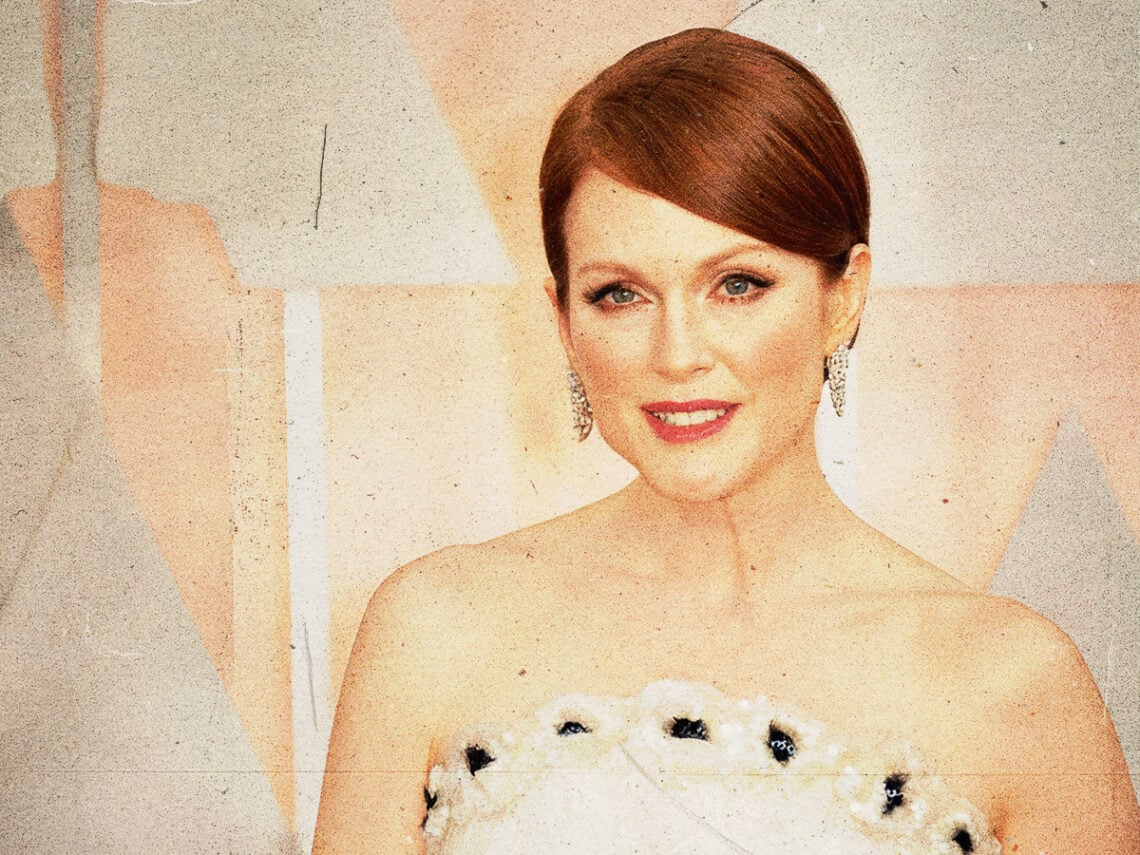
Julianne Moore discusses her inspirations: “She’s the gold standard for every actress”

Many aspiring actors look up to Julianne Moore as someone to admire, appreciate, and emulate, but the Academy Award-winning star would never refer to herself as the “gold standard” of acting. She does know exactly who’s deserving of such a lofty title, though, and it’s a sentiment many of her peers and contemporaries would wholeheartedly agree with.
Packing the acclaimed Boogie Nights, The Big Lebowski, Magnolia, Children of Men, and The Kids Are All Right into her delicious CV, this makes Moore’s appreciation all the more meaningful, but she’s far from the first A-lister to wax lyrical on the consensus pick for their generation’s finest.
In Stephen Daldry’s 2002 drama The Hours – adapted from Michael Cunningham’s novel, which was itself penned in tribute to Virginia Woolf’s Mrs Dalloway – Moore breathes life into the unhappily married and pregnant Laura Brown. For her performance, she earned an Academy Award nomination for ‘Best Supporting Actress’, but it was Nicole Kidman who won the ‘Best Actress’ gong for playing Woolf.
The only one of the film’s central trio who didn’t make the Oscars shortlist was Meryl Streep, who brought Clarissa Vaughn to life in the 2001-era timeline. It was an impressive collection of powerful actors, but even talents of Moore and Kidman’s calibre deferred to Streep as the cream of the crop.
In a joint interview with Oprah Winfrey, Moore and Kidman really poured their hearts out to Streep. “Nicole, you’ve said Meryl is the reason you’re an actress,” the television personality inquired, to which the star couldn’t help but agree.
“Absolutely. Here’s a woman who has integrity, who has never compromised on what she believes in, and is just the greatest; that’s it,” Kidman explained. The love-in wasn’t done there by any stretch after Moore weighed in to underline just how impactful Streep had been on her own career.
“She’s the gold standard for every actress,” she said. “Meryl, when you were on the cover of Time, it made such an impression on me. You were doing extraordinary work, and everyone knew it.” Streep graced the cover of the magazine in September 1981, coinciding with the release of The French Lieutenant’s Woman in 1981, several years after picking up her first of three golden statuettes.
She was already a star by then, whereas Moore wouldn’t make her screen debut until 1984 when she appeared in seven episodes of the procedural soap opera The Edge of Night. Streep was already an influence by that point, making it a full-circle moment when they finally worked together on The Hours.
They’ve never collaborated since, but Kidman did get to continue her hero worship when Streep boarded the cast of HBO’s dark dramedy Big Little Lies for its second season.
