


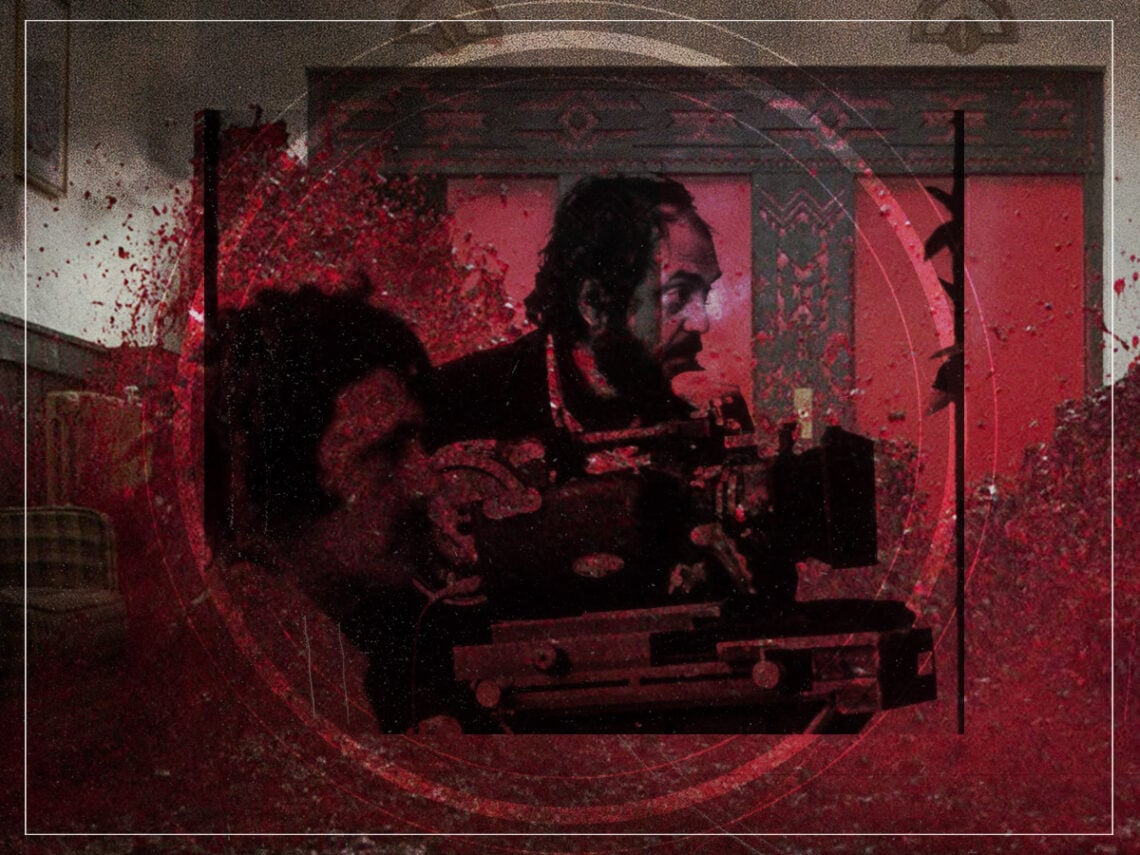
‘The Shining’ explained: How did Stanley Kubrick make the elevators bleed?

Stanley Kubrick tackled a wide variety of genres as he continued his journey as a pioneering filmmaker, ranging from crime thrillers to the science fiction magnum opus that is 2001: A Space Odyssey. While many of his films have subtextual horror elements, his proper treatment of the genre came in 1980 when he released The Shining. It was a landmark moment for cinema and, arguably, changed the genre forever.
Although it was an adaptation of a popular book, Kubrick managed to make the film his own by imparting his own artistic vision to the narrative and general philosophical implications. While the author refused to accept the film as a real adaptation, fans have continued to hail it as one of the greatest horror films ever made.
The movie stars Jack Nicholson as a failed writer who decides to take his family to a secluded hotel during the winter in order to focus on his literary project. It’s one of the actor’s defining roles and sees him at his unhinged best. As the days progress and the climate gets harsher, he finds himself slipping further into insanity and lashes out at everything in sight. Kubrick wanted it to be a commentary on the fundamentally human nature of evil, shifting away from the supernatural sensibilities of the book.
The Shining is now cited as one of the most prominent examples of Kubrick’s characteristic visual style, and even though it was dismissed by critics when it first came out, re-evaluations have solidified its status as a classic of the genre. The film has a lot of iconic moments, but one of the most surreal ones revolves around those infamous elevators.
Known as the ‘elevator of blood’ sequence, it was the scene where a river of blood gushed out from the elevators in the Overlook Hotel, making for an oddly chilling cinematic experience. While it only took three takes to film it, Kubrick and his team spent almost a year trying to come up with a perfect plan in order to get it just right.
Kubrick was annoyed with the consistency of the fake blood, which kept messing up the electronic configurations of the elevator. In addition, the fake blood kept leaking through the elevator doors, and whenever they got it wrong, the team had to spend a lot of time scrubbing the set just to make it go back to the way it was before the blood gushed out.
“We spent weeks and weeks and weeks trying to get the quality and colour of the blood as natural as it could be,” Kubrick’s assistant Leon Vitali explained in an interview while talking about the arduous process. “You didn’t want it too red. The consistency was also quite important, because we were pouring out hundreds of gallons of the stuff.
Vitali went on to add: “And then, of course, there were the mechanics of it, because if you have that much pressure inside something like an elevator, it’s going to blow if you’re not careful.” According to Vitali, Kubrick couldn’t even bear watching the scene as it happened but was elated when he saw the footage. He even managed to convince Warner Bros to keep it in the trailer by telling them that it was meant to be rusty water instead of gory blood.

…but who wrote The Shining book?
The book, released in 1977 was famously written by horror master Stephen King.
While the author had gained some success in the literary world before this release, the novel would cement his place as perhaps the most prolific and potent horror writer in the modern era. King has had many novels turned into movies, such as Carrie, Pet Semetary and The Shawshank Redemption, however The Shining was one book that King didn’t like the adaptation of.
King was a believer in the humanity of the lead character, Jack Torrance, pulled apart by supernatural forces, whereas Kubrick believed Torrance to be a fundamentally evil role. It meant that the two forces struggled to see eye to eye on the story being told by Kubrick.

How The Shining changed horror movies forever…
Horror movies have been a pivotal part of cinema for some time. The thrills and spills of a scary story have been vital to the human condition since we sat around campfires warmed by the warm glow in the face of the dark abyss beyond. But Kubrick took the psychological scare factor to new heights and confused us about who the real monsters were.
King’s story put the Overlook Hotel as the serial perpetrator, a supernatural force corrupting the innocent soul of humanity. However, Kubrick put not just Torrance but society in general as the evil monsters in the movie. This changed the spectrum of genre and added a new facet of fear.
