


‘Spring Breakers’, the American Dream, and Brat summer: will we ever let go of the desire for escape?

Last summer was indisputably the year of Brat, Charli XCX’s neon-infused party manifesto, which advocated for doing a “little line” and “living that life”.
Despite the album actually featuring more nuanced moments than many realised, the songs that gained the most popularity were the ones that resonated with people’s desire to drink and dance, to be a “365 party girl,” or at least give the impression of one, tiny sunglasses and baby-tees to boot.
A deluxe edition of the record soon followed, which featured the song ‘Spring Breakers’, an ode to Harmony Korine’s 2012 movie of the same name. A similarly neon-illuminated display of pure hedonism and shamelessness, Spring Breakers is aggressively early-2010s, with its Skrillex soundtrack and lead characters who look like they’ve been lifted straight from a Tumblr dashboard.
Sporting bright bikinis and multi-coloured nail polish, the four girls at the centre of the film – played by three former child stars, Selena Gomez, Vanessa Hudgens, and Ashley Benson, as well as Korine’s wife, Rachel Korine – embody that intense and constant hunger for something more which comes as part of the American Dream. They revel in excess, the spectacle of drugs and alcohol, guns, sex, and the thrill of being bad – the kind of bad that they’ve seen aestheticised in video games, movies, and online.
Korine simultaneously criticises and glorifies the state of youth culture in a media-saturated age, where the desire to participate in pure self-gratification and pleasure-seeking is encouraged. You’ll get a good photo out of it at least. When Spring Breakers opens to the dubstep soundtrack of ‘Scary Monsters and Nice Sprites’, we see colourful images of college students dancing and drinking on the beach, where naked bodies are shot in invasive close-ups like we’re witnessing animals on parade at the zoo. This is pure spectacle, and the objectification of these bodies is the whole point. This is the American Dream sold to young people through music videos and popular music.
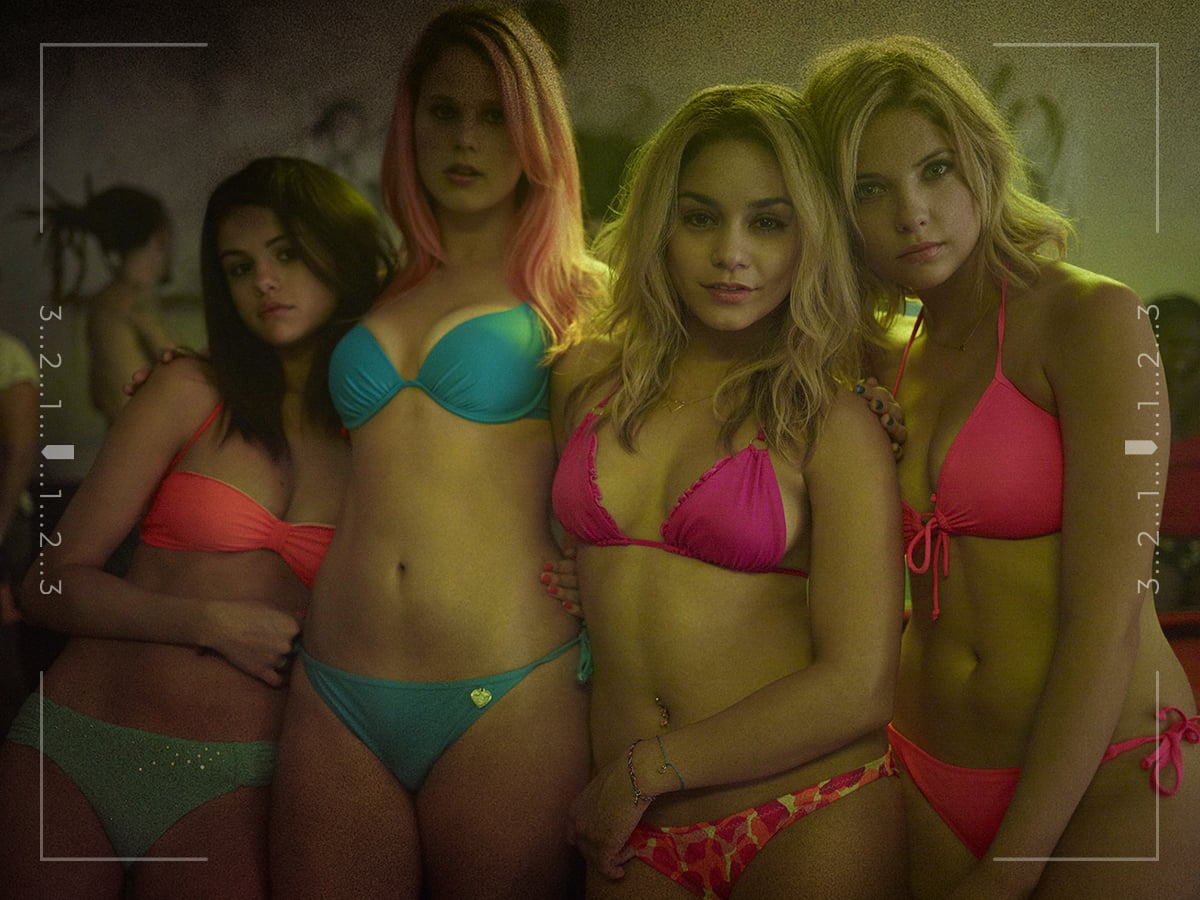
The four girls buy into this dream, idolising spring break as if it’s something that’ll allow them to discover the real meaning of life. To them, the meaning of life seems to involve escaping mundanity and indulging in selfish acts of debauchery and violence without a care for how it affects others, and Korine emphasises just how far the American Dream can take its devoted followers. Hudgens’ Candy and Benson’s Brit get swept up in the crossfires of pure pain and pleasure, willingly looking past the dangers that come with hanging out with drug dealers and gangsters who possess a shameless drive for money and opulence.
James Franco stars as Alien, a sleazy white drug dealer who thinks he’s black by sporting a golden grill, wearing dreads, and adjusting his accent. He epitomises this complete assimilation into a world of pure hedonistic thrill, where reality completely breaks down as he gets by on drug-fuelled fantasy alone. The girls want in, and while Candy and Brit are successful in breaking through into this world of romanticised, sexualised violence – represented by threesomes in the pool and exclusively wearing bikinis and short shorts – Alien inevitably succumbs to reality by the end of the film when he is shot dead.
Korine uses the girls to represent those who naively idolise a world they’ve seen in video games, Instagram, Tumblr, and MTV videos, while Alien is the grim reality. He’s cheesy, gross, corny, and offensive, but the girls see him as their guide, albeit one they can manipulate for their own good.
So, that brings me back to Charli XCX’s ‘Spring breakers’, which sees her spout lyrics like “Yeah, I knew I’d end up with my hands behind my back/ In a police car, blue and red sirens/ All flash, flash, flash, flash, lights and cameras everywhere/ Now I’m on the news with the DUI stare.” As she sings these lines, you can picture the Spring Breakers girls being thrown into a police car before standing bikini-clad in front of a judge. The sleaziness of Korine’s film lingers in the slight industrialism of XCX’s electronics, which exude a sense of pure danger and unpredictability.
The song encapsulates Brat summer, a phenomenon that had even the most straight-laced of folk suddenly professing themselves club rats, posting pictures of night outs (which probably involved nothing more than a few vodka cokes and a puff on a vape) to the sound of ‘Von dutch’ or ‘365’. Sure, people aren’t listening to Skrillex or wearing neon Triangl bikinis anymore, but if the popularity of Brat has shown anything, it’s that the desire for pure hedonistic escape hasn’t gone anywhere.
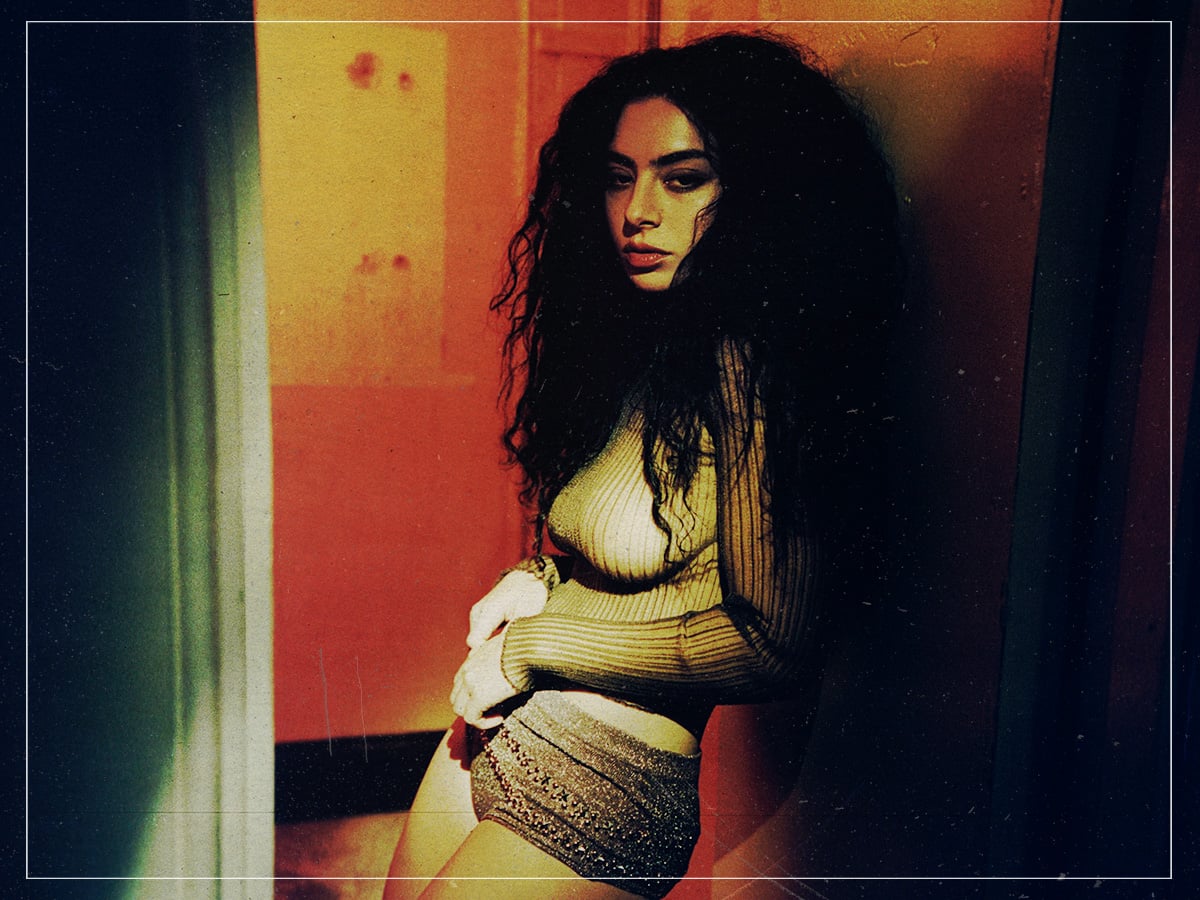
Spring Breakers was misunderstood by many as a tacky, exploitative mess of party montages and Franco acting every part the creep, and while it is all of that, Korine utilises these images to comment on the absurdity of a youth culture saturated in aestheticised imagery that communicates some vague sense of freedom and escape. With the success of Brat over a decade on from the release of Spring Breakers, Korine’s film has proved to be just as relevant, because the world that XCX crafted with Brat fits right into this trashy, neon-soaked landscape.
There is hidden depth within both Brat and Spring Breakers that many consumers have overlooked in favour of their aesthetic elements, but really, both straddle the line between glorifying a world of partying (because what else is there to do?) and reckoning with the harsher realities of life (see ‘I think about it all the time’ or ‘Sympathy is a knife’).
Brat is the spiritual successor to Spring Breakers – it’s shameless, it’s silly, and it’s trashy. Yet, the release of XCX’s album shows just how ahead of the pulse Korine was with his film, which attracted an audience that didn’t fully understand the nuance at the heart of his obnoxious images. Thus, both pieces of media inherently play into the perpetuation of this dream, in spite of showing its darker sides. Images of the Spring Breakers cast in their bikinis and hot pink disguises still circulate aesthetic-based social media accounts years later, while Brat is still playing at clubs.
Brat revels in debauchery that verges on ridiculous, and while some of us know not to take it too seriously, others see it as the ultimate height of cool, to be emulated no matter the consequences. But that’s the essence of Korine’s film, really. So many young people are unable to let go of this desire to escape reality, where indulging in a fantasy world, no matter how dangerous, is the ultimate goal, because we’ve been fed an overly-saturated diet of songs and films which glorify such behaviour.
Korine is critical of this culture, which you can find on the surface of Brat, but he knows that there is little he can do about it, so he succumbs to it with a humorous sense of self-awareness, as encapsulated in Franco’s purposefully corny repetition of his dream-infused mantra, “Spraaang break.”
