


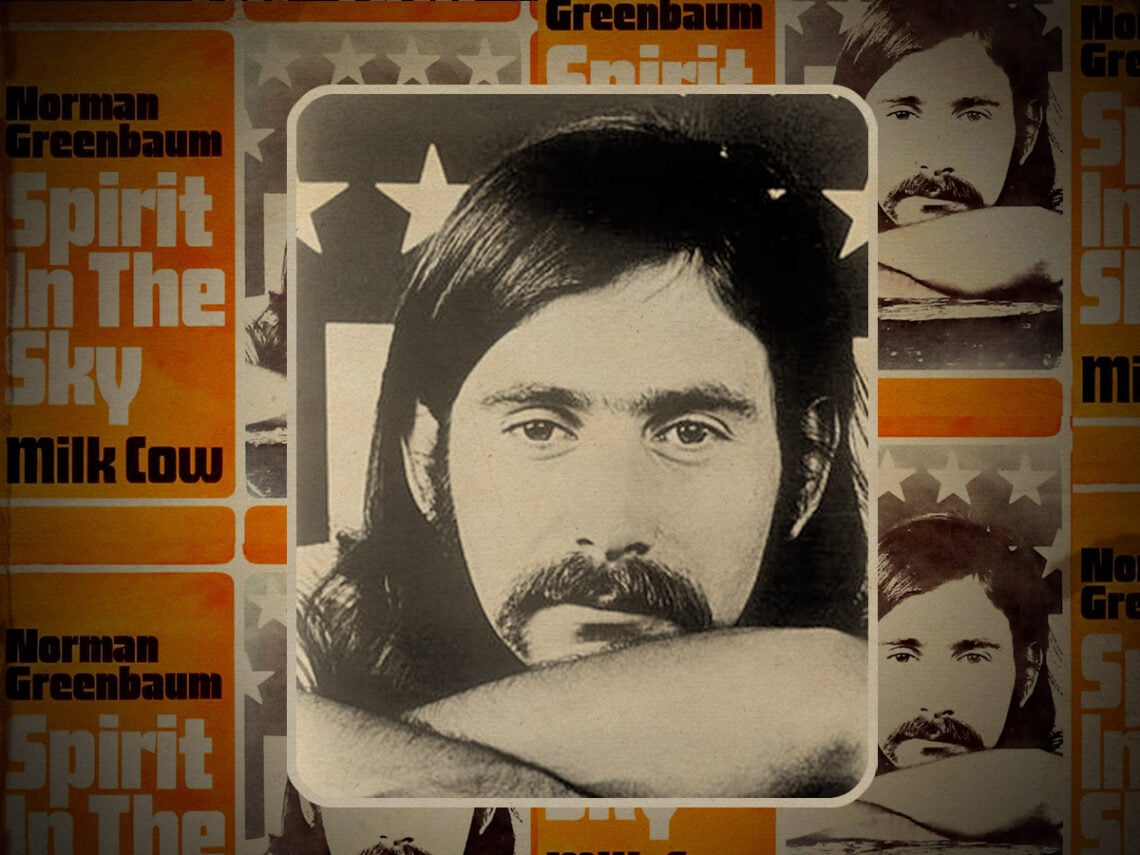
‘Spirit in the Sky’: How Norman Greenbaum became the world’s most unlikely unsuccessful success story

You could set your watch to the pop charts; even during the music industry’s most diverse, revolutionary ages, the singles chart has always been fairly predictable. Every once in a while, though, a hit record seems to arise entirely from left field, and back in 1969, Norman Greenbaum’s ‘Spirit in the Sky’ became that unlikely triumph.
Oddballs were ten a penny back in the psychedelic age of 1960s hippiedom. It was, after all, the period in which rock and roll blew away the cobwebs of conservatism in a gust of LSD-tinged wind.
Still, some outfits, like Dr West’s Medicine Show and Junk Band, were far too strange for mainstream consumption – although their band name should have been enough to give you that impression. That was the group in which Norman Greenbaum cut his teeth, creating psychedelic novelty records for typically niche audiences.
Although bizarrely, Greenbaum and Dr West’s Medicine Show did score a minor hit in 1967 with ‘The Eggplant That Ate Chicago’, the songwriter was aware of the fact that his potential was perhaps being wasted. So, shortly after the success of that single, Greenbaum went out on his own with the aim of becoming a successful folk musician. That aim might never have fully come to fruition, but he certainly experienced his fair share of success in the form of ‘Spirit In The Sky’.
A track which managed to ride the wave between hippie psychedelia and Christian-rooted gospel (despite Greenbaum himself being Jewish), ‘Spirit In The Sky’ also boasted one of the most memorable riffs of the 1960s, but it wasn’t expected to amass the kind of success that it did, particularly with Greenbaum being a virtual unknown. Either way, the song managed to top the UK singles charts and peak at an impressive number three in the US (kept off the top spot by both The Beatles and the Jackson Five).
As Greenbaum himself recalled to The Guardian recently, the success of ‘Spirit In The Sky’ seemingly came out of nowhere. “Initially, Warner said a four-minute single containing lyrics about Jesus would never get played on pop radio, but eventually they relented,” the songwriter recalled. “In 1969, it sold two million copies.”
He added, “But I couldn’t recreate the success.”
In spite of numerous attempts, Greenbaum never recaptured the success of that unlikely single, and today holds a reputation among the most successful one-hit wonders in musical history. Even stranger than the single’s initial success, however, was its multiple rebirths in subsequent decades. First, glam rockers Doctor and the Medics topped the charts with a version of the track in 1986 and then Bradfordian pop powerhouse Gareth Gates had a number-one with his cover in 2003.
“I was working as a cook when Dr and the Medics took it back to number one in the UK,” Greenbaum shared. “Then Gareth Gates’s 2003 version meant it was number one in three different decades.” It is perhaps the only one-hit wonder, therefore, to have spawned multiple different success stories over the years.
For Greenbaum, the song and its enduring spirit have never truly lost their lustre. “A few years ago, I was a passenger in a car crash and spent three weeks in a coma,” he revealed. “I feel like I was granted another life. So now every day, I pray and give thanks to the spirit in the sky.”
