


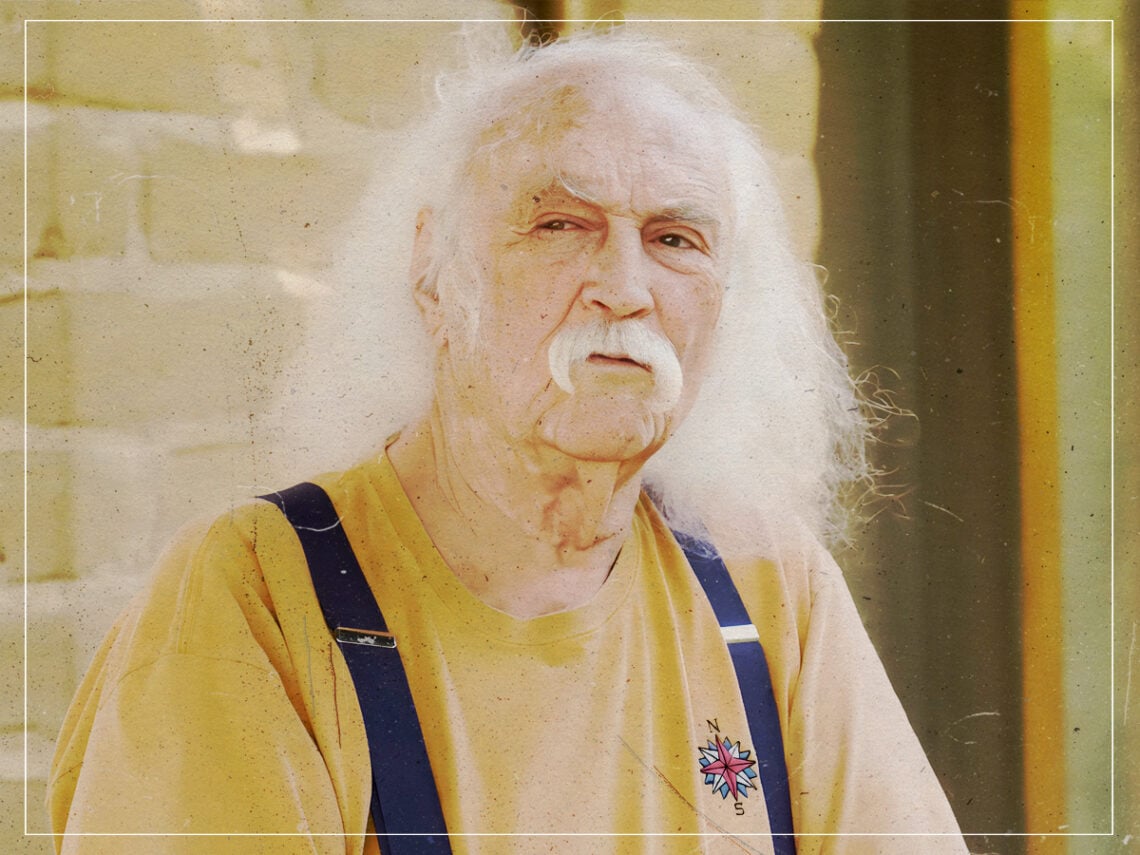
‘Guinnevere’: The song David Crosby thought “could be my best”

Although David Crosby was a divisive figure among those who knew him, he was undeniably one of the artists who defined the countercultural spirit through both his life and his music. A master craftsman of potent vocal harmonies and intricate guitar lines, his lyricism and otherworldly sound perfectly captured the era’s unfettered optimism, its complex romances, and the altered mental states that shaped his generation.
Crosby wrote or had a hand in writing some of the era’s most quintessential songs, such as The Byrds’ ultimate hippie anthem, ‘Eight Miles High’. Yet, it was after he was kicked out of the jangly folk act that he would really come into his own as an artist, untethered by the whims of the other big characters competing for songwriting supremacy.
As fate would have it, Crosby would end up linking up with former Buffalo Springfield member Stephen Stills and frustrated Hollies man Graham Nash. One evening in 1968, they had dinner together and realised that their differing personalities gel and their vocals fit together as one. As each of their bands had been heavily reliant on vocal harmonies, the trio were veterans of such a creative tact, and after that momentous evening, Nash quit The Hollies. They would quickly become CSN.
They almost immediately started working on their 1969 debut, Crosby, Stills & Nash. It was a hit across the board, producing band classics such as the singles ‘Suite: Judy Blue Eyes’ and ‘Marrakesh Express’. It also contains one of the definitive Crosby and Stills compositions in ‘Wooden Ships’.
However, Crosby thought another song was not only the best on the album but could well have been his finest ever. In a rare instance, it is one of his takes that most people might agree with. The composition is the deeply meditative ‘Guinnevere’, led by the pastoral chiming guitars and the absolute majesty of the trio’s vocal harmonies. Afforded a truly transcendental, fantasy aspect given the titular Arthurian queen and lyrics, as her name might suggest, it is also imbued with a great sense of romance.
Comprised of three verses, each concerns a different woman. One is folk songstress Joni Mitchell, Nash’s lover at the time, and another is Christine Hinton, Crosby’s late girlfriend who was killed in a car crash in 1969, which left him so heartbroken he started taking drugs more heavily than he had been doing. The latter is another woman Crosby would never reveal the identity of.
Written in the odd opening tuning of EBDGAD, Crosby also unknowingly enacted a genius rhythmic change in the song, with each verse a sequence of 4/4, 6/8 and 7/4. He didn’t actually realised he’d done it until one of his friends in the Grateful Dead pointed it out.
Speaking to Music Radar in 2012, Crosby explained his love for the song. He said: “I like it musically, I like it lyrically, and I like the mood that it creates a lot. The guitar pattern, I can’t say how it came about. I just fooled around and it came out.”
The late musician revealed that he got the tuning from a man in the Midwest, and that he had since shown it to many people, who had gone off and written classics with it. However, there was something truly special about the composition that he popularised the tuning on, with him saying earnestly: “I do think this one is beautiful. It could be my best.”
