


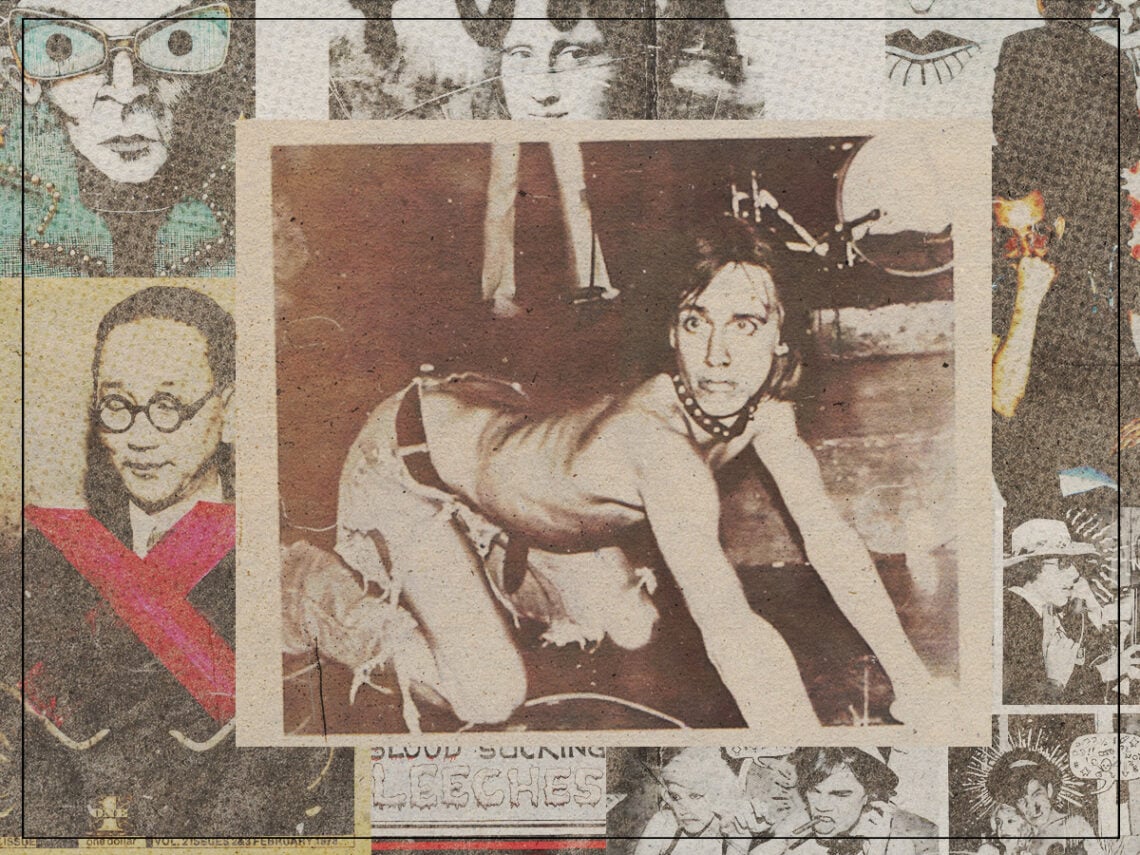
Snapshots from the first ever Punk Art exhibition, 1978

In most pop cultural movements, an associated name often arrives a little late and becomes an all-consuming retrospective handle. These tags are usually conjured by the media, such as Britpop, grunge or shoegaze, and are prone to grouping artists of relatively disparate styles under an umbrella with which many aren’t so comfortable. This never appeared to be an issue for the punk banner.
Music historians tend to trace punk music back to the so-called proto-punk work of American bands like The Velvet Underground and The Stooges. These groups laid essential tracks with seminal releases through the late 1960s and early ’70s, but beyond musical material, they set a crucial precedent with a visage of reckless abandon.
Of course, earlier in the 1960s, rock groups had been marginalised by governments on both sides of the Atlantic as troublemaking hedons, but characters like Iggy Pop and Lou Reed took this front to new extremes entirely. While the former slashed his chest with razor blades on stage, the latter sang openly about drug abuse and salacious enterprise in landmark tracks like ‘Heroin’ and ‘Sister Ray’.
Glam rock and prog-rock entertained the interim, but punk was well on its way, reaching a defined peak in the mid-1970s. With haircuts reminiscent of those seen on The Stooges’ 1969 debut album cover, New York City’s Ramones are generally accepted as the first group to fall under the pure punk umbrella. After forming in 1974, the band embodied the genre with heaps of attitude, ripped jeans, motorcycle leathers and choppy, simplistic chord progressions.
The punk virus rapidly spread far and wide, with Sex Pistols, The Damned and The Clash in the UK and The Saints in Australia making headway by the end of 1976. Although punk’s anarchistic “don’t know what I want, but I know how to get it” attitude had engulfed much of the Western world by the end of the ’70s, its innovative hub remained in New York City.
The pure punk movement was a flash in the pan, rapidly evolving into refined sub-genres dissolved by the vague new-wave and post-punk pigeonholes. In 1978, Sex Pistols signified this turning page with their disbandment; having released just one album with his formative band, frontman John Lydon began a new chapter with his post-punk band, Public Image Ltd.
Meanwhile, in New York City, Ramones’ impact and impetus waned amid drummer Tommy’s departure as colourful new-wave acts, like CGBG regulars Talking Heads and Blondie, stepped up to the plate. At this point in space and time, we stumble upon today’s featured art collection.
In a ripple of Andy Warhol and Vivienne Westwood’s oar in the visual palette of punk, the New York-based artist, photographer and curator Marc H. Miller sought to condense the punk and new-wave scenes through his artwork and exhibitions in the late 1970s and early ’80s. In 1978, Miller and his collaborator Bettie Ringma curated what is considered to be the first-ever Punk Art Exhibition.
“As Bettie Ringma and I watched various musicians at CBGB successfully launch under the rubric of Punk Rock, it occurred to us that we might do the same for the visual artists who were part of the extended scene,” Miller says. “It was partly tongue-in-cheek, partly hype, but secretly, we actually believed we were presenting something new and important. The year was 1978, and the show we mounted with Alice Denney at the Washington Project for the Arts in Washington DC has gone down in history as the world’s first Punk Art exhibition.”
“In truth, it was part of something bigger, a moment of generational change and the initial breaking of the dam that had contained the art world since the 1960s,” he continues. “We repeated the Punk Art show twice: first as a one-night multimedia event at the School of Visual Arts in New York [November 1978] and then in a small exhibition at Art Something in Amsterdam, Holland [June 1979].”
Over the past four decades, the spirit of punk has been kept alive in ancestral music and similar exhibitions often curated in association with the era’s surviving icons. Meanwhile, Miller and Ringma have kept their exhibitions alive in a 28-page catalogue which contains dozens of artist’s interviews, an essay by art historian Gerald Silk, and Andy Warhol’s commentary on the punk movement.
Although the catalogue has long been out of print, you can see a new abridged version on Miller’s Gallery 98 website. See highlight shots from the first Punk Art Exhibition below.


Never Miss A Beat
The Far Out Punk Newsletter
All the latest Punk content from the independent voice of culture.
Straight to your inbox.