


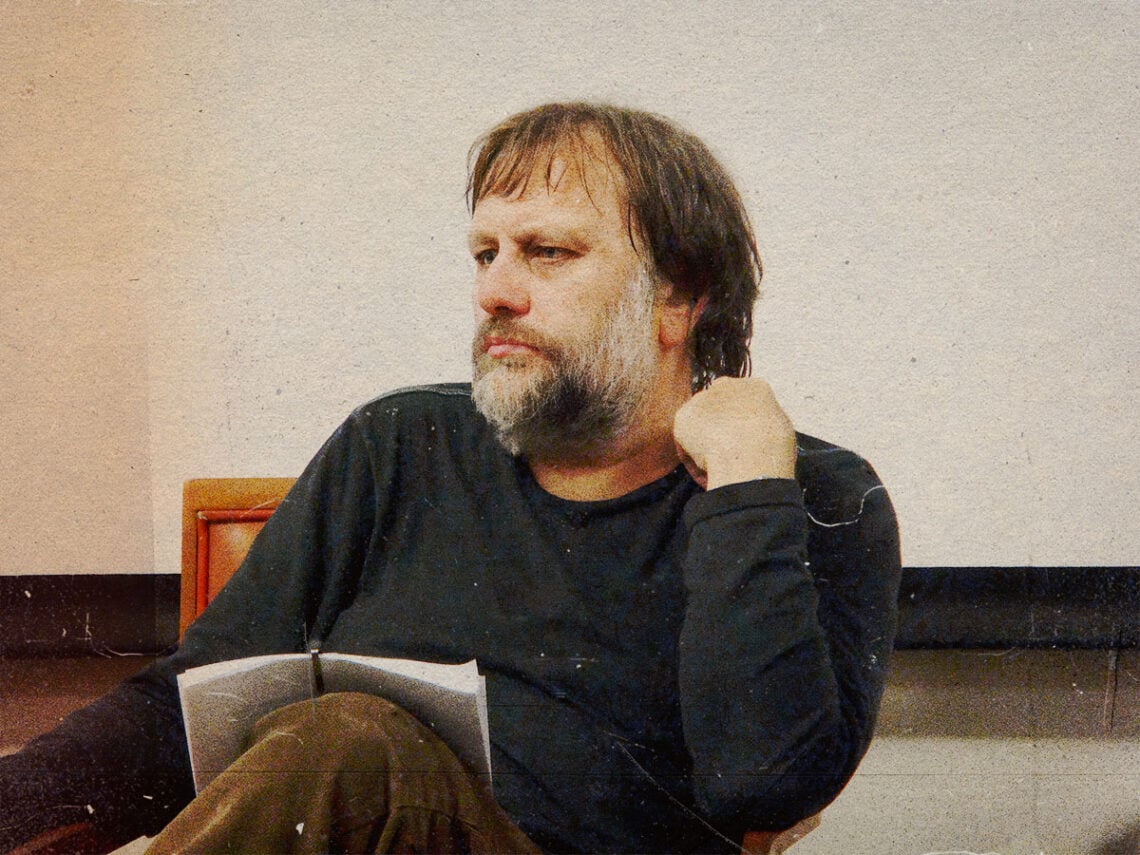
Slavoj Zizek on the “true genius” of Charlie Chaplin

As well as being well versed in continental philosophy and psychoanalysis, Slavoj Zizek also has a wide-ranging theoretical understanding of cinema, being in deep admiration of Japanese film master Akira Kurosawa, who he once claimed: “does Shakespeare better than William Shakespeare”. However, Zizek also holds great respect for the legendary actor and director Charlie Chaplin.
In his Pervert’s Guide to Cinema, Zizek introduces Chaplin’s 1940 film The Great Dictator with the following words: “Nobody was as fully aware of the properly traumatic dimension of the human voice – the human voice not as the sublime, ethereal medium for expressing the depth of human subjectivity, but human voice as a foreign intruder – nobody was more aware of this than Charlie Chaplin.”
While Zizek clearly holds admiration for the way Chaplin explores different kinds of voices in his 1940 comedy, he reserves some of his biggest praise for Chaplin’s 1915 silent film The Tramp, in which Zizek believes Chaplin provides a “metaphor of our predicament” in terms of us falling in love with other people.
“All too often, when we love somebody, we don’t accept him or her as what the person effectively is,” Zizek says. “We accept him or her insofar as this person fits the coordinates of our fantasy. We misidentify, wrongly identify him or her, which is why, when we discover that we were wrong, love can quickly turn to violence.”
He adds: “There is nothing more dangerous, more lethal for the loved person than to be loved, as it were, not for what he or she is, but for fitting the ideal. In this case, love is always mortifying love.” From there, Zizek goes into a closer analysis of how Chaplin explores the idealism vs the reality of love.
Even though Chaplin had played The Tramp character previously, it was the 1915 film that really marked the start of the kind of person he is known as today. Chaplin had previously portrayed The Tramp with a slapstick approach, but The Tramp showed a more human side, as Zizek clearly admires. Throughout the film, The Tramp slowly falls in love with a farmer’s daughter named Edna, even though he himself is indeed a lowly person in terms of social stature. However, Zizek argues that this contrast not only causes The Tramp to expose to Edna what he really is but also serves as a metaphor for Chaplin exposing himself to his audience as an actor and a director.
“Here’s it’s not only The Tramp as the figure within the film’s narrative exposing himself to his beloved girl, it’s at the same time, Chaplin as actor and director exposing himself to us, the public,” Zizek says, “‘I am shameless. I am offering myself to you, but at the same time, I am afraid.'”
As for the crucial moment at which The Tramp reveals his true self to Edna, Zizek says, “The true genius of Chaplin resides in the way that he was able to stage this psychological moment of recognition at the level of form, music, visual aspect, and at the same time, at the level of acting.”
He adds: “When the two hands meet, the girl finally recognises him for what he is. This moment is always extremely dangerous, pathetic. The beloved falls out of the frame of the idealised coordinates; finally, there exposed in his psychological nakedness. ‘Here I am, as what I really am’.”
Fascinatingly, Zizek admits that we need not few the end of The Tramp as a complete story. Things roll on and may well change. “I don’t think we have to read it as a happy ending,” he says. “We don’t know what will happen. We have the letters ‘the end’ and the black screen, but the singing goes on. As if the emotion now is too strong, it spills over the very frame.”
