


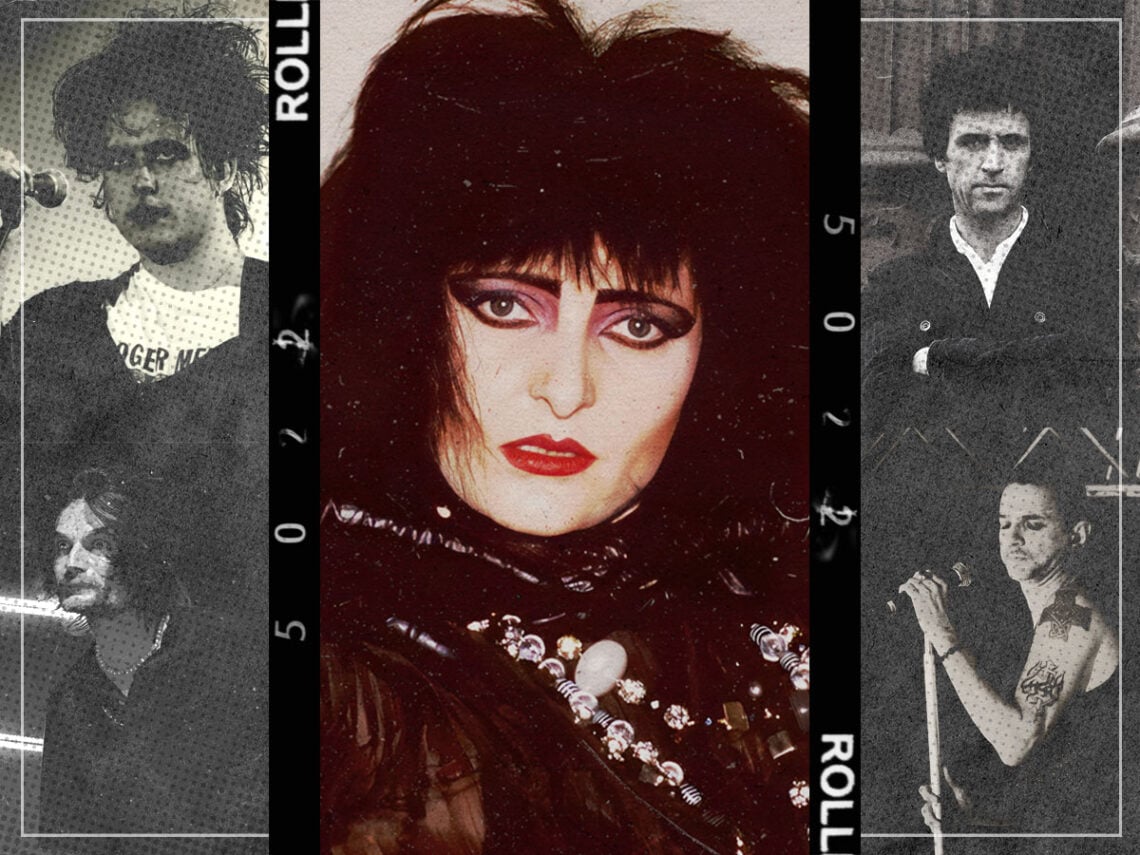
The beauty of Siouxsie and the Banshees in the words of their famed admirers

In the late 1970s, the British punk wave broke with monumental force, paving the way for a colourful accretion of subgenres. On the darker end of this chromatic spectrum, we had early gothic acts, including Siouxsie and the Banshees, Bauhaus, Joy Division and The Cure. Although dark and moody themes had adorned plenty of prior material, ‘Bela Lugosi’s Dead’, Bauhaus’ debut single of 1979, planted a firm flag in the timeline.
Siouxsie and the Banshees, our primary focus today, formed in 1976, three years before Buhaus’ vampiric masterpiece. The band was initially associated with the pure punk wave, guided by the experimental guitar textures of John McKay towards their 1978 debut album, The Scream.
This early lineup of the Banshees established a unique sound, typified by McKay’s dense and choppy rhythm sequences and founding drummer Kenny Morris’ distinctive beat. This early iteration of the band profoundly influenced Joy Division, especially bassist Peter Hook and drummer Stephen Morris.
“Siouxsie and the Banshees were one of our big influences,” Hook told Q in 2013. “The Banshees’ first LP was one of my favourite ever records; the way the guitarist and the drummer played was a really unusual way of playing, and this album showcases a landmark performance.”
Morris expanded on this endorsement in his 2019 book, Record Play Pause: Confessions of a Post-Punk Percussionist. “It would be Siouxsie and the Banshees to whom I most felt some kind of affinity,” he wrote. “The bass-led rhythm, the way first drummer Kenny Morris played mostly toms. In interviews, Siouxsie would claim the sound of cymbals was forbidden. The Banshees had that foreboding sound, sketching out the future from the dark of the past. Hearing the sessions they’d done on John Peel’s show and reading gig write-ups, I had to admit they sounded interesting.”
Perhaps Siouxsie and the Banshees’ most apparent influence was The Cure. When the Crawley-based group supported Siouxsie and the Banshees in 1979 for one of their earliest tours, frontman Robert Smith was invited to fill in for McKay on guitar, much to his delight.
“On stage that first night with the Banshees, I was blown away by how powerful I felt playing that kind of music,” Smith reflected in Siouxsie & the Banshees: The Authorised Biography. “It was so different to what we were doing with the Cure. Before that, I’d wanted us to be like the Buzzcocks or Elvis Costello, the punk Beatles. Being a Banshee really changed my attitude to what I was doing.”
Later, during The Cure’s hiatus between 1982 and ’84, Smith would be invited to join the Banshees as a full-time member and replacement for the legendary guitarist John McGeoch. The Scottish guitarist, formerly a member of Magazine, joined the band in 1980; despite departing just two years later amid alcohol woes, his distinctive style defined the Banshees’ second iteration, inspiring generations to come.
McGeoch’s most notable contributions arrived in the 1981 masterpiece Juju, home to essentials like ‘Monitor’, ‘Into the Light’, ‘Arabian Knights’ and the towering lead single, ‘Spellbound’. Just one of the many salient advocates for this chapter in the Banshees’ development was Johnny Marr, the former guitarist of The Smiths.
When the NME asked Marr, “Who do you regret not going to see live” in 2014, Johnny Marr replied, “Siouxsie and the Banshees Mk one. But Mk two were even better.” Of course, most of Marr’s praise was saved for McGeoch. “Really, my generation was all about a guy called John McGeoch from Siouxsie and the Banshees,” he told the Houston Chronicle in 2018.
Marr’s former bandmate and songwriting partner Morrissey is party to the sentiment. “If you study modern groups, those who gain press coverage and chart action, none of them are as good as Siouxsie and the Banshees at full pelt,” he told Q of the band in 1994. “That’s not dusty nostalgia, that’s fact.”

Speaking on California’s KROQ-FM in 1997, the singer bolstered his assertion: “Siouxsie and the Banshees were excellent. […] They were one of the great groups of the late 1970s, early 1980s.”
Radiohead, who formed in the mid-1980s as the school band On A Friday, were also hugely inspired by Siouxsie and the Banshees during their later phase. Guitarists Jonny Greenwood and Ed O’Brien have frequently cited McGeoch as a crucial influence. In a 2020 Facebook post, the latter noted that the late guitarist was “responsible for some of the greatest riffs ever – ‘Spellbound’, ‘Christine’, ‘Happy House’. His riffs are so elegant, and once you learn how to play them, there is almost a zen-like quality to the sound and movement of your hands. It reminds me of the beauty in Johnny Marr’s playing.”
Meanwhile, Radiohead frontman Thom Yorke became spellbound by the unique stage presence of Siouxsie Sioux. Speaking on BBC Radio 6 in 2017, Yorke remembered a 1985 gig by Siouxsie and the Banshees as the one that inspired him to become a performer. “That one completely blew my mind,” he said. “I’d never seen anyone manage to captivate an audience like she did.”
Sioux’s vocals remain a unique force in music history, but her style, both aesthetically and sonically, has touched innumerable subsequent performers. “It’s hard to beat Siouxsie Sioux, in terms of live performance,” PJ Harvey told the Los Angeles Times in 2000. “She is so exciting to watch, so full of energy and human raw quality.”
Writing a review for the single ‘Candyman’ in a 1986 edition of Smash Hits, Dave Gahan, the lead singer of Depeche Mode, also praised Sioux’s style. “Siouxsie’s not a ‘singer’ like Aretha Franklin, but she makes great use of what she’s got, and she always sounds exciting,” he said. “She sings with a lot of sex – that’s what I like. This is a great Banshees record. Obviously, they’ve got a bit of a ‘formula’, but I like their sound. I used to go and see them quite a lot when I was younger, when I was a punk rocker.”
Siouxsie and the Banshees continued to develop their sound through the late 1980s and into the 1990s. Although their influence would never return to the heights of the late 1970s and early ’80s, their increasingly synth-tinged sound garnered widespread attention both critically and commercially.
The group finally disbanded in 1996 after a two-decade stint waltzing the fine line between audacious experimentalism and commercial appeal. Siouxsie Sioux and drummer Budgie continued for several years as The Creatures, but their role in history was all but complete. Slowdive, Jane’s Addiction, My Bloody Valentine, Jeff Buckley, LCD Soundsystem, Sonic Youth, The Jesus and Mary Chain, Primal Scream and Suede joined the above-mentioned artists to help carry the Banshees’ DNA to the next generation.
