


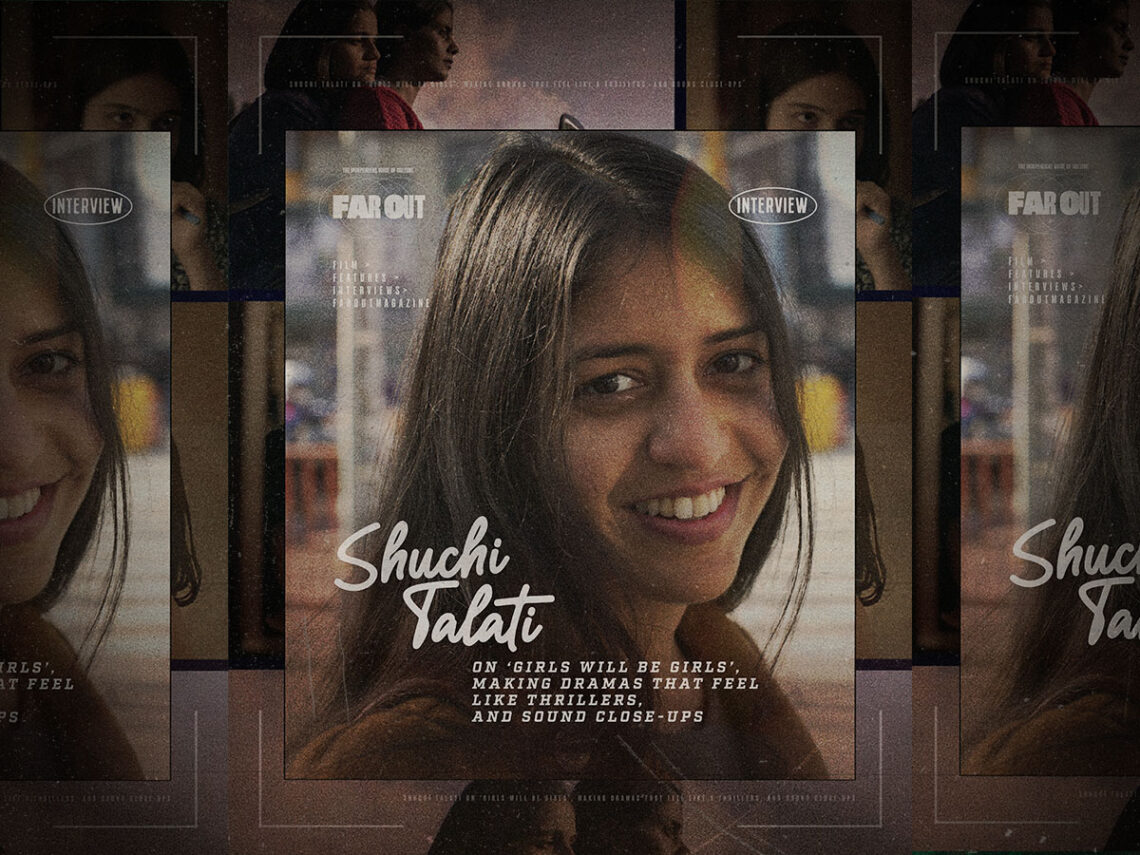
Shuchi Talati on ‘Girls Will Be Girls’, making dramas that feel like a thrillers, and sound close-ups

It took Shuchi Talati eight years to finish her first feature film, 2024’s Girls Will Be Girls. “I think I was writing for several years before I even thought it could be a film,” she tells me over Zoom, “Or just to have the confidence that this is going to amount to something”.
Set in a boarding school in the Indian Himalayas, it follows Mira, played wonderfully by Preeti Panigrahi, a straight-A student whose academic ambitions falter when she strikes up a romance with a charming new student named Sri, played by the equally brilliant Kesav Binoy Kiron. As she navigates her sexual awakening, she bristles under the watchful eye of her mother, Kani Kusruti’s Anila, who builds her own bond with Sri that Mira struggles to untangle.
When Talati started writing the script, she was doing so from a place of anger, channelling her frustrations about her own upbringing through Mira’s character and leaving very little sympathy for the people around her. “I wanted to write a story that kind of reflected that world, but really allowed this girl to enjoy her sexuality, for it to be mundane, for her to have agency,” Talati explains. But she also wanted the rest of the characters to feel like real people, too. And so she continued writing until she knew all of the characters inside and out.
The only villains in the story are a handful of boys in Mira’s class who represent the most toxic side of systematic misogyny. But while you might expect her relationship with Sri to turn equally controlling and humiliating, it never does. There are no earth-shattering betrayals or explosive breakups. Similarly, the flirtation between Sri and Anila never becomes sexual. It’s clear that Anila envies the freedom that her daughter has and is charmed by Sri, but their relationship doesn’t tip over into melodrama.
For Talati, creating complex, naturalistic connections between her characters was hard won. She studied filmmaking at the American Film Institute in Los Angeles, and it didn’t take long for her to discover that the type of movies that were taught there fell into a specific Hollywood mould. There was an emphasis on genre, for one thing. Talati gamely tried her hand at post-apocalyptic horror and dark fantasy, but it never felt right. “I have to say I lost my way a little bit at AFI, because I was starting to make films that are not really me,” she explains, “I was always trying to turn them into dramas, and I was not doing a really good job.”
The other issue that she kept running up against was the emphasis on creating conflict. It’s a central rule of storytelling that there has to be some sort of tension, but Talati’s version of tension was always very different from what most of her peers and teachers at AFI had in mind. In one of her early short films, centred on a couple navigating an open relationship, she faced pushback for a scene in which the wife of one of the characters offers tea to the woman her husband is sleeping with.

“The feedback I got from AFI friends was like, ‘There’s no conflict’,” she recalls, describing it as a clarifying moment. “I was just like, ‘I’m not interested in that. I’m interested in how people really behave and how they navigate situations. I’m not interested in the tropes that Hollywood has fed us.”
That said, she is equally disinterested in making ponderous art house movies that people admire rather than enjoy. “I don’t want people to watch [it] because it’s… independent or watch from a distance,” she says, “I want them to be invested—be at the edge of their seat.”
It is hard to articulate just how gripping Girls Will Be Girls actually is based purely on its plot, probably because Talati manages to find so much complexity and suspense just through the intricacies of gestures and expressions. Luckily, she’s already found a way to describe it: “I often say that I’m trying to make a drama that feels like a thriller”.
This is where her dual role as the writer and director of the film is most apparent. It is hard to believe that Girls Will Be Girls is her first feature until you remember that it took eight years to complete. Talati spent the bulk of that time writing the script, and it shows. It isn’t that the dialogue is polished or particularly noticeable; it’s that the characters are fully realised. Mira’s spiky relationship with her mother, Sri’s ability to gently flatter his way into both women’s hearts simultaneously, and Anila’s complicated personal and maternal feelings as she watches her daughter and Sri are so rich and specific that they seem almost novelistic, and it has nothing to do with dialogue.
“In my films, the words are not that important,” Talati admits, “The subtext is really important… People are usually not saying what they mean… So the writing process for me and spending all that time is to be very, very clear about what is emotionally happening in this scene, and then when I have this clarity in my head, I find I feel very secure as a director.”
This is most apparent in two scenes that involve dancing. In the first, Mira dances in front of the mirror, a smile building on her face as she settles into the freedom of it. Anila comes into the room and starts dancing too. For her, it’s an olive branch, an attempt to connect with her teenager, but for Mira, it’s an invasion of privacy. Her face falls into stony disapproval, and she abruptly stops dancing. Anila looks annoyed, but resigned. Everything you need to know about their relationship is in that wordless interaction.
Towards the midpoint of the movie, there is a scene in which the mother and daughter dance with Sri. At first, he dances a little awkwardly and chastely with Mira, but when Anila begins to dance, Mira is sidelined, watching her mum and boyfriend from the edge of the room as they dance fluidly and expertly.

There might not have been any words in either scene, but Talati and her cinematographer, Jih-E Peng, could recite the subtext as if it were narration. “That emotional precision is really important,” she explains. “I need to know exactly what is happening, what is the turn, and then we find the body language”.
Another way that Talati creates richness and imparts information without extensive dialogue is through the sound design. Of course, this is what sound design is for, and all movies have some version of it. However, in Girls Will Be Girls, it is doing a lot of heavy-lifting without ever taking centre stage. Dogs bark, crickets chirp, and the wind rustles through the trees, all conspiring to create a sense of teeming life, the kind of disorganised fullness that accompanies being a teenager and having too many emotions to possibly express.
“Our guiding principle was that the sound should make you feel what Mira is feeling,” Talati notes. “So our sound designer very early on said, ‘Your film has many silences, but I want to create for you silences that are happy, silences that are bright, silences that are dark and suffocating.’ Because there are all these ways that Mira feels in a silent scene, whether there are crickets that are slightly shrill and uncomfortable, or there are… far away birds that feel happier and lighter. You can do with sound an opening up of space when things feel expansive and spacious, and you can kind of zoom in and have a closed and suffocated feeling.”
Another key aspect of the sound design was breath. They recorded the actors’ breathing during moments when they had no dialogue and added it back in post-production to make it audible to the audience in certain moments. It fits so seamlessly that you may not even realise you’re hearing it. “There’s so much communicated in breath,” Talati highlights, explaining, “The moment that you hold your breath, your breathing slows down, your breathing quickens, whether you’re breathing through your nose or your mouth… there are moments where you feel like you hear Mira breathe, and that’s how close you are.”
She points to one scene in which Sri gives Mira an orgasm for the first time, and it slowly dawns on her that if he knew how to do it so expertly, he must have lied to her when he said that he’d never been sexually intimate with anyone else. “I think for me, that’s one of my favourite sound design moments, because he gives her an orgasm, and then there’s a moment on her face where you feel like she’s kind of processing what happened,” Talati says, “And there’s a sound close up, [where] all the ambience falls away. And then as she’s processing and she’s slowly realising that he lied to her, there’s these one, two, three layers of crickets. And it’s a very, sort of, ugly sound, and as she begins to forgive him, those crickets slowly die away and you hear birds.”
When I ask the obligatory question about what Talati is working on now, she says she’s taking things slow. “I feel like our world is just so ‘Go, go, go,’” she says, highlighting the industry tenet that you should always have several pitches at the ready when you’re ‘hot’. “I just try really hard not to subscribe to that,” she continues, “When people even ask me at Q and A’s, ‘What’s next for you?’ I always just say, ‘Sleep.’”
“I just really believe that writing something good and deeper just takes time,” she says. “I need to mature as a person and have something to say… And you can’t rush that process”.
