


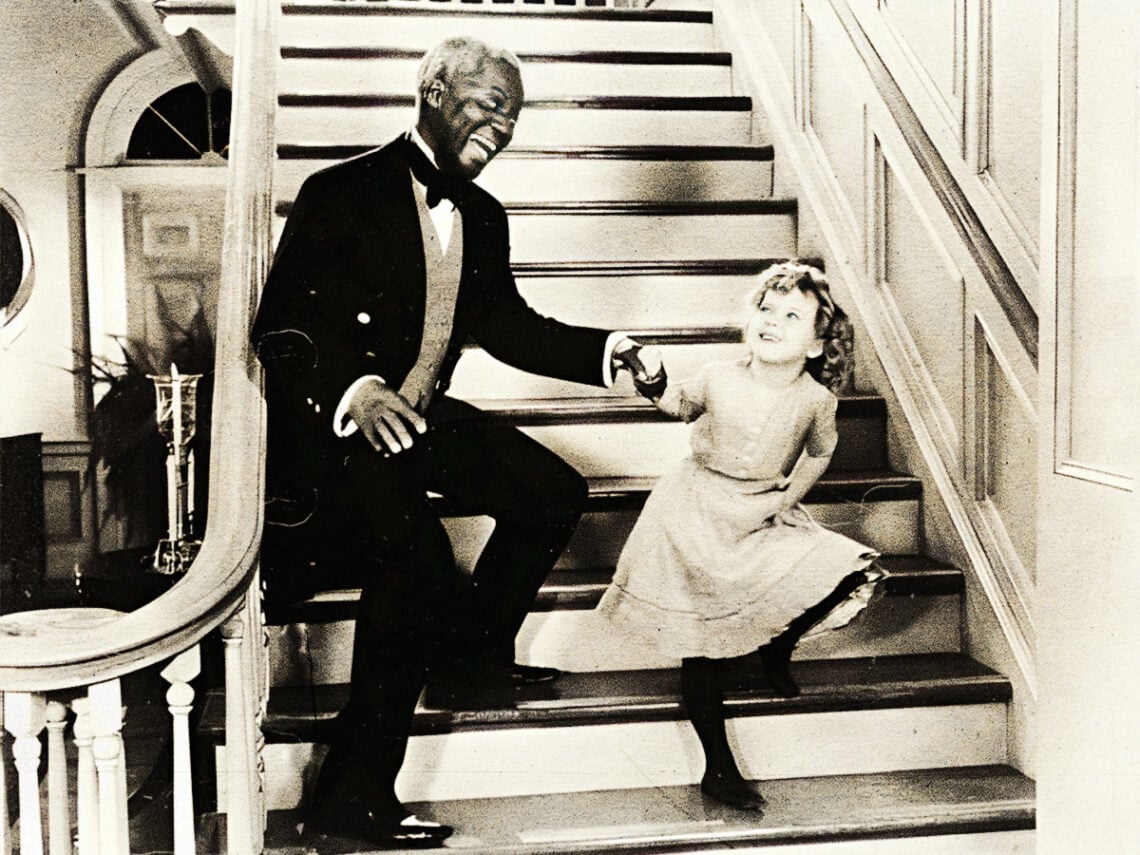
Shirley Temple and Bill Robinson: the first interracial dance partners in Hollywood history

A pint-sized Shirley Temple brought joy to the masses when she burst onto the silver screen in the 1930s. The bounce of her famous ringlets and the flash of her cheeky grin lifted the spirits of ’30s Americans who were left reeling after the Great Depression. “It is a splendid thing,” said Franklin D. Roosevelt of the child star, “that for just 15 cents, an American can go to a movie and look at the smiling face of a baby and forget his troubles.”
Temple was a genuine pioneer at only six years old, carving out child stardom as a viable career path that the likes of Elizabeth Taylor and Drew Barrymore would go on to emulate. But her ingenuity didn’t end there. Her performance in The Little Colonel alongside Bill ‘Bojangles’ Robinson made them the first interracial pair to dance on screen. The famous scene sees both of them tap dance up and down stairs as Robinson practically glides through the air, never missing a beat while leaping up and down steps to the delight of Temple.
Her childlike conclusion of “I want to try that!” launches them into a joint routine in perfect tandem, and although she only reaches his hip, their unison and timing is nothing short of perfect. Robison taught Temple how to tap dance after the idea to bring in a Black dancer alongside her was floated between Fox heads Winfield Sheehan and D. W. Griffith. Performing a tap routine on the stairs was a technique he made famous and unsuccessfully tried to patent later in his career.
After being signed by 20th Century Fox, it was agreed Robinson would do his famous stair dance with Temple. She had tap danced before with James Dunn in Stand Up and Cheer! so it was assumed it would be no issue. But Robinson quickly realised the complex routine would be impossible to teach Temple in the few days they had to practice. Instead, he taught her to kick each step on the staircase with her toe and changed his own movements so that it looked like she was imitating his steps on camera.
Despite having over four decades between them, they became lifelong friends, appearing together in The Littlest Rebel, Rebecca of Sunnybrook Farm, and Just Around the Corner. In Child Star: An Autobiography, Temple fondly recalled the first time she’d worked with Robinson. He was walking a step ahead of her, but when he noticed her scurrying behind to catch up, he dropped his pace so they could walk together.
“I kept reaching up for his hand,” she wrote, “but he hadn’t looked down and seemed unaware. Fannie called his attention to what I was doing, so he stopped short, bent low over me, his eyes wide and rows of brilliant teeth showing in a wide smile.” They continued walking hand in hand when she asked if she could call him Uncle Billy. “’Why sure you can,’ he replied. ‘But then I get to call you darlin.’ It was a deal. From then on, whenever we walked together it was hand in hand, and I was always his ‘darlin.'”
It was said Robinson carried pictures of Temple with him whenever he travelled and shielded her from the racial prejudice he’d experience because she was too young to understand it. When working on a film in Palm Springs, Temple was puzzled that she was staying in a private cottage while he had to stay above a drugstore – to which he told her not to fret; his chauffeur was staying there too. Despite his efforts to protect her, Temple has said he always treated her as an equal, once telling NPR: “He didn’t talk down to me, like to a little girl. And I liked people like that. And Bill Robinson was the best of all.”
During one of the most trying economic periods in American history, against a backdrop of horrific racism and segregation, Temple and Robinson tap-danced their way into the hearts and minds of the American public and formed a long-lasting friendship that defied nearly every social convention the period demanded, both on and off-screen.
