


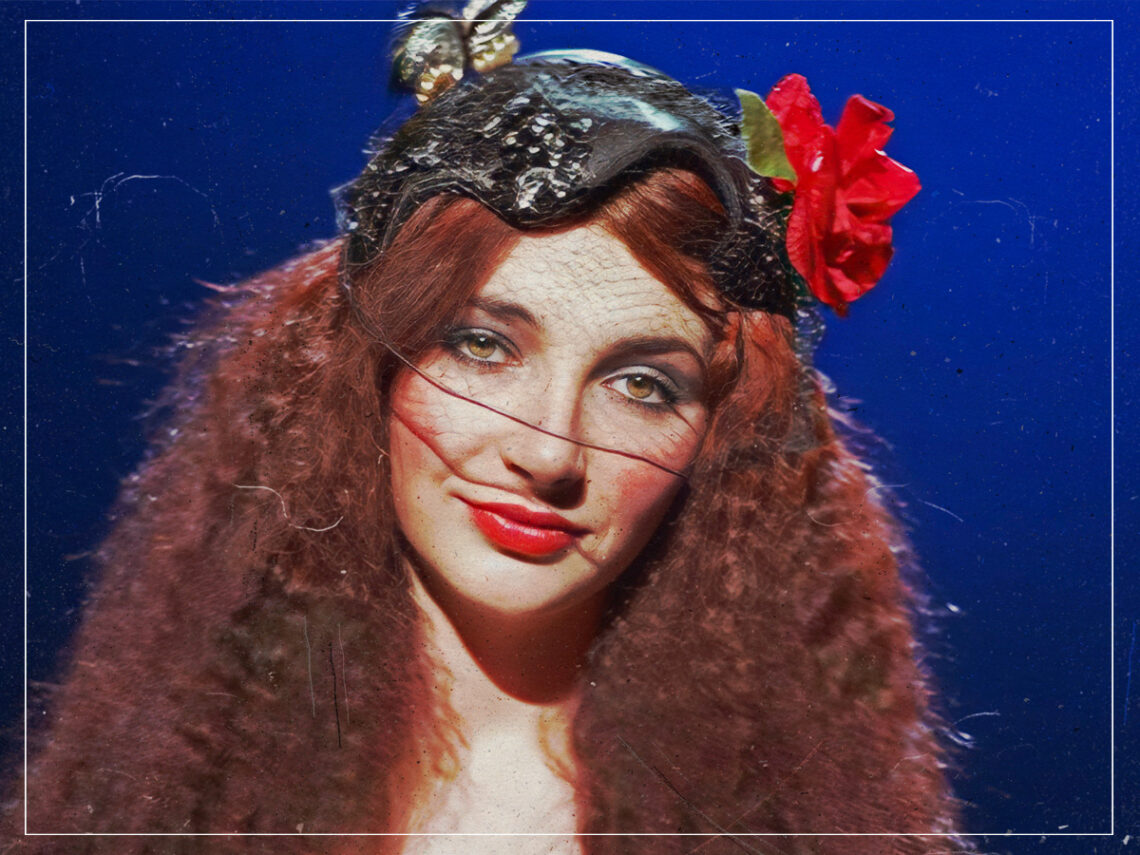
“Awful noise”: How self-doubt almost convinced Kate Bush her songs were terrible

Renowned for her mystical world-building that is brought to life in her music, Kate Bush‘s commitment to authenticity is one of the most awe-inspiring in music.
From the beginning, Bush has always leaned into her individuality; however, strange her tastes may seem to others. As her career was beginning in the early 1970s, the then-teenager was coming of age in a music world that was dominated by progressive rock, but there was an underlying search for something more. Prog was experimental by nature, but certainly, it could not be the only genre to push boundaries.
Consciously or not, Bush was eradicating boundaries before the notion of music truly came to fruition for her. Born in Bexleyheath, south-east London, in 1958, Bush’s childhood was spent on a 350-year-old farm in Welling, Kent. With her two older brothers, John and Paddy, Bush was free to explore the wide-ranging artistic gems that surrounded them in the home: a grand piano sat in the front room, an expansive library, and an old barn where Bush would first practice playing music.
She pored over classic British children’s literature, favouring the stories of Peter Pan and The Wind In The Willows, as well as Greek mythology. She was raised in an artists’ household: her father, Robert, was a general practitioner as well as an amateur pianist; her mother, Hannah, was a staff nurse and amateur traditional Irish dancer; her brother, Paddy, made instruments, and her brother, John, was a poet and photographer; both brothers played in the local folk music scene. Taking a liking to music was inevitable, but for Bush, music was not just an art form; it was a source of personal reckoning.
From an early age, Bush possessed a sensitivity that was unavoidable. “I had such an excess of emotion that I needed to get it out of my system, and writing was how I did it,” she once expressed, as quoted in Classic Rock. “I think everyone is emotional, and I think a lot of people are afraid of being so, they feel that it’s vulnerable. Myself, I feel that it’s the key to everything, and that the more you can find out about your emotions, the better.”

Bush began to write poems that would later take on new lives when set to song. She soundtracked her adolescence with the likes of Simon and Garfunkel and King Crimson, alongside Elton John, David Bowie and Billie Holiday – all of which would inform the eclectic sound of her music to come. Lyrically, she drew inspiration from various spiritual teachings (Roman Catholic, paganism, Buddhism, astrology and more), literary heroes (the likes of Oscar Wilde, James Joyce and Kurt Vonnegut) and television and musicals that leaned into comedy and horror.
Motivated by her family’s belief in her work, she began soundtracking her poems to piano at the age of 13. Songs that would appear on her 1978 debut, The Kick Inside, including ‘The Saxophone Song’ and ‘The Man With The Child In His Eyes’, would come to fruition, but a lurking sense of self-doubt would hinder Bush’s spirit.
“I could sing in key, but there was nothing there,” she admitted to Trouser Press.
“It was awful noise, it was really something terrible. My tunes were more morbid and more negative… they were too heavy.”
Kate Bush
Still, the teenager persisted, recording several demos on cassette and early drafts of songs on her father’s reel-to-reel tape machine. Her family revived her spirit once again when they asked John’s friend, Ricky Hopper, to share her demo tapes with labels. While not initially catching the attention of the “major” labels, one of Hopper’s old university friends was intrigued: David Gilmour.
The Pink Floyd guitarist was so inspired, he invited the then-16-year-old Bush to record at his home studio in Essex, backed by himself and the country-rock band Unicorn, another of Gilmour’s protégés. The musician went so far as to finance Bush’s recording of a master demo tape, choosing three songs of 40-50 that Bush had prepared, for her to record with members of the London Symphony Orchestra. As Bush was soon signed to EMI in 1976, surely any lingering thoughts of self-doubt were soothed.
Bush was then given the space to truly push her artistic vision even further. With the advance from her label, she studied under Lindsay Kemp, the dancer, mime artist and one-time mentor to David Bowie; and received further mime training from Adam Darius, learning from both how to prescribe dance and movement to her music. Still enrolled in school, she expanded her songbook to include nearly 200 songs and, one year later, the recording of The Kick Inside would begin.
Forever in a constant state of evolution, Bush’s artistry is expansive beyond comprehension, creating on her own terms and striving to achieve the near-impossible. “My success is in terms of fulfilment of my art, perfection of my art. That’s something I’ll never reach,” she once shared. “I never will. And I have to accept that.”
While perfection may always be elusive, in Bush’s world, it comes close.
