


‘Seeing in the Rain’: Chris Gallagher’s Vancouver

Over the years, films about cities have formed their own genre as filmmakers have tried to translate the unique essences of the great cities of the world into a visual experience. While some try to tackle complex subjects like history and sociopolitical developments, others experiment with the boundaries of the medium to create something new. One brilliant example of the latter category is Seeing in the Rain, a seminal avant-garde work by Chris Gallagher.
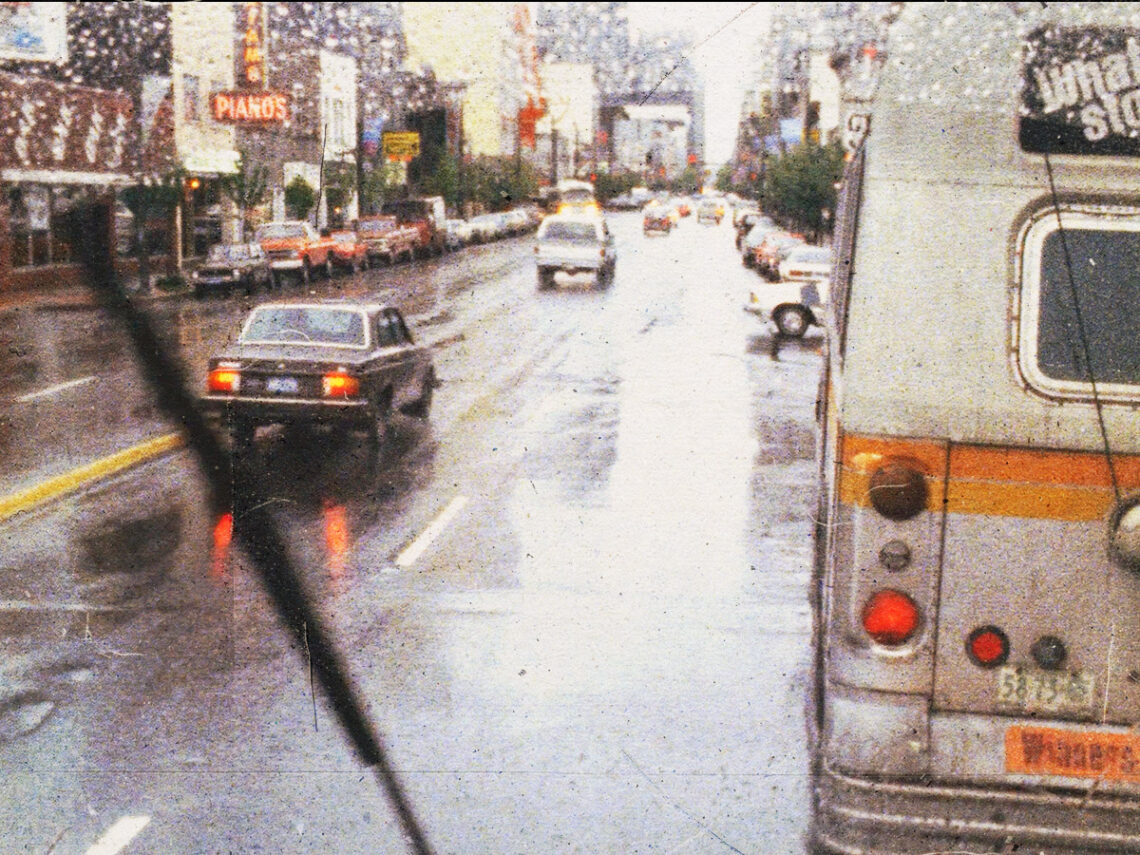
Filmed through the windshield of a bus, Gallagher documented the route of a bus traversing the Granville Street route in Vancouver on a rainy day. While the setting itself is unique and offers a glimpse of Vancouver’s past, it’s Gallagher’s fascinating approach to editing that sets Seeing in the Rain apart from other entries within the same corpus. Shot in real-time, the mesmerising work operates like a hypnotic session which transports the audience to a completely different psychological space.
During a conversation with Mike Hoolbloom, Gallagher said: “I was interested in taking a scene where one small element of perception was changed and seeing what followed. Seeing in the Rain is photographed out the front window of a bus running down Granville Street, Vancouver, in the rain. The windshield wiper runs back and forth across the frame, and I synced the sounds of a metronome with each pass of the wiper. I simply recorded ten minutes of this trip in real-time, turned the camera on and waited until the film ran out.”
However, unlike other films about cities, the protagonist in Seeing in the Rain isn’t Vancouver but time itself. Gallagher uses the bus’ windshield wiper as a metronome, oscillating between different coordinates of space-time as the sound of the wiper lulls us into tranquillity. By using the changing motion of the wiper as the focal point for the editing, Seeing in the Rain transcends the concept of real-time shooting and actually creates a new perception of time.
Gallagher explained: “Like much of my work, the main character is time. The sound of the wipers suggests a clock working, and their apparent continuity in the face of the disjunctive trip creates a bewildering paradox; the time of the film is correct, but the film’s space is upset. Cinema’s a beautiful place to work out theories of time because time is one of its plastic elements. Cinema can serve as a model for different notions of time. Someone should open a department of time, a study of time through its representation in photography and film.”
Usually, contradictions in the spatial and temporal arrangements of a film prove to be disruptive and create a disjointed experience for the viewers. However, Seeing in the Rain is particularly interesting because it is these disruptions that actually maintain the flow of the film. We soon realise that the bus isn’t travelling in space since it can’t occupy a particular coordinate for more than a few seconds. It’s actually travelling in time, like a spectre haunting Granville Street, severed from the registers of reality that hold us in place.
Watch the film below.
