


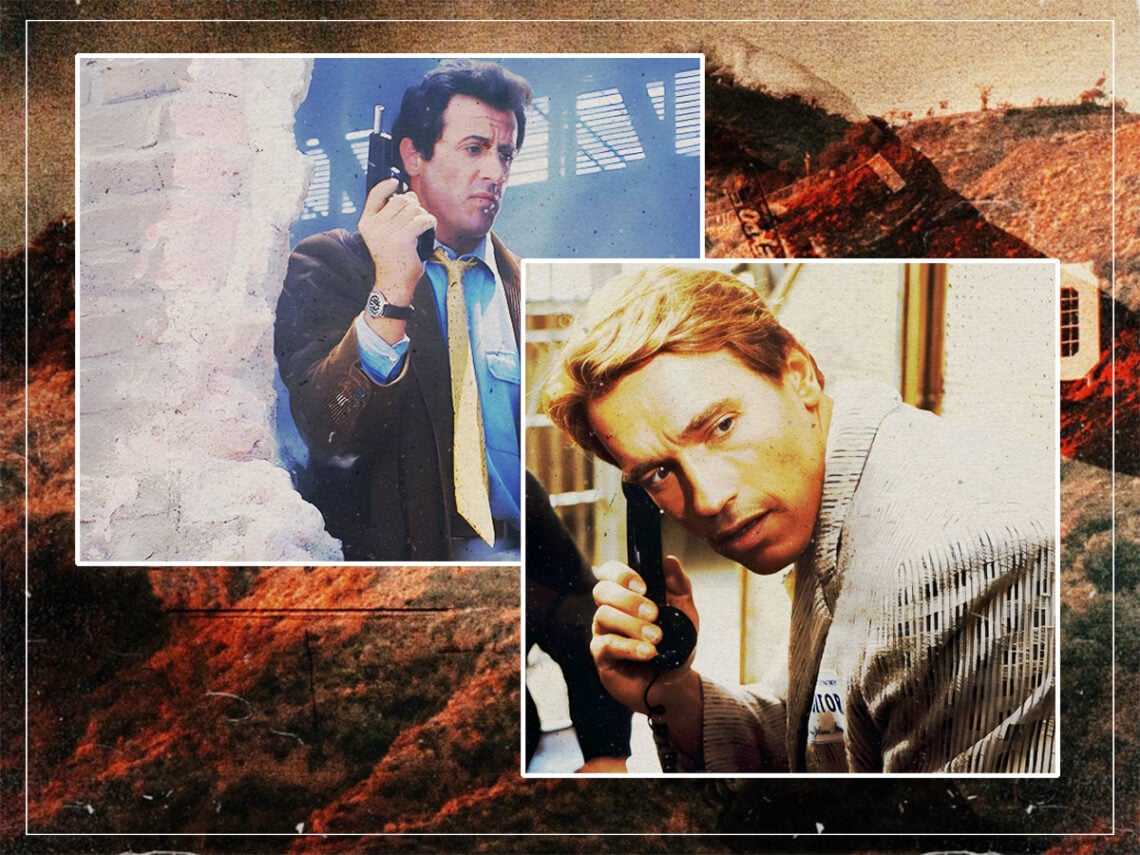
Arnold Schwarzenegger vs Sylvester Stallone: the bitter rivalry that defined an entire genre

The best way to illustrate just how important the rivalry between Arnold Schwarzenegger and Sylvester Stallone was to action cinema is that a clear line can be drawn between everything that happened before their shared rise to superstardom and everything that came after.
The genre was hardly in its final throes prior to the 1980s, but the majority of the finest actioners outside of the martial arts genre tended to focus on actors who looked and behaved like regular people. However, when the two beefy behemoths engaged in their seminal battle for supremacy, it reinvented the entire notion of how both studios and cinemagoers treated the medium.
Encapsulating the Regan-era excesses of the time, tortured characters were out, and bulging biceps were in. Although Stallone had first gained prominence as an Academy Award-nominated actor and writer of the ‘Best Picture’ winner Rocky, it’s not a coincidence that his star shone brighter than ever when he packed on a ludicrous amount of muscle and engaged in posturing of a figurative and literal kind with his arch-nemesis.
Schwarzenegger may have won a Golden Globe for ‘New Star Of The Year’ in 1977, too, but he was hardly going to show up in prestige drama based entirely on his dimensions and impenetrable accent. Putting his bodybuilding career to the only use it had in cinema, he carved out a career blowing armies of faceless goons away with reckless abandon and a carefully placed one-liner.
Naturally, this fostered an intense dislike between the two that saw them repeatedly firing shots at each other in the press. Schwarzenegger even tricked Stallone into starring in one of his worst-ever movies after maliciously leaking that he had serious interest in a script he knew was terrible, solely to get his arch-rival to sign on for a guaranteed flop.
Beyond that, though, their shared status as the faces of the action movie saw a slew of performers who barely boasted a shred of acting ability between them, embarking on their own lengthy careers. Would the likes of Steven Seagal, Chuck Norris, Dolph Lundgren, Jean-Claude Van Damme, and Michael Dudikoff have stood a chance were it not for the trail blazed by Schwarzenegger and Stallone creating widespread interest for buff ass-kickers taking precedence over story, character, and on-camera talent? Absolutely not.
Even the rise of the everyman hero towards the 1980s and early 1990s – personified through Mel Gibson’s Lethal Weapon, Bruce Willis’ Die Hard, and Keanu Reeves’ Speed, to name three of the greats – wouldn’t have happened without the pair’s unbreakable stranglehold. Audiences had started to grow weary of seeing bulletproof and indestructible protagonists with pecs for days, allowing the focus to gradually shift away from the self-created paradigm of Schwarzenegger and Stallone into a new era.
It’s not a coincidence that stars including Nicolas Cage, Christian Slater, Chow Yun-fat, Tom Cruise, and Will Smith were headlining their own string of action-packed gems at the same time the strapping statesmen of the 1980s saw their own stars beginning to flame out. Their unmatchable dominance ushered in a brand new era that reflected evolving audience interests to see flawed characters they could relate to take centre stage over the guys who could single-handedly lay waste to 100 goons without barely a scratch on them.
Even today, any action star to emerge in the aftermath often gets labelled as ‘the new Arnold Schwarzenegger’ or ‘the new Sylvester Stallone’. Such is the way their names have become indelibly linked with the art form. The former even literally passed the torch to Dwayne Johnson in 2003’s The Rundown to make that as obvious as possible, while Chris Hemsworth took it as a personal insult.
“I got asked the other day, ‘Did you always want to be the next Schwarzenegger?’ And I thought, ‘That’s what you’ve got from what I’ve done?” he said. “I was really disappointed like I thought that I’d chosen these scripts and loved them because they had real actors in them and real story and heart, and sometimes with films, the action overshadows anything else.” He’s got muscles, and he carried a gun on-screen, then, which, by extension, means that comparisons are obligated to be made.
The entire complexion of cinematic action was changed entirely for better and worse by Schwarzenegger and Stallone. The 1980s were swamped with unremarkable copycats trying to get in on the protein-fuelled bandwagon. The 1990s left them behind by doing the exact opposite of what had brought them so much success in the first place, while the 2000s have seen them evolve into self-aware veterans who still manage to be name-checked anytime a new movie channels the spirit of their respective heyday.
