


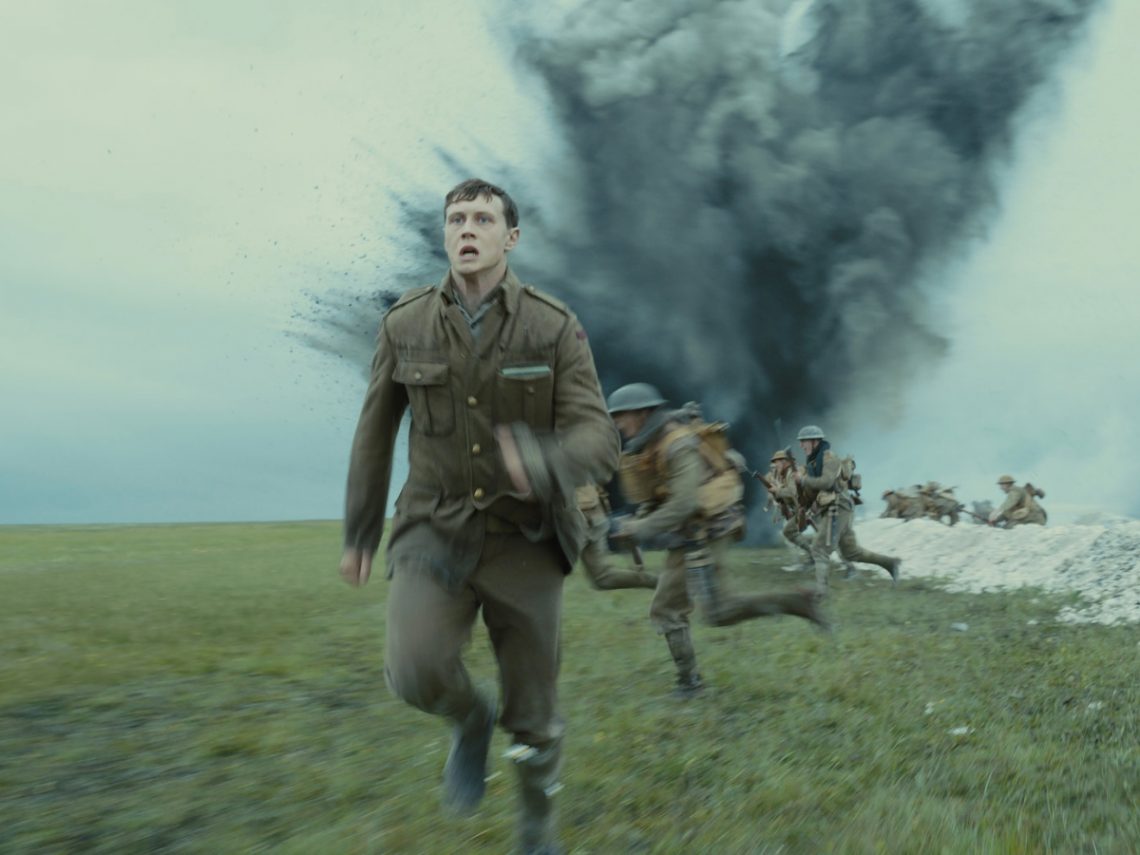
Sam Mendes details the true story behind ‘1917’

Of all the symbols of the First World War, the waterlogged trench remains the most evocative. Etched along the Western Front, men as young as 14 lived and died in these serpentine networks, enduring extraordinarily difficult conditions only to be sent to near-certain death by generals sat 40 miles behind the frontline. This was a world that Albert Mandes, grandfather of Sam Mendes, knew all too well. Indeed, Albert’s stories from that time are the basis for the 2019 picture 1917. Here, Sam recalls one particularly haunting tale from Albert’s life in the trenches.
“My grandfather, he was a novelist called Alfred Mendes,” the director told BBC Radio 4’s John Wilson. “He had never told the stories of the First World War and of the experiences he had as a 17 and 18-year-old at the end of the war to anyone, including his own sons.” That was until he found an audience of grandchildren sitting at his feet, begging to be told about the war. Sam had already noticed something peculiar about his grandfather: “He used to wash his hands all the time, repetitively. It was like a sort of ritual,” he continued. “And I remember asking my dad, you know, why does grandad do that strange thing where he hashes his hands? And he said: ‘he remembers the trenches, the mud of the trenches – and he couldn’t get the mud out of his hands.'”
“I just think it blew my tiny mind that an experience could remain in your body like that,” Mendes said. “Could remain in your psyche to such a degree that your entire behaviour patterns change.” Eventually, Sam’s nagging got the better of Alfred. “I remember one [story] where his friend had his head blown off and carried on running,” he recalled. “You don’t forget that when you get told a story like that as a child.”
Mendes’s grandfather was highly unusual in this respect. Most of the men who fought in the First World War rarely spoke about their experiences, being too traumatised to relive those memories. Alfred, meanwhile, was discussing his wartime experience in explicit detail with a ten-year-old child. “He also wrote a memoir which is published,” Mendes went on. “He doesn’t tell that story, and indeed the one I based 1917 on, because he had a lot of stories. But he did talk about how one of his other friends was hit by a shell directly and literally just disappeared. I mean, he was just mist; there was nothing left of him.”
In the end, the story that stuck with Sam wasn’t about men being brutalised in the trenches; it was a tale of courage. “He was a very small man,” Mendes continued. “He was of Portuguese origin, so they called him The Petit Portuguese. And he was billeted to carry a message out into no man’s land along the trench and three back into the trench because it was the fastest way to go. And because the mist hung at six feet, they gave him the job because he couldn’t be seen over the top of the mist. And so, he would carry these messages but only at a particular time of day when the mist descended. And that image of that little man carrying that message through no man’s land – that was really the basis for 1917.”
You can revisit a clip from 1917 below.
