


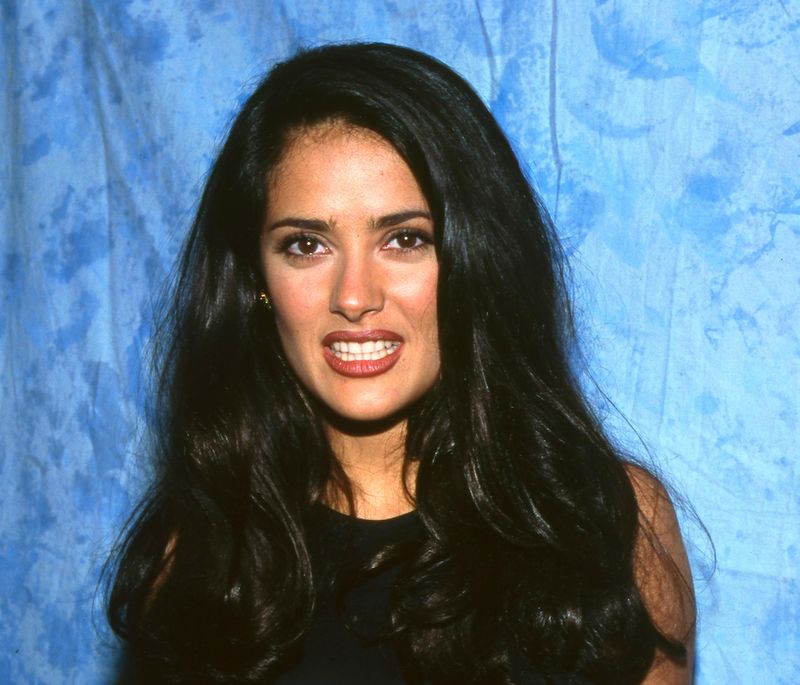
“I had things said to me that you would not believe”: Salma Hayek’s early struggles with typecasting

Many of the brightest stars in Hollywood have complained about typecasting over the years. For some reason, even in a business predicated on actors pretending to be someone they’re not, many people can only see certain stars in one kind of role. Salma Hayek has admitted to facing an uphill battle in her early days in American cinema, and was told some incredibly problematic things. Unfortunately, that typecasting extended much further into her career than it should have.
When Hayek was only 23, she landed the lead role in Teresa, a telenovela in her native Mexico. Telenovelas are that country’s soap operas, and they achieve enormous ratings. For instance, at the height of its popularity, Teresa was watched by 70% of the Mexican population. The show ran for 125 episodes, but it never brought Hayek the critical praise she’d hoped for. For the 30% of the population that didn’t watch them, telenovelas were considered lowbrow entertainment, and people who starred in them weren’t to be taken seriously as actors.
Despite being a huge TV star, this attitude toward telenovelas meant that Hayek’s career had nowhere to go in her homeland after the show finished. So, she moved to Los Angeles to pursue a career in American film and television, studying at an acting school founded by the legendary Stella Adler. It was Adler who taught legendary Mexican actress Dolores Del Río how to forge a path in Hollywood in the 1920s, but when talkies were invented, and people finally heard her heavy accent, the roles dried up considerably.
Despite Hayek trying to make her way in Hollywood seven decades later, she was horrified to discover that many of the same prejudices that scuppered Del Río’s chances of stardom still applied. In 2016, Hayek told The Telegraph, “I had things said to me that you would not believe.” While she wouldn’t name names, she revealed that a major studio executive once told her, “The moment you open your mouth, you remind everyone of their maid.”
At this time, Hayek was only considered for roles that fell into two categories: sexy temptress and sexy housekeeper. Astonishingly, she confessed that her cultural background even negated her being cast in top-of-the-line temptress roles, which weren’t exactly the fulfilling parts she’d imagined playing anyway. She scoffed, “They’d consider me for prostitute, but never lead prostitute.”
Sadly, Hayek found then herself battling against two kinds of typecasting. Once she’d seemingly graduated beyond her accent and cultural heritage holding her back in Hollywood, she found her looks prevented her from being considered for certain parts. After bursting onto the scene as Santanica Pandemonium in Robert Rodriguez’s From Dusk Till Dawn, she wasn’t inundated with offers to play scene-stealing female villains. Instead, she was confronted with a lot of scripts about strippers.
For many years, Hayek admitted she had to play Hollywood at its own game if she wanted to work, so she played lots of exotic and beautiful women lusted after by the men in the movies. However, she credited an unusual source with freeing her of this particular kind of typecasting: Adam Sandler.
In 2023, Hayek told GQ, “I was typecast for a long time. My entire life, I wanted to do comedy, and people wouldn’t give me comedies. I couldn’t land a role until I met Adam Sandler, who put me in a comedy, but I was in my forties.” This comedy was Grown-Ups, and even though it was critically savaged, Hayek returned for the sequel and subsequently branched out into other comedic films.
Of the attitude she faced in her early Hollywood days, she lamented, “Not only are you not allowed to be smart, but you were not allowed to be funny in the ’90s.”
