


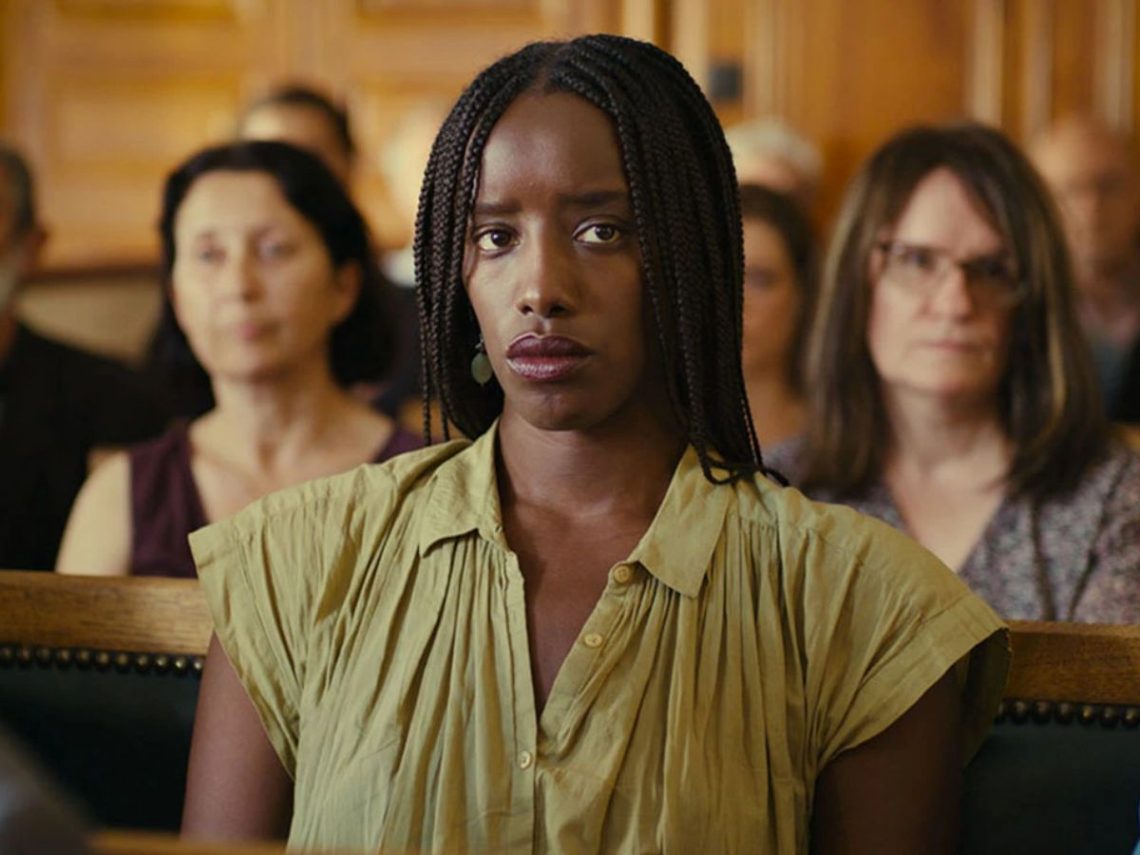
‘Saint Omer’ Review: Alice Diop delivers a captivating meditation on motherhood

Although Alice Diop began her filmmaking career as a documentarian, her newest release, Saint Omer, marks her first foray into narrative territory. Since its native release in France last November, the film has scooped up multiple awards, including the prestigious Grand Jury Prize at Venice Film Festival – and for good reason. Diop’s stunning drama is an intricate portrait of womanhood, motherhood and race, situating the audience in the midst of a compelling court case.
Saint Omer’s Laurence Coly, accused of infanticide, is inspired by Fabienne Kabou, a young Senegalese woman who left her baby on the beach to be swept away by the tide. A pregnant Diop, the daughter of Senegalese parents, found herself drawn to the trial in 2016, telling The Guardian: “I went there under the magnetic pull of an obsession that for a long time I couldn’t put into words. There was this psychoanalytic and mythical dimension underlying the way [Kabou] explained her actions.”
Diop translates the events of the trial onto the big screen with great care, interlacing the courtroom drama with scenes of the protagonist Rama, a pregnant lecturer and novelist. Between attending the trial, we see Rama attempting to process the case whilst reflecting on her own pregnancy, childhood, and relationship with her mother.
Diop moves between slow, meditative scenes of Rama in her hotel room, ambiguous flashback scenes, and lengthy static courtroom shots, creating a heightened atmosphere of tension as the three thematically intersect. Despite the length of certain scenes, Saint Omer never falters or becomes tedious. Instead, Diop’s film captivates, drawing audiences into the heartbreaking story of an isolated and mistreated woman, forcing us to ponder the complexities of motherhood. During an interview with the Financial Times, Diop explained: “This is not a film that investigates a crime, but one that questions the complexity of the maternal bond. The difficulty of being a mother is very rarely talked about. The profound anguish of what it means to be a mother or to become a mother is hardly ever spoken of.”
Guslagie Malanda’s stunning portrayal of Laurence relies equally on subtle facial expressions as much as speech. It’s as though she is speaking another language with an uncertain stare or the steady movement of an eyebrow. According to Malanda, Diop “wanted [her performance] to be absolutely unspectacular, with a sort of formal reserve. I had to show emotion without showing it”. Similarly, Aurélia Petit gives a standout performance as Laurence’s Defence Barrister, delivering a stunningly powerful monologue in the final act that is likely to move the audience to tears.
Diop’s film is a quietly harrowing unravelling of what it means to be a mother, presenting each character with patience and control. Furthermore, Diop attentively explores the experience of being a woman of colour living in post-colonial France. Saint Omer marks Diop as one of this year’s most promising new narrative filmmakers, with her documentary background giving her work an extra layer of sensitivity.
Saint Omer is released in the UK on February, 3rd, 2023.
