


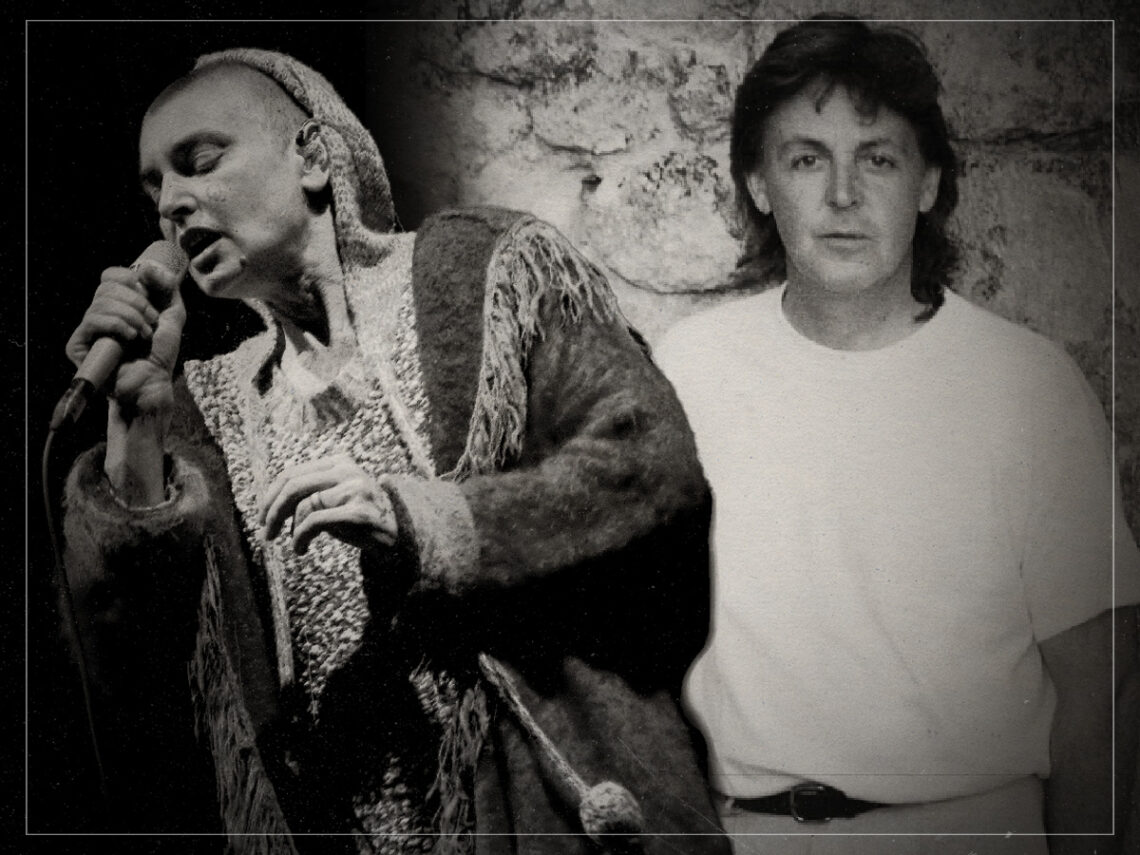
The sad Paul McCartney chorus Sinéad O’Connor sharpened for a political anthem

Many artists feign a sense of creative rebellion, positioning themselves as daring revolutionaries willing to do whatever it takes to get their message across, but when it comes to the crunch, many of those artists wilt, and the contrived nature of their activism is exposed. Never did that happen to Sinéad O’Connor, though, who was the truest musical revolutionary to have ever existed.
Her most daring performance came on Saturday Night Live in 1992, when O’Connor ripped up a picture of The Pope live on television, in a bid to criticise the Catholic Church’s long history of sexual abuse. There was no commercial compromise from O’Connor, who was more concerned with paying faith to the thousands of abused victims, as opposed to the powers that largely control the media output of the modern world.
But it was unsurprising, given just how intensely involved O’Connor’s music had always been with activism. Two years later, she backed up that performance with a recording that struck to the very heart of Ireland’s politicism and wasted no time in laying out the facts that have long existed behind the suffering.
‘Famine’ was a wickedly constructed track that outlined O’Connor’s argument that the 1840s Irish Potato Famine was not a natural famine, but instead one of man-made construction, politically designed by the British rule looking to inflict starvation and cultural destruction.
O’Connor explained, “Everyone believes there was a 19th-Century famine, but in fact, there was lots and lots of food in the country, it was just being shipped out of the country. It was just that you were shot dead if you were Irish and you went near anything but a potato”.
“The fact is that to call it a famine is a lie”.
Sinéad O’Connor
Predictably, the song sparked controversy in the UK, but that never stopped O’Connor from playing the song in its full and true form whenever she had the opportunity. In fact, a famous performance from The Jools Holland Show has long done the rounds on the internet since ‘94, carrying on O’Connor’s furious legacy as a musician who stood up for her own principles, even in the face of the people it was offending.
But while the lyrical content was unflinching in its attack on Britain, O’Connor adopted a more subtle and underhanded technique when it came to offending the British. Just as she believed the Irish were robbed, she stole from Britain’s most beloved outfit when constructing her chorus.
The song’s hook of “All the lonely people, where do they all come from” is an homage to The Beatles’ song ‘Eleanor Rigby’, which had the exact same words but in a slightly different melody. But it worked on a more profound level, given how McCartney’s track mused on a sense of social isolation that existed within his protagonist, which O’Connor then flips and poses as a making of British design.
Regardless of the interpretations, it remains one of O’Connor’s most beloved tracks and does The Beatles’ number justice, for they were a band intensely engaged with the sort of social activism O’Connor championed.

Never Miss A Beat
The Far Out Beatles Newsletter
All the latest stories about The Beatles from the independent voice of culture.
Straight to your inbox.