


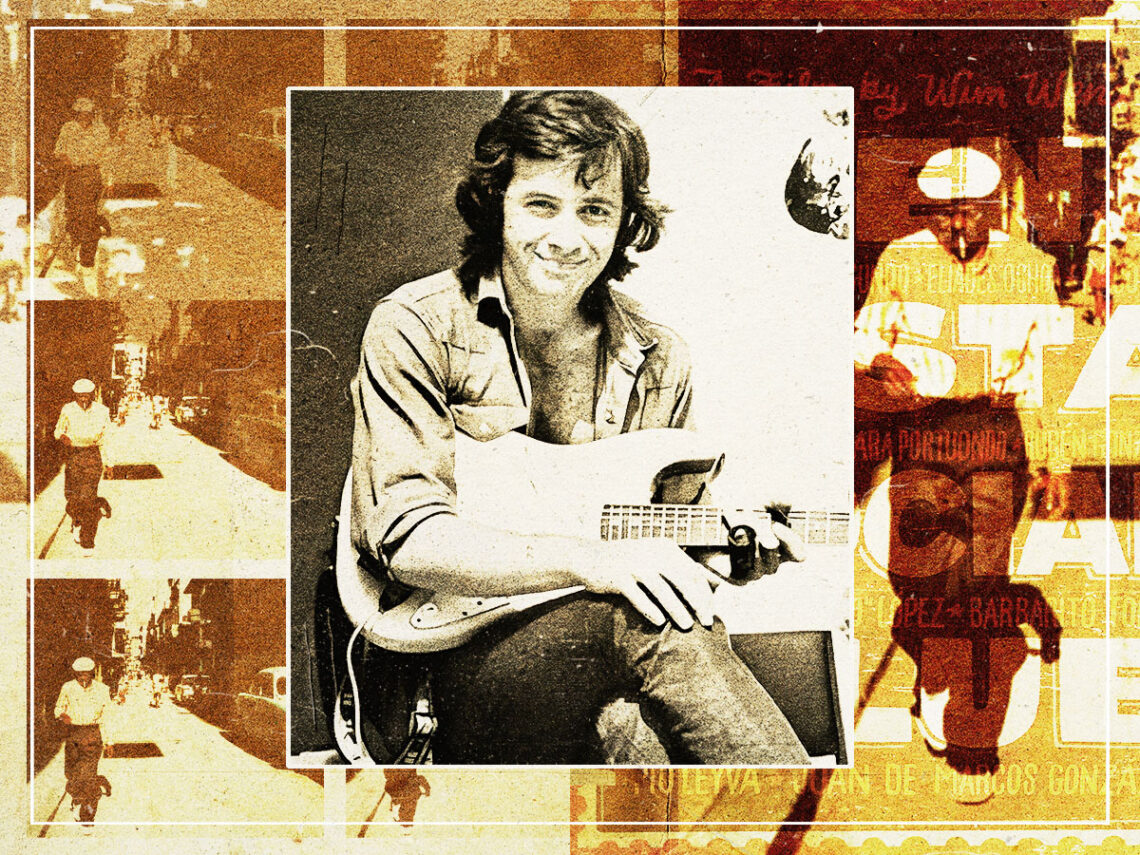
From Los Angeles to Cuba: Ry Cooder’s journey to the Buena Vista Social Club

Ry Cooder has spent a career travelling the world in order to get in touch with roots music, reshaping and repopularising the likes of gospel, blues, and country, as well as lesser-known genres like Louisiana’s Zydeco, Tex-Mex and Hawaiian music.
The California-born singer-songwriter was instrumental in producing 1997’s award-winning Buena Vista Social Club, which saw him travel to Havana, Cuba, to get in touch with the country’s sound and play alongside the musicians based in the area.
Cooder first became enchanted with Havana in the 1970s. He’d spent time in New York leafing through obscure records and come across its music, mostly compilations of old performances from musicians either not playing anymore or no longer around. His curiosity was piqued, and he and his wife Susie travelled to the island by boat.
When he arrived, Cooder saw Ñico Saquito, the Cuban musician who popularised the guarachas genre during his stint in Los Guaracheros de Oriente, playing his guitar in a park. “I saw that music was such a big part of their daily lives,” Cooder told Uncut. “He was really old by then, with his little trio playing under a palm tree, for heaven’s sake! I thought, ‘OK, that means I could come here, see these people, and get to know them.'”
Shortly after the first trip, Cooder’s son Joachim was born, so all travels were off for the foreseeable future. But 20 years later, he returned, as he always knew he would. Alongside British producer Nick Gold, he intended to record a session of two African musicians who were collaborating with Cuban artists. After arriving via Mexico to avoid the US travel embargo to Cuba, Cooder discovered that the African musicians hadn’t been sent their visas and couldn’t travel there.
Gold and Cooder quickly changed plans, enlisting the help of pianist Rubén González, Manuel ‘Puntillita’ Licea, and octogenarian singer Compay Segundo. The three local musicians who agreed to record the project joined bassist Orlando López, guitarist Eliades Ochoa and musical director Juan de Marcos González – who were all originally involved with the first planned recording.
Within three days of the project’s birth, the impromptu group of local artists recorded genuine Cuban music, playing standards from the trova and filin catalogue as authentically as could be imagined. The recording took place at EGREM/Areito studios at Centro Havana, and its studio and equipment had been largely untouched since the 1950s. Rather than a drawback, this actually suited the majority of the group, who were veterans of Cuban music’s golden age throughout the 1940s and ’50s.
Those same players who bought Buena Vista Social Club to life with their decades of experience had fallen out of favour in post-Castro Cuba. Their music was assumed to be “bourgeois, probably fascist and exploited by American gangsters and corporations”, explained Cooder, “which, of course, is totally wrong. You can’t legislate or govern music out of people – but it’s true that being a dictatorship, they could make life hard for the players.”
But the players persisted, and Cooder’s second Cuban trip made history. The album sold eight million copies, making stars out of the unknown musicians on it and inspiring a documentary directed by Wim Wenders, which itself went on to be nominated for an Academy Award. It was a dazzling feat and a beautiful snapshot of authentic roots music, recorded in a studio of musicians who, for the most part, didn’t even speak each other’s languages.
Although there was an interpreter present, Cooder has always insisted “musicians understand each other through means other than speaking,” which is the philosophy that undercut his entire trip to Cuba.
