


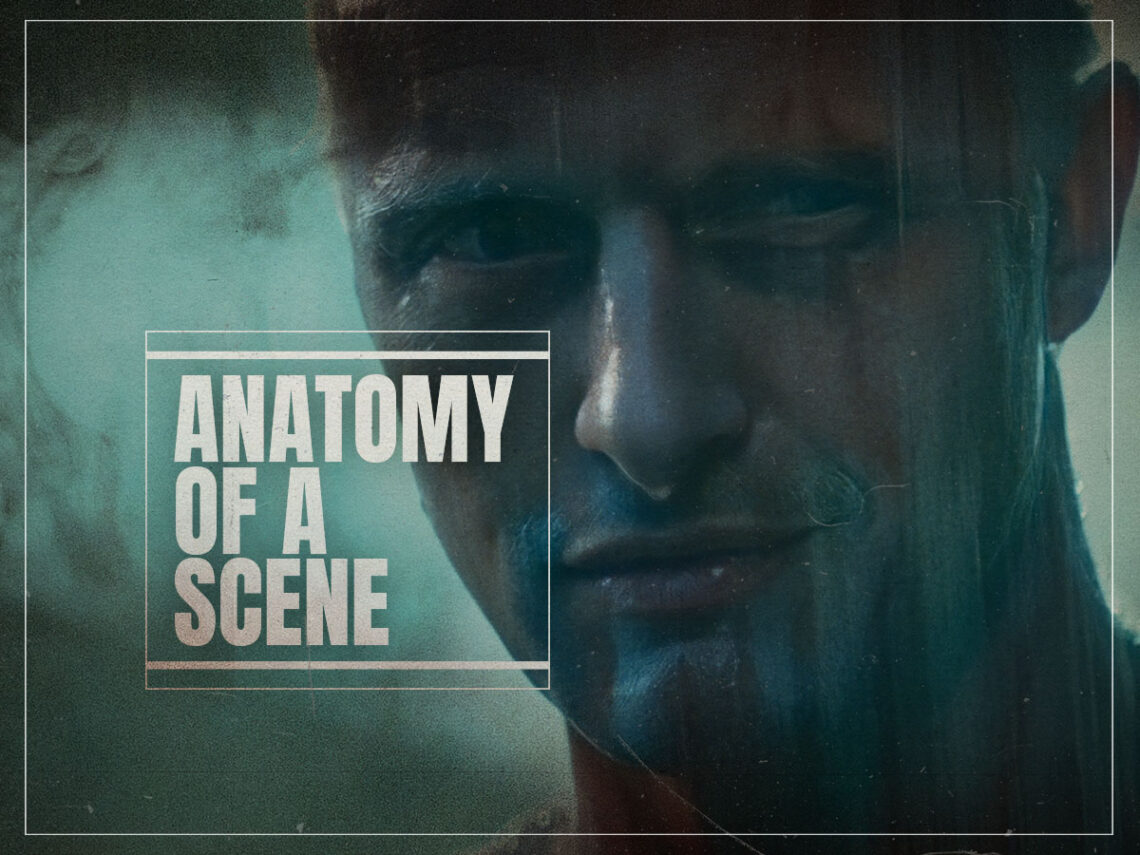
Anatomy of a Scene: Rutger Hauer’s tears in the rain of ‘Blade Runner’

42 words on a rooftop in the rain – that was all it took for Rutger Hauer to cement his place in the canon of sci-fi greats. The tears in the rain monologue from the end of Ridley Scott’s 1982 science fiction classic Blade Runner is widely looked upon as one of the greatest scenes in film history. But what is it about those 42 words, dispassionately delivered, largely consisting of impenetrable references to life in space, that has so stuck with the viewing public?
You could argue the history of robots in film before the 1980s runs in three main gears. First, there’s the ever-present robot as a monstrous anti-human antagonist, as in the tradition of Doctor Who or 1950s B-movie fodder. Then there’s the anthropomorphised appliance of R2-D2 or Rosie in The Jetsons. A third more inscrutable category is the robot as an avatar of some mysterious other – as in the case of Ash in Alien, the fifth columnist turning on the crew of the Nostromo in service of the corporation, or Gort in The Day the Earth Stood Still, a highly powerful deterrent used by an alien civilisation to force humanity into peace.
But it was the replicants that were born from the mind of Philip K Dick that turned the lens fully inward for the first time and made the audience feel the cold loneliness of synthetic life from the inside. Aside from the questions of who and who isn’t an organic android in different cuts of the early cyberpunk classic, at the very heart of this is the performance of Rutger Hauer as Roy Batty.
Batty is a rogue replicant, a synthetic humanoid indistinguishable from humans bar one important factor – a lifespan restricted to just four years. Bred for hard labour and combat in deep space, Batty and a group of comrades break loose and head for Earth in a fruitless search for a way to extend their lives.
It’s Pinocchio on a galactic scale. Batty is excluded from humanity by his own impending expiration date and is searching for a way to become a real boy before his clock ticks down.

His monologue at the end of the film is delivered just before his body gives out. It’s a moment of a quasi-human coming face to face with mortality with a clear and open mind and realising the truly ephemeral nature of his adjacent to human experience. But what sticks with the viewer is the way we are invited into that brief flicker of recognition at the vastness of nothing at the other end of Batty’s life – a kind of psychic intimacy no film had attempted to give to an automaton.
And what sells this moment as sublime is ultimately Hauer’s performance. His piercing blue eyes and angular features sell his next-to-human status, while an almost Zen-like calmness pervades his soliloquy as he recounts experiences no actual human can share or perhaps even comprehend: “I’ve seen things you people wouldn’t believe.”
The brief list of intergalactic wonders (“attack ships on fire off the shoulder of Orion… C-beams glitter in the dark near the Tannhauser Gate”) is a moment of masterful world-building, giving no real answers but momentarily flooding the viewers’ brain with images of strange and terrible miracles happening in some distant corner of the universe. It’s but a fleeting hint at some other epic happening off the edges of the screen – interplanetary war at a scale that cannot fit in the mind’s eye.
But it doesn’t matter how immense and awe-inspiring those memories are for Batty: “All those moments will be lost in time, like tears in rain”. It’s the strangeness of this creature’s too-short life that really hammers home the tragedy of his inevitable death moments later. It doesn’t matter how far he has travelled, what he has done or seen – how exalted or enlightened he has become in his labours – the end still comes, leaving him a decaying husk on a rooftop, finally truly indistinguishable from any other dead human.
In that sense, Pinocchio does get his wish in the world of Blade Runner. But as the old adage goes, be careful what you wish for.
In recent years, Ridley Scott has confirmed that Hauer himself played a part in the writing of the speech, adding the last line and cutting several other references to off-world phenomena that he described as “opera talk”.
In an interview with Rotten Tomatoes in 2017, Scott compared the final product to a Shelley poem. It does bring to mind work like Ozymandias, of whose great works “nothing beside remains”.
Hauer died in 2019, leaving behind excellent performances across a range of genre films like The Hitcher. But although those moments have not yet been washed away like tears in the rain, it’s clear the moment he will most be remembered to cinephiles is his star turn in Blade Runner and the way he made audiences empathise with this not-quite-human in search of life stretched just a little bit longer in a cruel universe: “Time to die”.
