


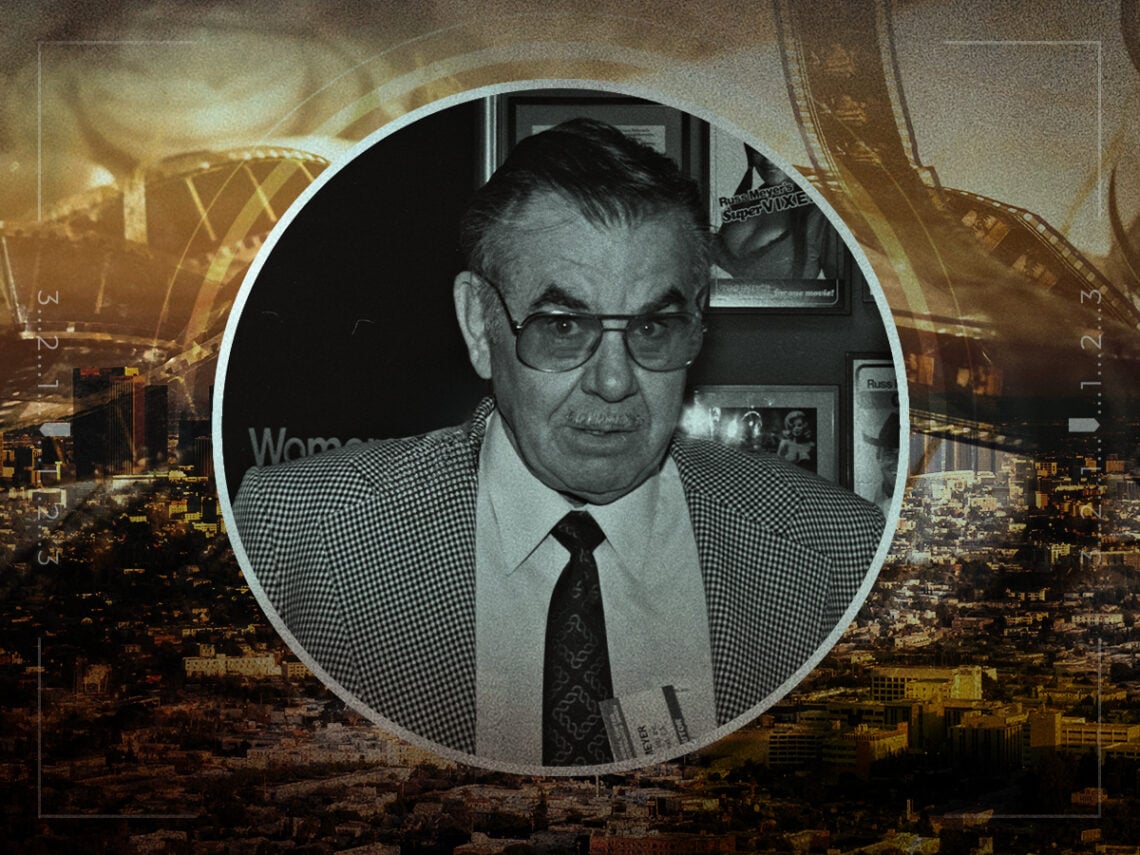
“It’s mainly sex and violence”: Russ Meyer’s only sexploitation movie shot outside of California

There’s always been a school of thought suggesting that it’s best to stick to what you know, and since Russ Meyer was born and raised in California, it was only natural that the top dog of sexploitation cinema’s 1970s heyday would shoot almost all of his movies in his home state.
He was never the most technically gifted filmmaker, and he wasn’t a career-launcher in the same vein as his fellow B-tier titan, Roger Corman, but Meyer has nonetheless become synonymous with an entire subgenre, all thanks to his preference for busty babes, camp humour, and a tongue planted in cheek.
Quentin Tarantino is one of his most famous fans, with the two-time Academy Award winner feeling dejected in his younger days that Meyers’ magnum opus, Beyond the Valley of the Dolls, didn’t change the face of Hollywood forever as he was so convinced it would, but he still made an impact.
Faster, Pussycat! Kill! Kill!, Vixen!, Supervixens, Beneath the Valley of the Ultra-Vixens, Motorpsycho, and more helped define the writer, director, and producer’s distinctive and very much of its time style, and some of them rank among the cultiest cult classics that American cinema has ever produced.
One of the many commonalities between almost all of Myers’ pictures was that they were either shot entirely or predominantly in California. He did venture overseas on very rare occasions, helming the historical comedy Fanny Hill in Germany before diving straight into his pseudo-doc Europe in the Raw immediately after, but only one of his sexploitation flicks was filmed outside of the ‘Sunshine State’.
In 1973, Meyer pitched up in Barbados to shoot Black Snake, starring Anouska Hempel in the role of a vicious plantation owner. The concept is questionable when viewed through a modern lens, and while he suggested that it marked a change of pace, he also seemed to contradict himself at every turn.
“This is not a sex film,” he declared, before illustrating the above point. “It’s mainly sex and violence.” He also described it as “a very liberal film, extremely so, and it’s told in a manner that is forthright, with my rambunctious style.” In a shocking twist, he didn’t cast Hempel for her physical attributes, either.
Instead, bucking what had become a career-long trend, Meyer explained that he “had to have a very good actress, which was more important than the physical characteristics,” which was very unlike him, to put it lightly, not that she wasn’t easy on the eyes.
Funnily enough, he didn’t enjoy himself being so far from his usual stomping grounds. Black Snake was “a very arduous thing,” and “every day there was a staggering new problem presented to us,” which could go a long way to explaining why it was the one and only time he staged one of his trademark sexploitationers outside of California.
