


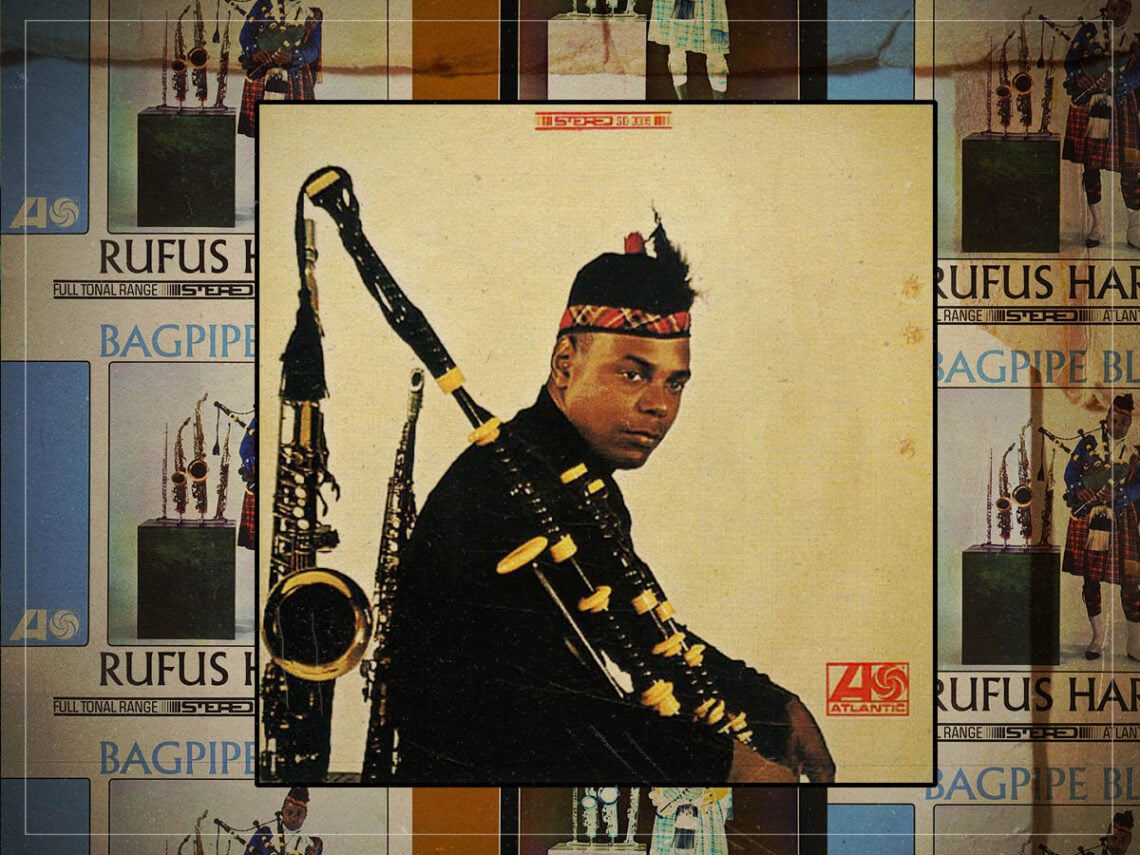
Rufus Harley: The story of the world’s first jazz bagpipe player

While there are no strict parameters around what can be considered jazz, there are certainly some features that are more commonly attributed to the genre than others. The presence of brass and woodwind instruments is incredibly prevalent, with plenty of trumpeters and saxophonists turning towards the style as their preferred outlet. Of course, there’s often the need for a rhythm section, whether that’s a standard drummer and bassist combo or through other forms of percussion and lower register instruments. Jazz is open to the inclusion of most instruments and sounds, and actively encourages expression through whatever means.
However, one instrument that is so infrequently heard and rarely ever associated with the genre is the traditional Highland sound of the bagpipes. In fact, unless you were raised in a Celtic community or have a close association with the military or fire brigade, then hearing them being played at all can be considered a rare occurrence.
Given that, how did Rufus Harley, a North Carolina-born musician, ever become fixated on the unique timbre of bagpipes, and why did he choose to adopt them as his primary instrument and choose to play them in the jazz tradition? Sure, they’ve got an incredible dynamic range that puts the majority of other wind instruments to shame, but their unconventionality and restricted range of tone would perhaps make it difficult to work alongside a larger ensemble.
Raised in Philadelphia, Harley became interested in jazz music from a young age, and by the time he was a teenager, he’d already begun to learn how to play the saxophone and trumpet. He would later go on to study a wider range of instruments from the woodwind family, such as flute, oboe and clarinet, and would perform alongside other accomplished jazz players in the Philadelphia area. However, at the age of 27, he would witness a major historical event that drew him towards the pipes, and from that point, there was no turning back.
In November 1963, the US was in mourning after the tragic assassination of President John F Kennedy, and the Black Watch performed as part of the funeral procession with an ensemble that featured nine bagpipers. Fascinated by the sound that the Scottish military regiment produced with their instruments, Harley immediately went searching far and wide to purchase his first pipes, and immediately began to teach himself once he had discovered a pawnbroker in New York who had some for sale for the price of $120.
There are plenty of reasons why the use of bagpipes is limited to certain contexts, among them being their extreme loudness, piercing and harsh sound, and the fact that it takes an immense amount of skill to be able to produce and sustain notes from them. In addition to this, the bagpipes are limited to a single key, and so if you want to alter the key you’re playing in, you’ll need to change to a different set of pipes. However, Harley was determined to make the instrument work in the context of his own music.
From 1966, he began to release a string of albums that showcased the full range of possibilities that the instrument had to offer, beginning with Bagpipe Blues. While this record adopted a hard bop style similar to that of John Coltrane and Art Blakey, his later explorations on records like Re-Creation of the Gods were of a more spiritual and avant-garde style, with the bagpipes being used as more of a drone rather than as the basis for a tune.
Harley had truly tested the limits of what the bagpipes were capable of and gained a reasonable amount of notoriety for how he adopted not only the instrument, but the traditional dress to accompany it. Despite being an American with no connection to Scotland, he was given his first tartan by a family who witnessed him perform on television, and he wore it with pride for the rest of his life. He may not have played in a conventional or traditional way, but the respect he showed to the culture was nothing but embracing.
While Harley didn’t leave a massive legacy behind, as his music today is relatively unknown compared to the output of his contemporaries, his innovation and desire to make jazz music using a less-than-conventional means have to be appreciated, and the deafening cries of his instrument on record are a true delight to behold.
