

Far Out Meets: Gerald Scarfe, the artist painting Pink Floyd’s wall
Read More


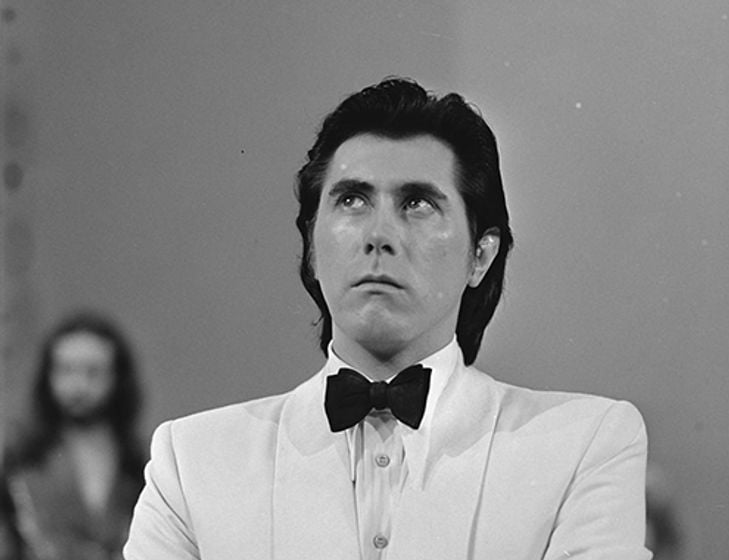
Hailing from Newcastle, England, Bryan Ferry went from a fairly normal childhood to being at the pinnacle of the art-music scene, helping to influence an entire generation, not just musically but with his smartly sartorial style too. In fact, the author Peter York even went as far as to say that he was an “art object that should hang in the Tate.”
While the wording of that hopefully doesn’t mean that York hopes to curtail the precious addition to our daily dismal lives that Ferry represents. Nevertheless, in a figurative way, Ferry was certainly a cutting-edge canvas worth mounting on any wall. And as a former student of fine art, this perhaps makes sense.
A mark of this trailblazing force comes from the fact that Roxy Music are the quintessential ‘Guess the Year Quiz’ trip-up merchants. You hear ‘Virginia Plain’ and instinctively the sound, production and avant-garde performance takes years off its actual age. With the help of Brian Eno in this department, Ferry and Roxy Music helped to release the shackles beginning to form on turgid rock ’n’ roll at just the right time. Thereafter, Ferry has journeyed through various genres in a diverse career that has never seen him lose his style or seeming to break his stride throughout.
In this regard, he has a kinship with the great artists who refused the heed the stylings of their era and slapped down a dose of expressionism on canvas. French painter Edouard Manet once wrote: “I paint what I see and now what others like to see.” In truth, that’s what Ferry was inspired by himself—Roxy Music prided themselves on shirking genres and set out to create something new.
Thus, it is perhaps no surprise that Ferry told Country Life that his favourite painting is Manet’s ‘Olympia’. The painting dates back to 1863 and reflects the rise of the libertine demimonde in a very controversial fashion. While it might not be readily apparent to modern eyes, there are more than a few hints that the Olympia (goddess) in the foreground was a prostitute which made the fact that she has a servant very illuminating regarding the sort of clientele she was welcoming, and the painting kicked up riotous response at the time.
This meant that conservatives called it “vulgar” and even artists like the novelist Emile Zola was brought to comment on the nudity in a perfunctory sense rather than the subtext, stating: “You wanted a nude, and you chose Olympia, the first that came along. When our artists give us Venuses, they correct nature, they lie. Édouard Manet asked himself why lie, why not tell the truth; he introduced us to Olympia, this fille of our time, whom you meet on the sidewalks.”
Ferry was moved by the depths of the painting to such an extent that it had a definitive impact on his music. “I first saw Olympia when I was an art student in the 1960s,” he commented, “and was immediately struck by how modern it is. It seemed to me to be a rather glamorous pin-up picture, and, as such, to have a strong connection to the world of Pop Art in which I was deeply immersed — the world of Hamilton and Warhol.”
Ferry concluded: “I now think that it was one of the key influences in my own development as an artist, and had a major impact on the album sleeves that I was later to design for Roxy Music, and, of course, for my latest album.” In short, Ferry identified ‘Sex Sells’.

