


Lost, abandoned and free: A photographer’s journey across California’s iconic Route 66

“… And they come in to 66 from the tributaries, side roads, from the wagon track, and the 66 is the mother road.”—John Steinbeck, The Grapes of Wrath, 1939.
Route 66, also known as the Will Rogers Highway, is arguably the most iconic original road in the United States. Established in 1926, it ran from Santa Monica, California, to Chicago, Illinois. Over the years, as the Interstate highway system expanded, Route 66 was gradually bypassed and eventually removed from the US highway system in 1985. However, the route’s significance has only grown, transforming it from a major thoroughfare into a symbol of American freedom, adventure, and nostalgia.
As a historical reminiscence, its remnants are now labelled as a scenic byway with ‘Historic Route 66’ signs. Many roadside reminiscences and curiosities remind the traveller of the exciting past when the country was developed for long-distance car travel.
As the above quote suggests, the great John Steinbeck labelled Route 66 as the “Mother Road” in his classic novel The Grapes of Wrath, a name which derived from the trend of desperate migrants attempting to escape the ‘Dust Bowl’ in search of work during the 1930s. “Highway 661 is the main migrant road,” Steinbeck writes. “66—the long concrete path across the country, waving gently up and down on the map, from Mississippi to Bakersfield—over the red lands and the gray lands, twisting up into the mountains, crossing the Divide and down into the bright and terrible desert, and across the desert to the mountains again, and into the rich California valleys.”
Continuing, Steinbeck notes: “66 is the path of a people in flight, refugees from dust and shrinking land, from the thunder of tractors and shrinking ownership, from the desert’s slow northward invasion, from the twisting winds that howl up out of Texas, from the floods that bring no richness to the land and steal what little richness is there. From all of these the people are in flight, and they come into 66 from the tributary side roads, from the wagon tracks and the rutted country roads. 66 is the mother road, the road of flight.”
While it is hard not to be swept away in the nostalgia of Steinbeck’s words, the freedom of Route 66 lies in its simplicity. There is no rush, no set itinerary. The road invites you to meander, to take detours, to stop whenever something catches your eye—a rusted-out car half-buried in the dirt, a museum dedicated to barbed wire, or an art installation in the middle of nowhere. Here, spontaneity is the rule rather than the exception, and the journey is truly in the hands of the traveller.
While some historic motels and gas stations are still in use, the route Steinbeck writes so vividly about no longer exists, and, in comparison, many of the establishments are now abandoned and prone to decay. While the decline began in the 1950s, many attempts have been made to preserve the route for historical benefit. With government and charitable donations, the route is essentially acting as a time capsule museum, offering a glimpse into a different way of life. Unsurprisingly, Route 66 is a bustling tourist attraction.
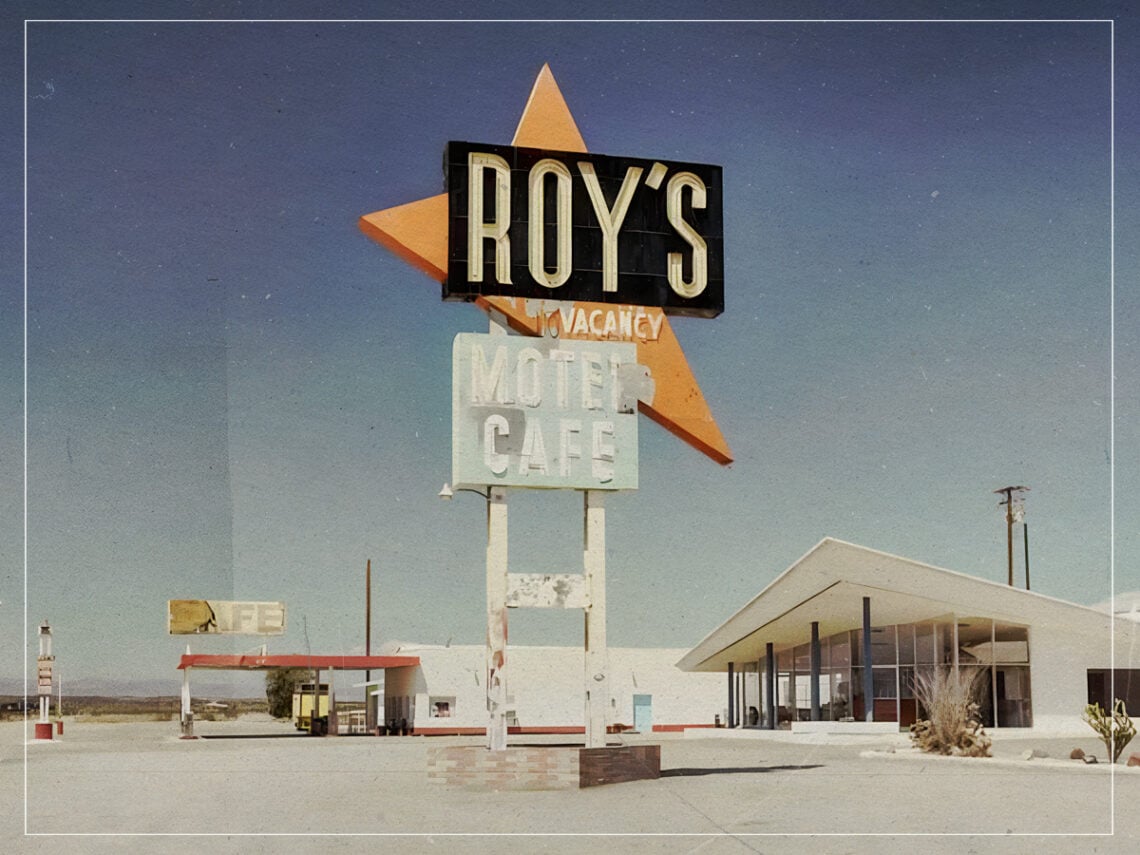
In August 2016, photographer Ralph Graef created a portrait of the historic Route 66 from California to New Mexico. The series showcases the stark beauty of the desert landscape, juxtaposing it against the mid-century architecture of Roy’s—a place where time seems to have stood still. The photographs highlight the minimalist aesthetic of the gas station, with its towering, retro neon sign standing as a beacon in the vast, empty expanse. The play of light and shadow, the faded hues of the desert sky, and the weathered surfaces of the buildings all contribute to a sense of timelessness, evoking a nostalgia for the golden age of American road trips.
As Nat King Cole rolled it out in his 1946 hit: “Well, if you ever plan to motor west, travel my way, take the highway that’s the best. Get your kicks on Route 66”.
Enjoy the ride with a selection of the images below.


For more information on Ralph’s work, visit his portfolio website or check out his Behance profile.
