


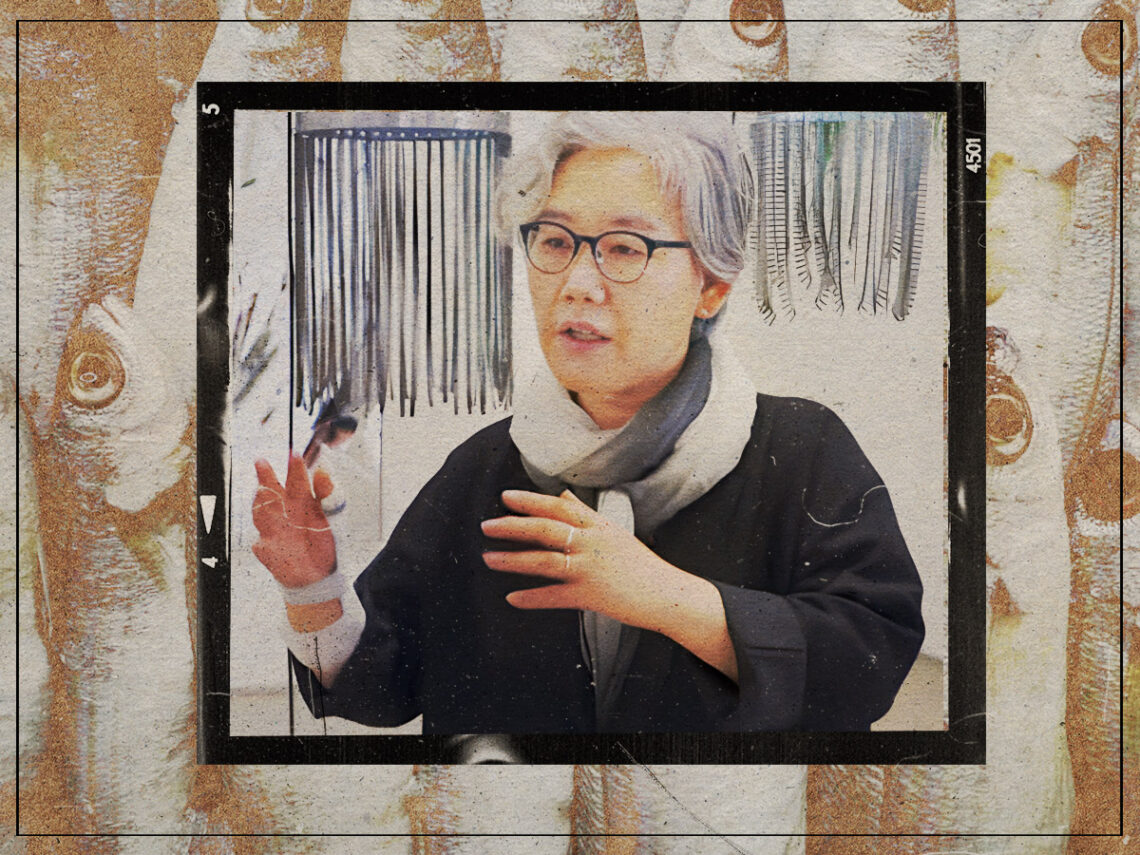
Rotting fish, fire and sequins: How Lee Bul’s exhibition went up in flames

Lee Bul’s art explores the realms of death and ritual, and in poetic fashion, her Crashing exhibition was delayed in 2018 after the rotting bodies of dead fish she’d covered in sequins started to combust. The surrealist exhibit had promised viewers a “spectacular, dream-like landscape”, and by all accounts, the foiled show achieved its every aim.
Crashing had been shown before in New York’s Museum of Modern Art (MoMA), a time when the work was once again thwarted by fish. Bul had featured several of them, all dead and hanging on walls as part of the 1997 exhibition Majestic Splendour. A comment on the pomp and circumstance of death, like soldiers buried with their medals, the fish were adorned with sequins and beads.
The problem came when the very real fish started to rot in the plastic bags they were slumped in. Pinned to the wall, the stench started putting off visitors. Museum guards were becoming physically ill, and as a result, MoMA pulled the exhibition.
After the first fish incident, Bul began submerging the fish in potassium permanganate in a bid to stop the smell from closing the shows down. Neither toxic nor flammable, what the oxidiser actually does is increase the combustibility of other materials near it.
Before the 2018 showing at the Hayward Gallery, notably its second-only exhibit in a newly opened space, both organisers and artist agreed the flammable element might be a bit risky. Content they’d made the safest decision, they began to take down the fish, which then ceremoniously burst into flames.
The local fire services were called, and Frieze reported that, luckily, “only minimal damage [had] been caused to the gallery by the exploding fish”. While it makes a strong case for the formaldehyde solution Damien Hirst used to suspend a shark, rather than dampening the show, the spontaneity of the fish explosions seemed very much in line with Bul’s core artistic message.
“I feel that when an image represents the body or another figure, it can often overshadow the production method or the material used because the image itself is too strong,” she told The Guardian. In both scenarios when she showed the fish, the production element is what led to its infamy. It’s this behind-the-scenes work, the selection of textures and colours, that she wants you to pay attention to. And it’s what both exhibitions brought to the forefront.
Always subversive, the most aesthetically pleasing element of the fish piece – its beads and sequins, wasn’t ever about beauty at all. “People are quick to associate them with decoration, or luxury goods,” she said. “For me, they represent hard labour.” From the bizarre body sculptures she made to her lengthy monologues about the difficulties of life as a Korean woman, her work has consistently sat on the knife edge of shock and power.
