


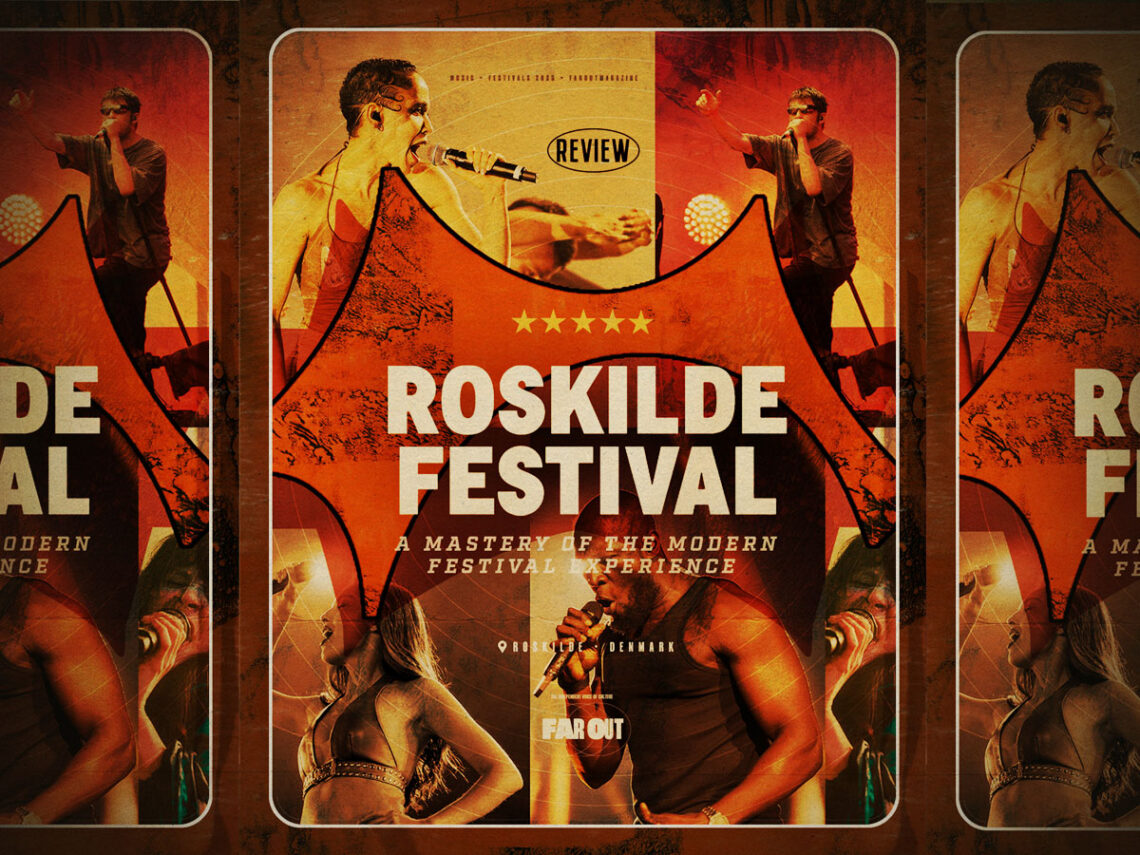
Roskilde Festival 2025: A mastery of the modern festival experience

For all the festivals that pride themselves on giving you too much to choose from in terms of their musical offerings, let it be known that less is, in fact, more. The hundreds of stages that make up an entire city’s worth of programming at Glastonbury each year provide those who are eager to catch as much as possible with a throbbing headache, and even the smaller festivals that only have a handful of stages sometimes fail to manage the delicate balancing act of timing performances in a way that means you have to make what feels like a life-or-death decision on who to see.
At Roskilde Festival, Denmark’s premier showcase of music, arts and activism, this isn’t a problem, but that doesn’t mean there isn’t a bounty of entertainment to gorge upon. Across eight main stages and eight days of programming, participants are treated to a veritable selection of the finest contemporary arts that the world has to offer, with a hefty focus on promoting a diverse range of activity that celebrates both the zeitgeist and the lesser-known cultural phenomena of our time.
Having operated as a not-for-profit festival since 1972, the festival has always adhered to this ethos of celebrating the richness of contemporary culture while maintaining a socio-political stance that is anti-racist, anti-transphobic, anti-sexist and anti-ableist. Given how plenty of festivals fail to stick to these core principles despite proclaiming their belief in them, you’d think that it takes a lot to succeed on this front. Roskilde is proof that it’s not only easy, but it’s a sustainable platform on which to function at the highest level for several decades.
There are some similarities between Roskilde and UK festivals, not least the unpredictability of the climate in Denmark. Over the course of the final four days, attendees were treated to searing heat, intermittent spells of torrential rain, and even thunderstorms, but those who were content to withstand the extreme elements for a long weekend can comfortably say that they were blessed with a near-perfect festival experience.
Not all of the 130,000 people gathered in attendance would proclaim to be a music connoisseur, but even those who aren’t inclined to discover the most obscure artists on the bill were given a masterclass in how to put on a polished pop production. The three main headliners who graced the iconic Orange Scene stage were artists currently at the peak of their power, delivering compelling performances befitting of their star status.

Wednesday night saw Charli XCX battle the adverse conditions by administering a dose of high-octane hyperpop while she continued to deliberate between the continuation and culling of the never-ending ‘brat summer’ that has elevated her to the upper echelons of the pop sphere. As the sole performer on stage for the entirety of her set, the fact that she manages to fill the empty space with a perfectly choreographed ode to club culture and dance music and hold the attention of her audience throughout is a marker of just how formidable she’s become in the last half-decade as she has taken her artistry down a more experimental route.
Similarly, Stormzy took to the same stage the following night and regaled Roskilde with a showcase of UK hip hop at its best. Revealing to the crowd that he was thrilled to be returning to the festival where he first announced himself on the international stage ten years ago, it felt impossible not to feel a great sense of love and admiration for ‘Big Michael’ as he powered his way through a sublime set of hits with an enchanting level of bravado and showmanship.
At just 22 years old, it’s staggering to believe that Olivia Rodrigo has the assuredness to compete with these two experienced acts as a headliner, but after her stunning headline set at Glastonbury, all doubts were cast aside, and she replicated the tour de force of a performance for the Danish audience. Star power simply oozes from the singer, and her melding of classic pop with sugary-sweet pop punk might sound like a horrific combination on paper, but is a surefire winner when it comes to riling up crowds and getting them to belt out every lyric.
Of course, it’s not just about the headline acts, but if the performances from artists on the undercard are anything to go by, there were plenty of worthy successors to the headline slot scattered across the programme. Irish post-punks Fontaines DC continued to prove why they’re one of the most important guitar bands of their generation, with an emotional gut-punch of a set that showed not just how much they’ve upped their game as performers, but demonstrated how vital their words of protest are as they encouraged their audience to echo pro-Palestine chants led by an activist group they welcomed to the stage.
In one of the most spellbinding sets of the weekend, rising hip-hop star Doechii schooled the Friday crowds on the history of the genre with a non-stop barrage of complex lyrical flows and love letters to her forebears. The classroom setting saw the rapper assume the role of a hip-hop pedagogue, lecturing her entourage of backup dancers on the importance of each of the genre’s key elements, and while there’s not much likelihood of any of them excelling to the same level as her, you can see her occupying a higher position at festivals in the not-too-distant future.
Floridian duo Magdalena Bay also managed to win over their crowd with a faultless start-to-finish rendition of their maximalist art pop masterpiece, Imaginal Disk. While they’re perhaps not quite a household name on the same level of any of the aforementioned acts, there’s a distinct possibility that their cult status will spill over into the mainstream within the next few years and propel them towards the top, because they’re absolutely capable of transcending their current stature.

One of the things that the festival prides itself on in terms of the booking process, according to their head of programming, Thomas Sønderby Jepsen, is how they look to bring in artists who bring energy into their live performances, and plenty of the acts had this in abundance. Friday night concluded with a wide-ranging set from Jamie XX, who needed to do very little to have his audience bouncing along to his floorfillers from all strands of electronic music. Saturday, on the other hand, boasted a back-to-back treat in the form of Ale Hop & Titi Bakorta’s hybrid of Peruvian and Congolese guitar and electronic music and HiTech’s relentlessly energetic and horny footwork and ghettotech ragers, both executed with the utmost proficiency on a technical level.
On the other hand, there were moments of respite from the higher-energy sets, particularly on the Avalon stage, which saw majestic performances from the likes of Jessica Pratt, Nala Sinephro and Faye Webster, among others. From blissful folk to cosmic jazz experimentation to heartfelt indie pop, these three proffered an opportunity to reflect on the beauty and serenity that the festival has to offer in its quieter moments, and each of them, while gripping in terms of entertainment value, were met with respectfully subdued silence from their audiences as they soaked up some of the more subdued moments.
Given its dedication to making the world a better place, the festival also wasn’t short of sets that provided a sense of catharsis while making the most of their opportunity to use the stage as a platform for protest. Rising indie-rock star jasmine.4.t’s songs that focus on her personal experiences of coming out as a transgender woman and exploring the comfort of queer love were met with rapturous applause not just from the LGBTQ+ members of the crowd, but from all allies who stand in solidarity with the transgender community as they face increased oppression from governing bodies around the world.
Not only did Anohni and the Johnsons deliver more trans power, but her impassioned songs and speeches about the growing climate crisis left the audience in awe at how eloquently she illustrated the levels of irreversible destruction we’re inflicting on our planet. While Fontaines DC may have had the biggest display of Palestinian solidarity of the weekend, Mancunian jazz saxophonist Alabaster Deplume also ad-libbed verses about fighting against the genocide during his Thursday afternoon set, although their occasional incoherence was lost on some members of the audience.
It has to be said that even the most seemingly perfect festivals aren’t without moments of disappointment, but that doesn’t detract from the overall brilliance. Not every act can perform to the best of their ability at all times, and sometimes a creative decision can backfire when utilised within the wrong environment. Wet Leg may be about to release their hotly anticipated second album, Moisturizer, but when audiences haven’t had the opportunity to get to grips with the new collection of songs, they can fall slightly flat no matter how much verve they’re performed with. Geordie Greep, on the other hand, chose to spend too long noodling with his band rather than playing a festival-appropriate set, and Nine Inch Nails, while billed as headliners, were booked to perform on a stage too small to give their theatrics any chance of impact.
To round up things on a high, however, there were several standout moments from sets that will embed themselves in the memories of those lucky enough to have witnessed them. Beth Gibbons’ set of songs from her debut solo album Lives Outgrown was jaw-droppingly good in its own right, but to squeeze in Portishead classic ‘Glory Box’ towards the tail end of her set had long-time fans reeling from the excitement of hearing one of the defining songs of her career.
Coming in a close second in terms of individual song performances, Lucy Dacus closed off her set and capped off the end of her Forever Is a Feeling tour with a raucous rendition of ‘Night Shift’, which reminded everyone in earshot not only of her songwriting prowess, but the fact that it remains one of the most flawless songs of the last 10 years. For all the tight choreography, gymnastics and elaborate costume changes involved in FKA Twigs’ Thursday night showing, it was her closing performance of ‘Cellophane’ that was the most breathtaking moment of the UK avant-pop icon’s set.
With art installations to peruse, delectable food stalls to sample and games of giant Connect 4 to be won, there was no shortage of merriment to be had during the final days of Roskilde beyond the musical aspect. For anyone eager to explore an alternative to Glastonbury during its fallow year in 2026, there are few words to describe how much Denmark has expertly curated not just a rival to the biggest festival in Europe, but perhaps a quietly superior option that excels in everything its competitors have fallen short on in recent years.
It isn’t without faults, but the fact that the people behind the festival are constantly open to trying new ways to make the festival a more inclusive, diverse and accessible space for participants of all backgrounds says a lot about why it has managed to achieve so much while maintaining the model of donating all profit to charity rather than reinvesting in ways that clutter and overcomplicate a winning formula. If the overarching goal is to create the utopian festival experience that many pine for, then it has to be said that it succeeds on virtually all levels.

