


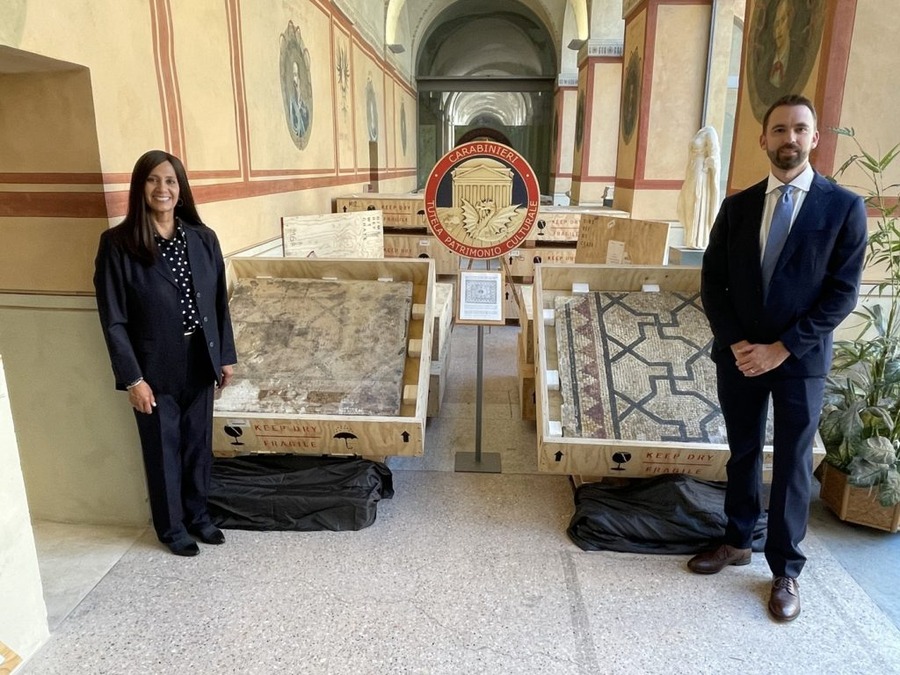
FBI returns 2,000-year-old Roman mosaic to Italy

A 2,000-year-old Roman mosaic featuring a portrait of Medusa has been returned to the Italian government nearly a century after its disappearance. Announcing the repatriation, the FBI confirmed that the artwork has been kept at a storage facility in Los Angeles since the 1980s.
The FBI’s Art Crime unit began work on the case in the final months of 2020 when an attorney got in touch with a special agent about a client who had acquired the mosaic. The FBI have since confirmed that the portrait “entered into cultural property records in 1909,” although those records only hold out until 1959, when the mosaic was advertised as being for sale in a Los Angeles-based newspaper.
Little is known about how the last owner came to possess the portrait, though it appears they offered to return the artwork when they discovered they were unable to sell it. The mosaic has since been authenticated by the art squad of the Carabinieri, Italy’s military police force.
Discussing the recent repatriation, FBI special agent Allen Grove said: “We worked with the owner and made sure we documented the condition and had everything we needed to ship it back to Italy. We then worked with the Italian consulate here in Los Angeles. This is something of great interest to Italy; they came and inspected the mosaic and helped us facilitate the logistics of actually getting it back to Italy.”
The most startling discovery was that the mosaic had been cut into 16 pieces at some point in its history. These segments – weighed between 75 and 200 pounds – were stored on individual, termite-infested pallets in Los Angeles. Thankfully, the pieces are “largely intact thanks to the climate-controlled facility they’d been kept in”.
Experts are currently restoring the mosaic to its former glory. “The mosaic was handcrafted from an age where people put an amazing amount of care and effort into it. It really speaks to the ingenuity and creativity of the time,” Grove said. “It’s not meant to be in Los Angeles. The mosaic belongs to the people of Rome. It allows us to understand a bit about the history of humans 2,000 years ago.”

