


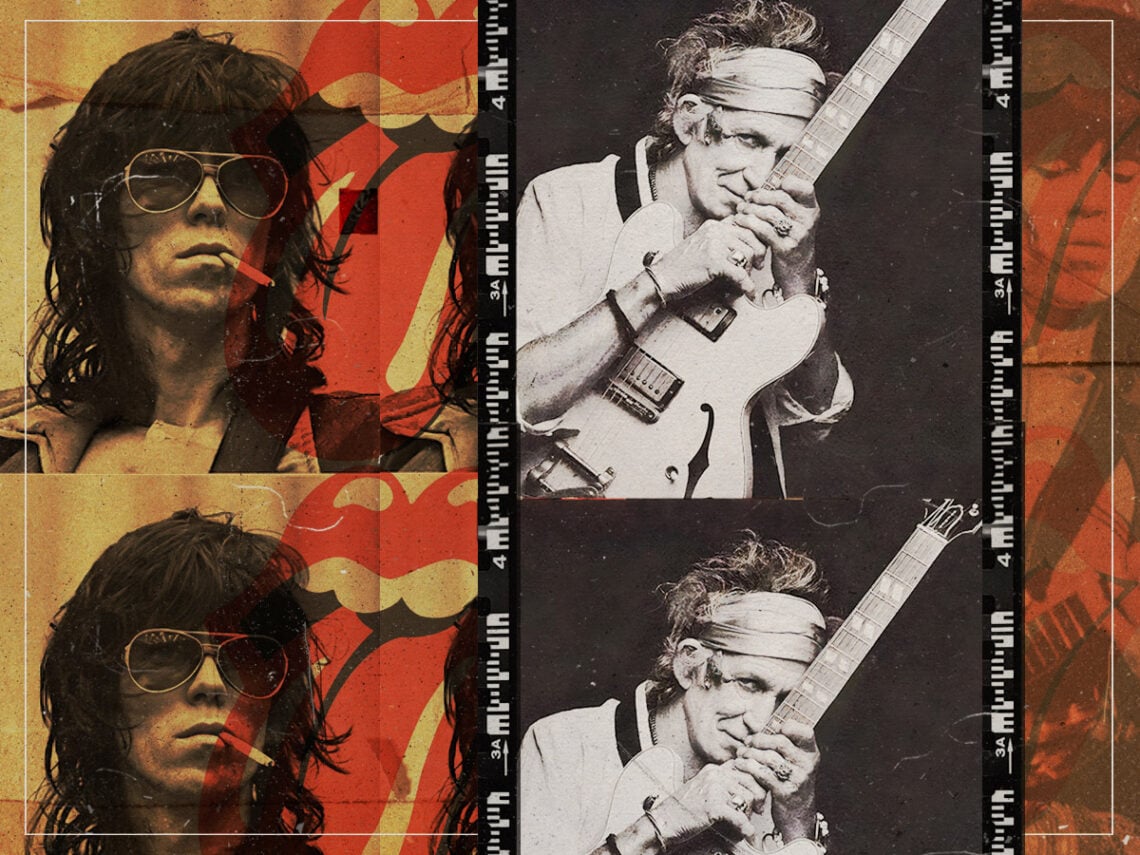
The Rolling Stones: Keith Richards’ 10 best guitar riffs

In the eyes of Pete Townshend, there have only ever been two classic rock bands: his own and The Rolling Stones. He’d also happily accept that his outfit comes second. The key reason for this is the one-man edifice of riffs and attitude that is Keith Richards. Like the ancient Rome of rock and roll, he might be crumbling these days, but he indestructibly endures and remains ever-vital.
Despite what you may have read, The Rolling Stones weren’t built on the foundation of sex and drugs but rather pure rock ‘n’ roll; everything else was secondary. The triumvirate just formed that way by virtue of inevitability. As a band, they were hell-bent on liberation, smashing the stilted shackles of conservatism that they had grown up with, none more so than the high seas Captain Richards.
The guitarist is now simply synonymous with rock ‘n’ roll. Like the ground beneath our feet, it feels difficult to remember a time when the band’s battle-hardened guitarist wasn’t a part of the fabric of existence in one form or another, either roaring through the radio, tearing up some column inches, or comically chastising Elton John. However, where he is best is with a guitar in his hand, and below, we’re bringing you ten of the gunslinger’s finest rock riffs.
Old or young, Richards is likely to have soundtracked at least one of your more memorable nights with his uncanny ability to pick out and perform some of the classic rock world’s greatest riffs of all time. The kind of riffs that make you want to give it all up for the hum of the generator and the blur of the disco lights, throw away your full-time job and start gigging around the clock and the country. This inspiration is a legacy he’d be most proud of, and then promptly explain how you don’t come close to competing.
The Dartford-born musician might well be about as British as they come with a cockney swagger and a sarcastic smile, but he found his musical nous across the pond and in the backwaters of Americana. Like many adolescents in the 1960s, a young Richards was consuming every R&B record that came his way. The guitarist then re-interpreted his love of blues, blending the backbone inspiration of musicians like Muddy Waters with the dark mysticism of Robert Johnson the vigour of and rock ‘n’ roller Chuck Berry into his own work with the axe. In fact, his passion for the roots of it all is how he and Mick Jagger became reacquainted.
With a passion grounded in mood and mastering the basics, Richards set out to be the most economical guitar player on the scene. He avoided the battle to be “the fastest gun in the west”, opting out of competition with noodling virtuosos like Eric Clapton and Jimi Hendrix and, instead, focused on creating energy and power with his all-action riffs. This sentiment of shunning flashiness and getting straight to the heart of the good times was more his speed, and he’s sustained it for an unrivalled amount of decades.
“I’m the riff master,” wrote Richards in his autobiography Life. “The only one I missed and that Mick Jagger got was ‘Brown Sugar,’ and I’ll tip my hat there. There he got me. I mean, I did tidy it up a bit, but that was his, words and music.” Richards continues later in the book, “these crucial, wonderful riffs that just came, I don’t know where from,” wherever they came from keep ’em coming!”
“I’m blessed with them and I can never get to the bottom of them,” he adds. “When you get a riff like ‘Jumpin’ Jack Flash’ you get a great feeling of elation, a wicked glee. ‘Flash’ is basically ‘Satisfaction’ in reverse. Nearly all of these riffs are closely related. But if someone said ‘You can play only one of your riffs ever again,’ I’d say ‘OK, give me ‘Flash.’”
While Richards will never be regarded as the most proficient guitar player of all time – it’s tough to top Hendrix as it is – he should be considered as one of the finest constructors of a rock ‘n’ roll riff ever in history. In fact, he pretty much wrote the book on it. Creating work which resonates for decades is no mean feat. And when all is said and all is done, surely it is the unshakable energy that still rings out of tracks like ‘Gimme Shelter’, rather than some egoist ten-minute exhibition of skill, that typifies what rock ‘n’ roll has always been about. In this regard, he may well be the master of the craft.
Keith Richards’ 10 best guitar riffs:
10. ‘All Down the Line’
This delicious cut from The Stones’ Exile on Main Street may seem like it’s all about Mick Taylor’s slide guitar, but in fact, it’s Richard’s rocking rhythm which does all the heavy lifting. Taylor and Richards shared a magical partnership for a short while and they operated perfectly on this basis of structure and decoration.
Richards would provide the groundwork, the foundations of the tune, and Taylor would unleash licks over the top to make your toes curl. It was a set-up that saw some of the Stones’ finest work, including ‘All Down The Line’. In other hands, it’s no more than a ditty, but Richards’ understanding of dueling instrumentation makes it electric.
9. ‘Can’t You Hear Me Knocking’
Following ‘Wild Horses’ on Sticky Fingers was always going to be a difficult task with the ballad being such a departure from The Rolling Stones’ signature sound. It’s also one of Richards’ favourite riffs from the band: “On that song, my fingers just landed in the right place, and I discovered a few things about that [five-string, open G] tuning that I’d never been aware of. I think I realised that even as I was cutting the track.”
The luck continued as the iconic final jam sessions were never meant to be recorded. “And then that jam at the end – we didn’t even know they were still taping. We thought we’d finished,” Keef continues, “‘Oh they kept it going. Okay, fade it out there – no wait, a little bit more, a bit more…’ Basically, we realised we had two bits of music: there’s the song and there’s the jam.”
Luckily, Richards was there to help deliver a spellbinding opening riff for ‘Can’t You Hear Me Knocking’ that will go down in the annals of rock. Its fortuitous inception is proof of how seamless his sense of ‘feel’ is a guitarist.
8. ‘Honky Tonk Woman’
A notable moment in the guitar life of Richards was his switch to the open G tuning; it would go on to define his sound and makes ‘Honky Tonk Woman’ a crispy bucket of deliciousness. A song seemingly endlessly covered, with all the swagger and sway of a straight-shooting dancefloor cowboy, this is a guaranteed gem.
About the track, Richards said: “‘Honky Tonk Women’ started in Brazil. Mick and I, Marianne Faithfull and Anita Pallenberg who was pregnant with my son at the time. Which didn’t stop us going off to the Mato Grasso and living on this ranch. It’s all cowboys. It’s all horses and spurs. And Mick and I were sitting on the porch of this ranch house and I started to play, basically fooling around with an old Hank Williams idea. ‘Cause we really thought we were like real cowboys. Honky tonk women.”
He continued: “We were sitting in the middle of nowhere with all these horses, in a place where if you flush the john all these black frogs would fly out. It was great. The chicks loved it. Anyway, it started out a real country honk put on, a hokey thing. And then a couple of months later we were writing songs and recording. And somehow by some metamorphosis it suddenly went into this little swampy, black thing, a blues thing.” It sees him capture that deep south growl with aplomb.
7. ‘Beast of Burden’
‘Beast of Burden’ is not the same rollicking Richards we’re necessarily used to but Keef’s ability to create a hazy riff and let it backdrop the track rather than overpower it is a lesson many of today’s rock stars could use. Teamwork makes the dream work, and here he happily let others rise to the fore.
His selflessness on this front is emphasised by the fact it is also one of Richards’ most personal songs: “Those who say it’s about one woman, in particular, they’ve got it all wrong. We were trying to write for a slightly broader audience than just Anita Pallenberg or Marianne Faithfull. Although that’s not to say they didn’t have some influence in there somewhere,” he said.
Concluding, he added: “I mean, what’s close by is close by! I’ve always felt it’s one of my best soul songs. It was another strict collaboration between Mick and me.” Both love stricken gents get the best out of each other.
6. ‘Gimme Shelter’
Typically, Richards’ riffs tread a steady course. However, when it comes to ‘Gimme Shelter’, his work is as wavering as the stormy mood that spawned the song, certainly one of the band’s finest. If all guitarists have their own signature, then this showcases Richards’ written in an italicised rage.
In doing so, he creates a world of atmosphere. Brooding and dense, the song courts danger and became a counterculture anthem as a result. While the brilliant production and performances might subsume Richards’ core riff in a cinematic blur of sounds, but it was still the gust that heralded the storm all the same.
As the guitar hero says of his work here, “I wrote ‘Gimmie Shelter’ on a stormy day, sitting in Robert Fraser’s apartment in Mount Street. Anita (Pallenberg) was shooting Performance at the time, not far away… It was just a terrible f–king day and it was storming out there. I was sitting there in Mount Street and there was this incredible storm over London, so I got into that mode, just looking out of Robert’s window and looking at all these people with their umbrellas being blown out of their grasp and running like hell. And the idea came to me… My thought was storms on other people’s minds, not mine. It just happened to hit the moment.”
5. ‘Rocks Off’
The Exile opener makes its way on to the list simply for the hopping good time it provides. It’s proto-punk by virtue of its strung-out nature and the fact Richards places energy uber alles when rattling it off. Perhaps one of the songs most synonymous with the band, it’s a track that instantly captures Richards’ style: simple, crisp, full of fuzz.
Within the first few bars, you not only know what the track is all about, but it then blossoms into a full on blitzkrieg allowing the band to build on his arrangement. This is an ethos that was subsequently copied a million times over, inspiring a new legion of bands.
Legend has it that Richards had fallen asleep while overdubbing a guitar part as the recording engineer then called it a night. That same engineer was then pulled from his bed at 5am so that Richards could add another guitar track to further elevate proceedings.
4. ‘Start Me Up’
If there was one riff in isolation that most people could point to as one of Richards’ own it would undoubtedly be the opening riff for ‘Start Me Up’. Another blessing from Richards switch to open G tuning, it remains a mark of the guitarist’s impeccable ear for a melody. The opening riff remains one of the most iconic in rock ‘n’ roll history and likely will forevermore. Richards revealed the song is actually one of his biggest disappointments. “I was convinced that was a reggae song. Everybody else was convinced of that. ‘It’s reggae, man’.”
“We did 45 takes like that,” recalls Richards, “But then on a break, I just played that guitar riff, not even really thinking much about it; we did a take rocking away and then went back to work and did another 15 reggae takes.” The guitarist continued, “Five years later, Mick discovered that one rock take in the middle of the tape and realised how good it was.”
For that reason, the song remains a thorn in Richards’ side, “The fact that I missed ‘Start Me Up’ for five years is one of my disappointments. It just went straight over my head. But you can’t catch everything.”
3. ‘Street Fighting Man’
If there was one guitarist ready to kick out against the establishment in 1968 it was Keith Richards and on Beggars Banquet he was a regular Karate Kid. ‘Street Fighting Man’ sees the Londoner at his most gnarly, capturing a sense of Friday night cockney swagger.
“When we went in the studio, we just couldn’t reproduce the sound of the original demo I did on cassette,” revealed Richards. “So we played the cassette through an extension speaker and I played along with it – we just shoved a microphone into an acoustic and overdubbed it onto the track from the cassette.”
In the end, and after a lot of fiddling around with capos and tunings, he concedes that even he doesn’t know which sound is which, “’Cause I tried eight different guitars, and which ones were used in the final version I couldn’t say.”
2. ‘Jumpin’ Jack Flash’
Following flirtations with psychedelia, The Rolling Stones came back to rock with a thunderous punch to the gut in the imperious riff on ‘Jumpin’ Jack Flash’. Famously written about Richards’ gardener it is the archetypal Stones song.
“We’d been up all night [he and Jagger]; the sky was just beginning to go grey. It was pissing down raining, if I remember rightly,” Richards writes. “Mick and I were sitting there, and suddenly Mick starts up,” continues Richards. “He hears these great footsteps, these great rubber boots – slosh, slosh, slosh – going by the window. He said. ‘What’s that?’ And I said, ‘Oh, that’s Jack. That’s jumpin’ Jack’.”
“We had my guitar in open tuning, and I started to fool around with that. [singing] ‘Jumpin’ Jack…’ and Mick says, ‘Flash’. He’d just woken up. And suddenly we had this wonderful alliterative phrase. So he woke up and we knocked it together,” he concludes. Meaty and soaked in sauce, Richards is at his bone-rattling best on this 1968 single. Richards said of the riff, “it just floats there, baby”. ‘Nuff said.
1 ‘(I Can’t Get No) Satisfaction’
Keith Richards is so good that he wrote ‘Satisfaction’ in his sleep. The legend goes that the guitarist woke in the middle of the night, recorded a poky version of the now-iconic riff and fell back to sleep—there’s a tape with Richards snoring for forty minutes to prove it.
It’s Richards’ signature sound but speaking to Guitar World, he still thinks it was improved upon by another: “When I wrote the song, I didn’t think of that particular riff as the big guitar riff. That all fell into place at RCA [recording studio in L.A.] when Gibson dumped on me one of those first Fuzz-Tone pedals. I actually thought of that guitar line as a horn riff. The way Otis Redding ended up doing it is probably closer to my original conception for the song. It’s an obvious horn riff.”
He added: “At least Otis got it right. Our version was a demo for Otis.” This humility in the face of magic is what has sustained the longevity of the Stones. More so than just about any other musician, Richards knows himself and what he’s about. That has proved invaluable, and the priceless cache of his catalogue is the gleaming evidence.
