


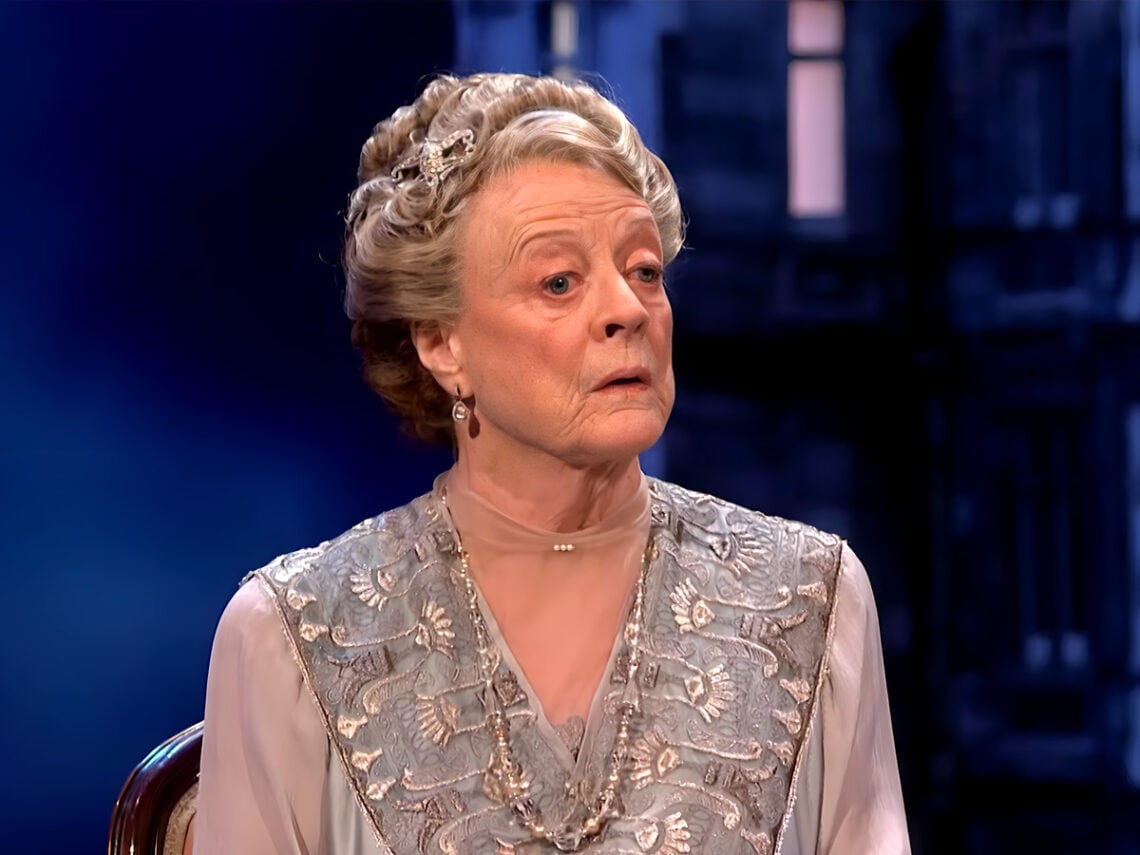
The role that changed Maggie Smith’s life for the worst: “Flattering, but awful”

It’s common for actors to hate watching their own work. Johnny Depp, Reese Witherspoon, Andrew Garfield and countless others struggle with the idea. For Maggie Smith, this experience was even more tainted by the fact that fame is one of the most unnatural things in the world.
Most actors – and people involved in artistic industries, for that matter – often feel anxious whenever their work finally gets put out there. Anyone involved in a film will worry about how the project will be received after the long process of putting it all together, just as most musicians will worry about the vulnerability of putting out a record after all the blood, sweat and tears that went into it behind the scenes. It’s the uncertainty of having something so personal out there for all to scrutinise.
For this reason, many actors never watch their own movies. Johnny Depp, for one, tries to stay as “ignorant” as possible once his films are actually out there, mainly because he prefers the experience to the final product. Anything after the fact doesn’t actually concern him.
As he once put it, “In a way, you know, once my job is done on the film. It’s really none of my business.”
Ron Howard shares the same view, and Alfred Hitchcock never watched his own movies because he didn’t see why people even enjoyed them. That and the fact that he was a pretty skittish person who didn’t find any enjoyment in films without “logic”, like his. But some, like Hitchcock, come from a deep-seated self-consciousness that goes beyond not being able to look at yourself on screen.
Some, like Maggie Smith, find it difficult because of all it epitomises, like the vulturistic nature of fame itself, and how, when you have a successful film, it not only increases your visibility among judgmental eyes but reminds you that your life is no longer what it once was. As she explained to Mindfood, “I really don’t like to watch myself – I hate it. You are helpless to do anything to stop it once it’s out there, and that has always terrified me. In the theatre things are a little different because you can say to yourself ‘I’ll have another go at that tomorrow night. I’ll change that, alter that.’, but with cinema it is there forever.”
Smith’s opinion came from her “caring too much”. She never once watched an episode of Downton Abbey because she was her own worst critic, but she also hated it because it exposed her to a level of fame she couldn’t come back from. As she revealed, “I was able to live a somewhat normal life until I started doing Downton Abbey. I know that sounds funny, but I am serious. Before that I could go to all the places I wanted and see all of the things that I like, but now I can’t, which I find incredibly awful… flattering, but awful.”
That said, she wasn’t entirely cynical about her own work. In fact, her only gripe came from personal experience. She didn’t want to watch her own work because she was uncomfortable watching herself, and had a particularly complicated relationship with her own career because of everything it made her sacrifice. But she was also aware of the cultural impact of shows like Downton Abbey, and how it rivalled an otherwise vapid media landscape that’s far too focused on poor technology.
As she went on to explain, she’s proud of Downton Abbey because it managed to captivate a mass audience who might’ve otherwise gone on to CGI-heavy shows. In her view, shows such as Downton Abbey bring the focus back to great screenwriting and storytelling, as well as the immersion in the simplicity of great, original ideas. Which, compared to her discomfort with her own involvement, is priceless.
