


Sympathy with the devil: why rock music isn’t as left-wing as people think

It’s a common misconception that rock music is exclusively a left-wing environment. For every Kurt Cobain and Neil Young, the ostensible defenders of the righteous cause and rock’s traditional association with left-wing politics, many prominent figures have placed themselves on the other side of the fence over the years despite the anti-establishment pull of their music.
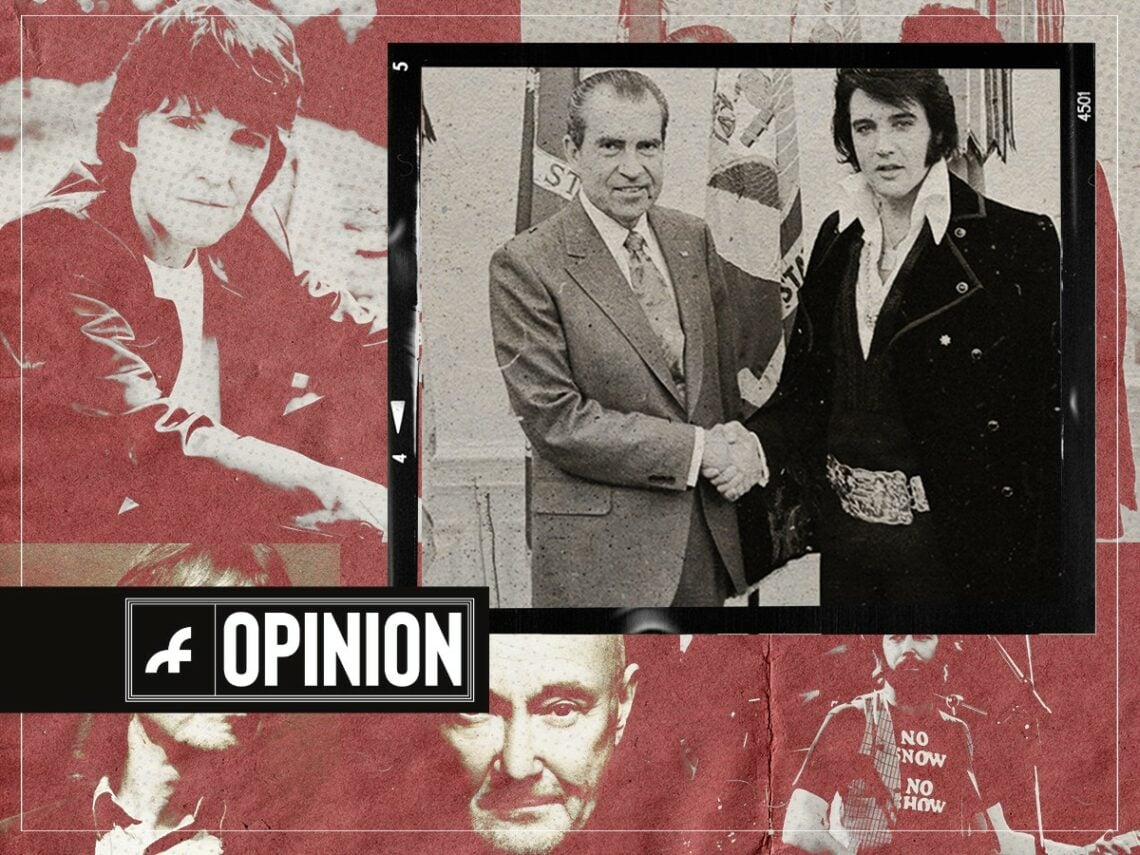
Of course, this is not a new thing. ‘The King of Rock and Roll’ himself, Elvis Presley, had openly Republican tendencies that opposed the swaggering nature of his music, significant for bridging the gap between Black and white America and spreading the supposedly establishment-rejecting gospel of rock ‘n’ roll to the masses. Famously, Presley met the hardline Republican President, Richard Nixon, on December 21st, 1970, at The White House, in a convergence that the musician engineered, reflecting his allegiance.
To do so, Presley wrote a six-page letter to Nixon, expressing his concern at the direction the country was taking, suggesting that he could use his position as the most famous musician in America to help fight against what he inferred were insidious left-wing elements. He begged to be elected a federal agent.
Given the unbelievable proportions to some that Elvis and Nixon’s meeting represents and its triumph to others, the photograph of the two men in the home of American power is the most requested item from the US National Archive. This is more so than the Bill of Rights and, more pointedly, the Constitution of the United States, a document that all citizens are well-schooled in.
Following Presley’s open dedication to conservatism, some of the most influential musicians whose rise was facilitated by his shifting of cultural tastes have expressed resolutely right-wing sentiments. Eric Clapton, one of Britain’s most influential musicians thanks to his work in John Mayall and the Bluesbreakers, The Yardbirds, Cream, Derek and the Dominos and as a solo artist, is a self-described “old-fashioned conservative”.
Clapton’s conservatism has manifested in different ways. Hailing from the traditionally conservative home county of Surrey, his politics aren’t a shock at all. Objectively, though, Clapton’s notorious dance with the far-right remains one of the most startling moments in rock history. In 1976, when far-right Conservative MP Enoch Powell’s anti-immigration rhetoric started to take hold with elements of the population, particularly white people living in poverty, Clapton, a wealthy man who had pioneered psychedelic rock and spread the counterculture with Cream, echoed his ideas as if he were nothing more than your drunken local racist.
During a show in Birmingham in 1976, an intoxicated Clapton leapt into a rant about “dark-skinned immigrants”, filled with egregious racial slurs. “Stop Britain from becoming a black colony. Get the foreigners out,” exclaimed Clapton to the stunned crowd. “Get the w*gs out. Get the c**ns out. Keep Britain white.”
Clapton’s racism had such an impact that punk, already in full swing, retaliated by forming the Rock Against Racism movement, which sought to strike back against Powell and his rhetoric, and washed-up rockstars like Clapton using their privilege for ill means. Rock Against Racism united Black and white fans through their love for music, in opposition to the above, and the fact that the fascist National Front was gaining traction at the ballot box.
As an apology, Clapton donated heavily to the cause. It’s safe to say that he’s never been able to escape his outburst, though, and has, over time, expressed regret for his actions. However, even his words of remorse for his rant have been questionable. “I was so ashamed of who I was, a kind of semi-racist, which didn’t make sense,” he said. “Half of my friends were black, I dated a black woman, and I championed black music.” Alas, a leopard can’t change its spots. Despite the apology for his racism, Clapton still offers right-wing sentiment and has since released anti-lockdown songs and espoused anti-Vaxxer views.
One of Clapton’s most successful peers, Billy Wyman, the longtime bassist of The Rolling Stones, is an avowed Tory. This shouldn’t shock too many, as the band notoriously became tax exiles from the UK in 1972, citing the high taxes of Harold Wilson’s Labour government.
In the 2010 documentary Stones in Exile, Wyman explains the band’s motivations for taking flight: “Tax, under the Labour government of Wilson, was 93% if you earned a million quid, which we didn’t, you’d end up with 70 grand. So it was impossible to earn enough money to pay back the Inland Revenue and stay here, in England.”
Interestingly, the band’s frontman Mick Jagger, who reportedly once said, “I’m not on anyone’s side. There is no side that has an absolute answer. That is the trouble with politics,” echoed Wyman’s point. He told the film: “I had to get out of the country to pay the tax incurred for me. That’s why I had to leave.”
As blue as blue can be, Wyman maintained those political leanings when speaking to The Guardian in 2000: “I remember what Labour’s all about. I remember having to leave the country in ’71 because tax was at 90%. Never trust ’em. I vote Tory because that’s where I come from.”
It’s not just some of the most commercially successful artists of the classic rock period who are self-described conservatives. Moe Tucker, an undoubted icon of popular music, as the drummer of alternative pioneers The Velvet Underground, who was, significantly, a woman in an all-male group in the 1960s, is a supporter of the fiscally conservative Tea Party movement. This seems unthinkable given the left-wing nature of her band’s subversive avant-garde efforts.
Tucker is such a steadfast Republican that in 2009, she revealed herself to support the Tea Party live on TV, speaking to WALB NBC at a rally in Tifton, Georgia. She expressed contempt for the then-incumbent Obama administration and was “furious about the way we’re being led towards socialism”.
Even prog-rocker turned pop star Phil Collins, a man whose initial steps with Genesis are in some capacity linked to the efforts of Elvis Presley and the rockers of the 1950s, is an open Tory. Famously, he promised to leave the UK if Tony Blair’s Labour were elected in 1997, which they did, so he moved to Switzerland. Later, before the 2005 election, Oasis mastermind Noel Gallagher urged the public: “Vote Labour. If you don’t and the Tories get in, Phil is threatening to come back.”
Even punk, the most anti-establishment force in music, which don’t forget, birthed Rock Against Racism, has some key figures on the right of the political spectrum. From the American first wave, the most infamous is the late Ramones guitarist Johnny Ramone. He was so Republican that he claimed he’d been one since the early age of 12.
“It was in 1960, the Nixon-Kennedy election,” Ramone told The Washington Post. “People around me were saying, ‘Oh, Kennedy’s so handsome’, and I thought, ‘Well, if these people are going to vote for someone based on how he looks, I don’t want to be a party to that.”

He told the publication, “People drift towards liberalism at a young age, and I always hope they change when they see how the world really is.” Ramone was also kind enough to list his ten favourite Republican figures, which included Ronald Reagan, Charlton Heston, Rush Limbaugh, and even Vincent Gallo.
On the British side of the coin, the former Sex Pistols frontman, John Lydon, has flirted with the right at points throughout his life, seemingly in a more anti-establishment way (ironic) than anything. Whilst there are a handful of examples, his comments on Good Morning Britain in 2017 stand out in the memory. He described meeting arch-Brexiteer Nigel Farage as “fantastic” and defended then-President Donald Trump from accusations of racism, both of which are particularly questionable in light of recent events.
There’s also the Ian Curtis anecdote. Allegedly, the Joy Division frontman was among the droves who voted Margaret Thatcher – the ultimate right-wing neoliberal ideologue – into power in 1979 in what is claimed to have been a protest against the sclerotic government of Labour’s James Callaghan. In one of rock music’s great legends, it is said that the post-punk leader even persuaded the local Liberal candidate to give him a lift to the polling station so he could vote. Tragically, Curtis took his own life in 1980, so the veracity of this story has never been verified.
Most shockingly, the cases included today are the following. As is well known, punk saw an explosion in alternative music in the 1980s and beyond, and its ethos spread, bearing many similarities to the counterculture of the 1960s. Left-wing, anti-establishment and against prejudice in all forms, punk saw post-punk, indie, hardcore, alternative rock and a host of other genres rise in its wake, spreading its message via the quality of the music.
What is life, if not surprising? Morrissey, the frontman of indie legends The Smiths, is one of rock’s most divisive right-wing figures. In his younger years, though, he was so anti-conservative that he wrote a direct protest against Margaret Thatcher, titled ‘Margaret on the Guillotine’, featured on 1988’s Viva Hate. He despised Thatcher so much that he repeatedly asks her in the song, “When will you die?”
This kind of sentiment is what makes his U-turn all the more astonishing. He’s gone from cuts such as the above and labelling Thatcher as “a terror without an atom of humanity” to claiming that Nigel Farage “would make a good prime minister”. He also supported the fringe anti-Islam politician Anne-Marie Waters and her For Britain party.
Reflecting just how extensive rock’s relationship with conservatism is, even Kurt Cobain’s wife and grunge icon in her own right, Courtney Love, has sounded her approval of the British Conservative Party. Before we outline how, it’s critical to note that it seems like a flash in the pan for The Hole frontwoman, as since then, she’s been damning of Donald Trump, writing on Twitter in 2016: “I would trust PeeWee Herman sitting behind me in a theatre while on a date with OJ Simpson drinking at Bill Cosby’s bar with Flint Michigan ice cubes after riding the radiator with Ray Rice all while Casey Anthony babysits for me before I would trust that pussy grabber Trump for president.”
Accordingly, and given other previous statements, the following is assuredly the most surreal stop on this tour. In 2011, Love announced her support for leading Conservative politicians David Cameron and Gideon Osbourne – the Prime Minister and Chancellor respectively – by tweeting, “TORY NOW”. This seemingly random tweet was followed by some incredibly Tory behaviour, which most would have expected to have been anathema to her. Yet, you’ve got to give it to Love; she really went for it.
That year, she attended a ‘Port and Policy’ debate organised by the Conservative Association of Oxford University, and in possibly the most Cameronite thing since misquoting The Smiths, she was bestowed the much sought-after title of “Non-Executive Officer for Rock ‘n’ Roll”. Photos have since emerged from the day showing Love posing in front of a Union Jack with a predominantly male group of young Tories – a demented scene.
As an appendage, I won’t bother going into detail about Blur bassist Alex James rubbing shoulders with David Cameron, Jeremy Clarkson and the bigwigs of the right-wing media, as no one was really surprised when he decided to swap the city for the sweet life in Chipping Norton. He wanted to live in a very big house in the country, and that is what he got.
So there we have it. Rock music is nowhere near as left-wing as many people think. Owing to people having different opinions and being allowed to do so, conservatives in rock will always exist whether we like it or not, as, after all, being too homogenous is boring. What is amusing, though, is guessing who the next one will be to air themselves as a right-winger. I won’t name anyone, as I can’t afford a lawsuit, but there are some evident candidates.
